
Contents
Pace Progression Tracking: Monitoring Your Fitness Improvements
Tracking pace progression reveals how your fitness is actually developing. Here's how AI monitors your performance trajectory and detects improvement, plateaus, and setbacks.

Quick Hits
- •Pace at a given heart rate is the most reliable fitness indicator you can track daily
- •Short-term pace fluctuations are normal—long-term trends reveal true fitness changes
- •AI filters out noise from daily variation to identify meaningful progression
- •Tracking multiple pace metrics (easy, tempo, interval) reveals different aspects of fitness
- •Consistent tracking over months reveals patterns that inform training adjustments
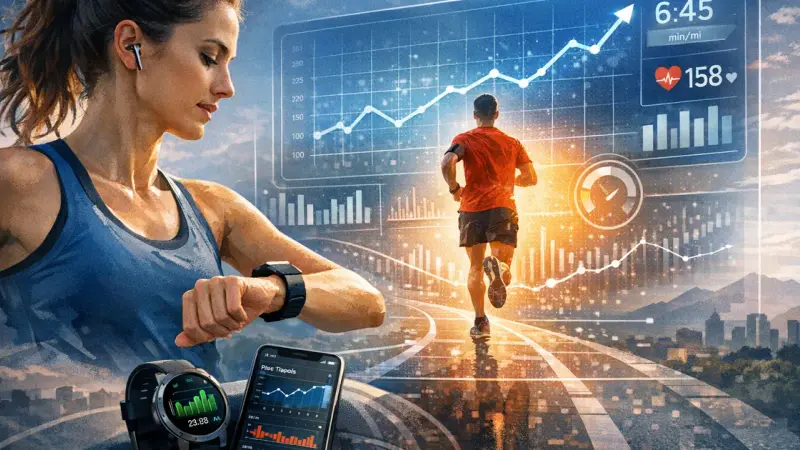
Are you actually getting faster? Pace tracking tells you for certain.
Why Pace Tracking Matters
The Feedback Problem
Without tracking:
- "Am I improving?" (Uncertain)
- "Is my training working?" (Hope so)
- "Should I change something?" (Who knows)
With tracking:
- "I'm 10 sec/mile faster at easy HR than 3 months ago" (Clear answer)
- "My tempo paces have improved 5%" (Evidence-based)
- "Progress has stalled for 6 weeks—time to adjust" (Actionable insight)
Beyond Feel
Subjective feel is unreliable:
- Hard days feel hard even when you're fitter
- Fatigue masks improvement
- Conditions affect perception
- Memory distorts comparisons
Pace data is objective: Numbers don't lie (when measured correctly).
Training Validation
- Is the training stimulus appropriate?
- Is recovery sufficient for adaptation?
- Are we making progress toward the goal?
Without this feedback, you're training blind.
What Pace Metrics Reveal
Easy Pace at Standard HR
The metric: What pace do you run when HR is at easy zone (e.g., 140 bpm)?
What it reveals: Aerobic efficiency. As aerobic fitness improves, pace at same HR increases.
Example progression:
- Month 1: 9:30/mile at 140 bpm
- Month 3: 9:00/mile at 140 bpm
- Month 6: 8:40/mile at 140 bpm
Clear aerobic improvement.
HR at Standard Easy Pace
The inverse metric: What HR does a standard pace (e.g., 9:00/mile) produce?
What it reveals: Same information, different perspective. Lower HR at same pace = better fitness.
Useful when: Conditions vary but you want to compare at consistent pace.
Threshold/Tempo Pace
The metric: What pace can you sustain at threshold effort (or HR)?
What it reveals: Lactate threshold fitness—the pace you can hold for extended hard efforts.
Critical for: Half marathon and marathon racing, sustained efforts.
Interval Performance
The metric: Paces achieved during VO2max intervals (800m, 1000m, mile repeats).
What it reveals: Top-end speed and aerobic power.
Useful for: 5K and 10K racing, overall fitness ceiling.
Long Run Metrics
What to track:
- Pace drift during long runs
- Finishing pace relative to starting pace
- HR drift over duration
What it reveals: Endurance and fatigue resistance—crucial for marathon success.
How AI Tracks Progression
Data Normalization
Raw paces need context:
- Temperature adjustment (heat slows pace)
- Terrain adjustment (hills slow pace)
- Fatigue adjustment (recent training affects performance)
AI normalizes data to allow meaningful comparison.
Trend Extraction
Short-term variation is noise: Day-to-day pace varies +-5-10% based on random factors.
Long-term trends are signal: Month-to-month patterns reveal actual fitness changes.
AI applies statistical methods to extract trends from noisy data.
Multi-Metric Integration
Single metrics can mislead: Easy pace might improve while threshold pace stagnates.
Complete picture: AI tracks multiple pace metrics and identifies patterns across all of them.
Output: Holistic fitness assessment, not just single-number progress.
Comparison to Expectations
AI models expected progression: Based on your training load, how much improvement should we see?
Comparison:
- Exceeding expectations: Training is very effective
- Meeting expectations: On track
- Below expectations: Something may need adjustment
Interpreting Pace Trends
Improvement Trajectory
Healthy progression:
- Gradual improvement over months
- Minor fluctuations within overall upward trend
- Different systems improving at different rates
Expected rates:
- Beginners: 1-2% per month possible
- Intermediate: 0.5-1% per month typical
- Advanced: 0.1-0.5% per month (smaller gains)
Plateau Detection
Signs of plateau:
- No pace improvement over 8-12 weeks
- All metrics flat simultaneously
- Training load stable (no progression)
Possible causes:
- Need training stimulus change
- Recovery inadequate
- Life factors limiting adaptation
AI detects plateaus and suggests interventions.
Regression Identification
Signs of regression:
- Paces getting slower over time
- Performance declining despite continued training
- Multiple metrics moving in wrong direction
Possible causes:
- Overtraining / insufficient recovery
- Illness or injury
- Life stress overload
- Training inappropriate for current state
AI distinguishes temporary dip from concerning regression.
Seasonal Variation
Normal patterns:
- Summer: Slower paces due to heat
- Winter: Potentially faster (if not too cold)
- Taper: Improved paces
- Build phase: Fatigued paces
AI accounts for seasonal effects when evaluating progress.
Using Tracking for Motivation
Progress Visualization
Seeing the trend: Graphs showing pace improvement over months provide powerful motivation.
The story: "I started at 9:30 easy pace and now I'm at 8:45. That's real progress."
Celebrating Milestones
AI can identify:
- New personal bests at various metrics
- Achievement of training goals
- Significant improvements from starting point
Recognition matters for long-term motivation.
Patience Through Plateaus
When progress stalls:
- Historical data shows you've improved before
- Plateaus are normal, followed by breakthroughs
- Current training will show results eventually
Data provides perspective during frustrating periods.
Goal Setting
Tracking enables:
- Realistic goal setting based on current trajectory
- Timeline estimates for target paces
- Adjustment of goals based on actual progress
Data-informed goals are more achievable than arbitrary targets.
Practical Tracking Tips
Consistency Matters
For reliable tracking:
- Track similar workout types over time
- Control conditions when possible
- Include context (weather, terrain, fatigue)
AI can work with imperfect data but benefits from consistency.
Don't Over-Interpret Single Points
One fast workout: Doesn't mean fitness jumped dramatically.
One slow workout: Doesn't mean fitness regressed.
Look at trends, not points.
Review Periodically
Weekly: Quick check on recent workouts.
Monthly: Look at trends, compare to previous month.
Quarterly: Big picture assessment, significant changes visible.
Trust the Process
Tracking shows: Whether your training is working over time.
If trends are positive: Keep doing what you're doing.
If trends are flat or negative: Something needs to change—and you have data to guide what.
Pace progression tracking transforms hope into knowledge. You don't have to wonder if you're improving—you can see it in the data. AI-powered tracking handles the complexity of normalizing conditions, extracting trends, and integrating multiple metrics, giving you clear insight into your fitness development.
Track your pace progression on your dashboard.
Key Takeaway
Pace progression tracking transforms training from guesswork into measurable progress. AI-powered tracking filters noise from daily variation, identifies meaningful trends, and provides clear evidence that your training is working.
Frequently Asked Questions
How often should I see pace improvement?
Why did my pace get worse despite training?
What pace metric is most important?
Can I be improving even if paces aren't faster?
How long before pace improvements show in races?
References
- Performance tracking research
- TrainingPlan methodology
- Training progression studies