
Contents
Single-Leg Exercises for Runners: Train How You Run
Running is a single-leg sport. Learn why unilateral training is essential and the best single-leg exercises to build running-specific strength.

Quick Hits
- •Running is essentially a series of single-leg hops - train accordingly
- •Single-leg exercises expose and correct side-to-side imbalances
- •Unilateral work builds stability that bilateral exercises miss
- •Start with bodyweight, progress to weighted variations over 6-8 weeks
- •Include single-leg work in every strength session for runners
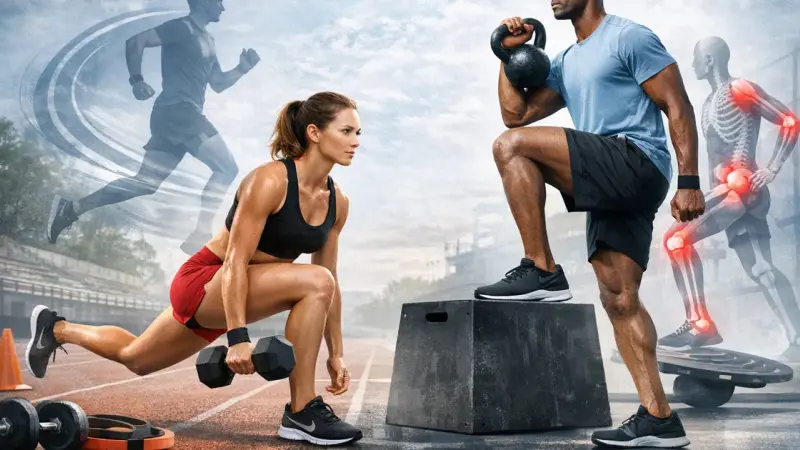
Running is a single-leg sport.
At no point during running are both feet on the ground. Every stride is a single-leg hop.
Yet most runners do squats and deadlifts on two legs. They're missing the point.
Here's why single-leg training transforms your running - and the exercises that matter most.
Why Single-Leg Training Matters
The Biomechanical Argument
During running:
- One leg supports your entire body weight
- That leg stabilizes pelvis and absorbs impact
- The other leg swings through for the next stride
- Repeat thousands of times per run
The demand: Single-leg strength, stability, and balance.
The training: Should match this demand.
What Single-Leg Work Develops
Stability muscles: The small stabilizers that keep you balanced on one leg.
Balance: Proprioception and control during dynamic movement.
Symmetry: Exposes and corrects side-to-side differences.
Transfer: Directly applicable to running mechanics.
What Bilateral Exercises Miss
Squats and deadlifts on two legs:
- Stronger leg can compensate for weaker
- Less stability demand (wider base)
- Less running-specific muscle activation
- Don't challenge balance
They build general strength, but not running-specific strength.
The Imbalance Problem
How Imbalances Develop
- Favoring one leg (consciously or not)
- Previous injuries
- Dominant leg doing more work
- Natural asymmetry
How Imbalances Cause Injuries
Scenario: Left glute is 15% weaker than right.
Result: Left hip drops more when landing on left leg. This stresses IT band and knee. After thousands of strides, injury develops.
Single-leg training exposes this. Then fixes it.
Self-Assessment
Single-Leg Balance Test:
- Stand on one leg, eyes closed
- Time until you lose balance
- Compare sides
- Difference >5 seconds = significant imbalance
Single-Leg Squat Test:
- Stand on one leg
- Squat as low as controlled
- Observe: Does knee cave in? Does hip drop? Do you wobble?
- Compare sides
The Essential Single-Leg Exercises
Single-Leg Glute Bridge
Purpose: Glute activation and strength, hip extension.
Sets/Reps: 3 x 12 per side
How:
- Lie on back, one foot flat, other leg extended
- Push through planted heel
- Lift hips until body forms straight line
- Keep hips level - don't let extended side drop
- Squeeze glute at top, 2-second hold
- Lower with control
Technique cues:
- Feel glute, not lower back or hamstring
- Hip of extended leg shouldn't drop
- Place hands on hips to monitor rotation
Progression: Add weight across hips.
Bulgarian Split Squat
Purpose: Quad, glute, and hip stability in split stance.
Sets/Reps: 3 x 8-10 per side
How:
- Rear foot elevated on bench or chair (laces down)
- Front foot about 2 feet ahead
- Lower straight down until front thigh is parallel
- Drive through front heel to stand
- Keep torso upright throughout
Technique cues:
- Front knee tracks over toes (slight outward ok)
- Don't push off back foot - it's just for balance
- Torso stays vertical, no leaning
Progression: Add dumbbells, then barbell.
Single-Leg Deadlift (Romanian)
Purpose: Hamstring, glute, balance, and hip hinge pattern.
Sets/Reps: 3 x 8-10 per side
How:
- Stand on one leg, slight knee bend
- Hold weight in opposite hand (or both hands)
- Hinge at hip, lowering weight toward ground
- Back leg extends behind for counterbalance
- Keep back flat, hips square
- Drive through hip to return to standing
Technique cues:
- This is a hip hinge, not a back bend
- Keep hips square - don't open up
- Feel stretch in standing-leg hamstring
- Back leg and torso move as one unit
Common mistake: Bending the back instead of hinging at hip.
Progression: Heavier weights, slower tempo.
Step-Up
Purpose: Glute and quad strength in climbing pattern.
Sets/Reps: 3 x 10 per side
How:
- Stand facing knee-height box or step
- Place one foot fully on box
- Drive through that foot only to stand on box
- Bring other foot up, then step back down
- Don't push off ground foot
Technique cues:
- All power comes from top leg
- Don't bounce off the ground foot
- Full hip extension at top
- Control the descent
Progression: Add dumbbells, increase box height.
Single-Leg Squat (Pistol Progression)
Purpose: Ultimate single-leg strength and mobility.
Sets/Reps: 3 x 5-8 per side (or regressions)
How (full pistol):
- Stand on one leg
- Extend other leg in front
- Squat as low as possible on standing leg
- Keep heel down, torso upright
- Drive up to standing
Regression progressions:
- Box single-leg squat (sit to box)
- Assisted pistol (hold TRX or doorframe)
- Partial range pistol
- Full pistol
Note: Full pistols require significant mobility and strength. Work the progressions.
Single-Leg Calf Raise
Purpose: Calf strength for push-off phase.
Sets/Reps: 3 x 15 per side
How:
- Stand on edge of step, one foot
- Other foot hooked behind
- Rise onto toes as high as possible
- Lower below step level (full stretch)
- Control throughout
Technique cues:
- Full range of motion - top and bottom
- Slow and controlled (2 seconds each way)
- Build to 25 clean reps before adding weight
Progression: Hold dumbbell, use weighted vest.
Lateral Lunge
Purpose: Lateral stability and adductor strength.
Sets/Reps: 2 x 10 per side
How:
- Stand with feet together
- Step wide to one side
- Sit back and down into stepping leg
- Other leg stays straight
- Push off stepping leg to return to start
Technique cues:
- Stepping knee tracks over toes
- Sit into the hip, not just bending forward
- Feel it in inner thigh of straight leg
Progression: Add dumbbells.
Balance Progression Series
Level 1: Static Single-Leg Balance
Exercise: Stand on one foot, 60 seconds per side.
Cues: Eyes forward, core engaged, minimal wobble.
When to progress: 60 seconds with minimal movement.
Level 2: Eyes Closed
Exercise: Single-leg balance, eyes closed, 30 seconds.
Cues: Removes visual input, increases proprioceptive demand.
When to progress: 30 seconds stable.
Level 3: Unstable Surface
Exercise: Single-leg balance on pillow or balance pad.
Cues: Surface moves, requires constant adjustment.
When to progress: 45 seconds stable.
Level 4: Dynamic Challenge
Exercise: Single-leg balance with arm movements or head turns.
Cues: External perturbations while maintaining balance.
When to progress: 30 seconds with continuous movement.
Level 5: Loaded Balance
Exercise: Single-leg balance holding weight on one side.
Cues: Asymmetric load challenges lateral stability.
When to progress: 30 seconds with significant weight.
Programming Single-Leg Work
Weekly Structure
Strength Session A:
| Exercise | Sets x Reps |
|---|---|
| Bulgarian Split Squat | 3 x 8/side |
| Single-Leg Glute Bridge | 3 x 12/side |
| Single-Leg Calf Raise | 3 x 15/side |
| Core work | As programmed |
Strength Session B:
| Exercise | Sets x Reps |
|---|---|
| Single-Leg Deadlift | 3 x 8/side |
| Step-Up | 3 x 10/side |
| Lateral Lunge | 2 x 10/side |
| Core work | As programmed |
Progression Over 8 Weeks
Weeks 1-2: Bodyweight, focus on form and balance.
Weeks 3-4: Add light resistance (dumbbells 5-15 lbs).
Weeks 5-6: Increase resistance, maintain rep quality.
Weeks 7-8: Progress to challenging weights, consider adding advanced variations.
Addressing Imbalances
If one side is weaker:
- Always start sets with weaker side
- Add 1-2 extra reps on weak side only
- Don't increase weight until both sides match
- Be patient - 4-8 weeks for correction
Common Mistakes
1. Skipping Single-Leg Work for "Efficiency"
The mistake: "Squats work both legs at once."
The problem: Misses stability, balance, and imbalance correction.
The fix: Include 2-3 single-leg exercises every strength session.
2. Compensating with the Other Leg
The mistake: Pushing off the ground foot during step-ups.
The problem: Defeats the purpose of unilateral training.
The fix: Strict form - working leg does all the work.
3. Ignoring Balance Component
The mistake: Holding a wall during all single-leg exercises.
The problem: Removes the stability challenge that matters for running.
The fix: Progress away from support as able.
4. Same Weight Both Sides Despite Imbalance
The mistake: Using 30 lb dumbbells on both legs when one is clearly weaker.
The problem: Weak side can't handle the load properly.
The fix: Reduce weight to what weak side can handle well.
5. Rushing Through Reps
The mistake: Bouncing through single-leg deadlifts.
The problem: Missing the stability challenge and injury risk.
The fix: Controlled tempo, pause at bottom of each rep.
Signs of Progress
Week 2-4
- Less wobbling during exercises
- Better balance on weak side
- Increased awareness of imbalances
Week 4-8
- Single-leg balance significantly improved
- Sides becoming more equal
- Can add resistance while maintaining form
Week 8+
- Running feels more stable
- Less hip drop visible
- Reduced asymmetry-related niggles
- Confident with loaded single-leg work
Running is single-leg activity. Train that way. Include Bulgarian split squats, single-leg deadlifts, step-ups, and single-leg glute bridges in your strength routine. Build balance progressively. Address imbalances directly. Your running will show the results.
Track your single-leg progress with our Training Log.
Key Takeaway
Running is a single-leg activity - your strength training should reflect that. Single-leg exercises build the stability, balance, and running-specific strength that bilateral exercises miss. Include 2-3 single-leg exercises in every strength session, progressing from bodyweight to loaded variations.
Frequently Asked Questions
Why are single-leg exercises better for runners than squats?
How do I know if I have a single-leg imbalance?
Should I train my weak leg more?
How many single-leg exercises should I do per session?
Can single-leg exercises prevent injuries?
References
- Unilateral training research
- Running biomechanics
- Athletic training literature