
Contents
What Your Strava Data Reveals About Your Training
Your Strava history contains powerful insights about fitness, fatigue, and improvement potential. Here's how to extract actionable intelligence from data you're already collecting.

Quick Hits
- •Most runners collect extensive Strava data but extract only surface-level insights from it
- •Heart rate trends over time reveal fitness progression more reliably than pace alone
- •Your data contains early warning signs of overtraining that appear weeks before symptoms
- •Patterns in your best performances reveal optimal training approaches for your physiology
- •AI can analyze your entire training history to personalize recommendations in ways you couldn't manually
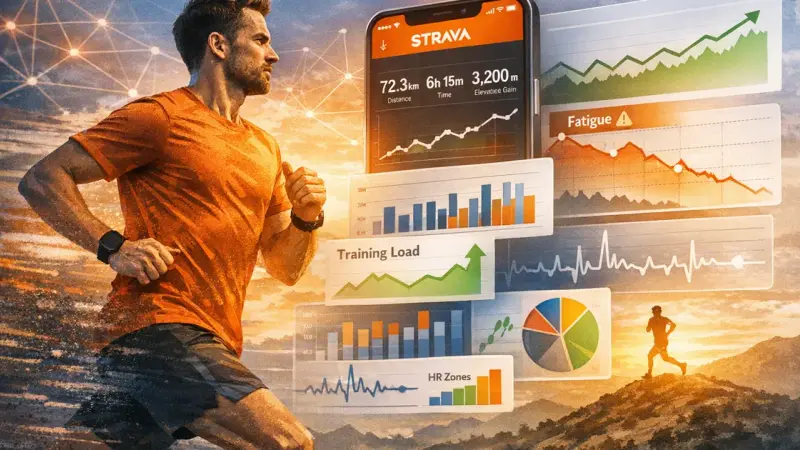
You've been collecting data for months or years. Here's what it's actually telling you.
The Data You're Sitting On
More Than Miles and Pace
Most runners check Strava for:
- How far they ran
- How fast they went
- Maybe total weekly mileage
But your data contains much more:
- Heart rate response patterns
- Pace-to-effort relationships
- Recovery indicators
- Performance trajectory
- Training load accumulation
- Injury risk signals
This deeper analysis requires more than glancing at summaries—it requires pattern recognition across your entire history.
Why Manual Analysis Fails
You've run 500 times over the past three years. Each run has 10+ data points. That's 5,000+ data points to analyze.
Questions you can't easily answer manually:
- How does my HR at easy pace compare to six months ago?
- What training patterns preceded my best races?
- When did my performance start declining before injury?
- How do I respond to different workout types?
AI excels at exactly this kind of pattern recognition across large datasets.
Hidden Patterns in Your Data
Fitness Progression Signals
Heart rate at standard pace: Track HR while running a consistent pace (say, 9:00/mile) over months. If HR gradually decreases at that pace, your aerobic fitness is improving—even if race performances haven't changed yet.
Pace at standard heart rate: The inverse: what pace can you hold at 145 bpm today versus six months ago? This "cardiac drift" metric reveals fitness changes before they show up in races.
Recovery between intervals: How quickly does your HR drop after hard efforts? Faster recovery indicates better aerobic fitness.
Fatigue Accumulation Signals
Elevated easy run HR: If your heart rate on easy runs creeps up over several weeks, you're accumulating fatigue faster than you're recovering.
Declining workout quality: Interval paces slowing at the same perceived effort? Fatigue is affecting performance.
Resting heart rate trends: If you track resting HR, upward trends suggest incomplete recovery.
Perceived effort mismatch: Runs that feel harder than the data suggests they should indicate fatigue or illness.
Performance Plateau Signals
Stagnant pace-to-HR relationship: If your efficiency (pace relative to HR) hasn't improved in months, something in your training isn't providing new stimulus.
Repetitive training patterns: Data might reveal you always do the same workouts at the same intensities—comfortable, but not progressive.
Missing workout types: Analysis might show you never do tempo runs, or you avoid intervals, leaving adaptations on the table.
What Metrics Actually Matter
Beyond Vanity Metrics
Weekly mileage matters but doesn't tell the whole story.
More revealing metrics:
Time in zones: How much time at easy, moderate, hard intensity? The distribution matters more than total volume.
Training stress score: Combines duration and intensity into a single load metric. High volume at easy intensity produces different stress than moderate volume at hard intensity.
Acute vs. chronic load: Comparing recent training (acute) to historical training (chronic) reveals injury risk. Rapid load increases are dangerous.
Efficiency metrics: Pace-to-HR ratio improvements indicate genuine fitness gains, not just "running more."
Heart Rate: The Underutilized Goldmine
Most runners ignore HR analysis beyond basic averages. But HR patterns reveal:
Aerobic threshold: The pace where HR starts climbing faster—your personal limit for sustainable easy running.
Lactate threshold estimates: The pace/HR you can sustain for extended hard efforts.
Cardiac drift rate: How much HR rises during long runs indicates fueling efficiency and heat adaptation.
Interval recovery: HR recovery speed between reps indicates aerobic fitness better than interval pace.
The Trends That Matter
Single data points mean little. Trends over weeks and months reveal truth:
Improving:
- Lower HR at same paces
- Faster paces at same HR
- Better workout performance
- Faster recovery between sessions
Declining:
- Rising HR at same paces
- Slowing paces at same HR
- Declining workout quality
- Longer recovery needed
Stagnating:
- No change in metrics despite continued training
- Comfortable but not progressive patterns
Training Load Analysis
What Is Training Load?
Training load combines volume and intensity into a single measure of how much stress you're applying.
Simple version:
- Easy 10 miles = moderate load
- Hard 5 miles = high load
- Easy 3 miles = low load
Volume alone doesn't capture this. A 60-mile week of easy running differs dramatically from a 40-mile week with intense workouts.
Acute to Chronic Workload Ratio
The key injury predictor:
Acute load: Training stress from the past 7 days Chronic load: Average training stress over past 28 days Ratio: Acute divided by chronic
Safe zone: 0.8-1.3 Danger zone: Above 1.5
If your recent week is 1.5x harder than your monthly average, injury risk spikes—regardless of how "ready" you feel.
What Your Load History Reveals
Analyzing your Strava history shows:
- Whether you typically build too quickly
- How you respond to load increases
- What load levels precede your best performances
- What patterns preceded injuries (if any)
This historical analysis personalizes safe progression rates for YOUR body.
Performance Trends Over Time
The Long View
Short-term performance fluctuates based on:
- Sleep
- Stress
- Weather
- Nutrition
- Random variation
Long-term trends reveal actual fitness changes.
AI can filter out noise to identify genuine progression (or regression) in your data.
Seasonal Patterns
Your data likely shows seasonal performance variations:
- Summer: Heat slows pace at same effort
- Winter: Cold improves performance but limits volume
- Spring/Fall: Peak performance conditions
Understanding YOUR seasonal patterns helps set appropriate expectations and training targets.
Goal Race Correlations
Looking at training patterns before your best races reveals:
- What weekly volume worked well
- Which workout types produced peak fitness
- How long your effective build phase was
- What taper approach worked
This personalized analysis beats generic advice because it's based on YOUR results.
Turning Insights Into Action
AI-Powered Analysis
Manual analysis of years of Strava data isn't practical. AI excels here:
Pattern identification: Finding correlations between training patterns and outcomes across hundreds of activities.
Anomaly detection: Flagging unusual data points that might indicate problems or breakthroughs.
Trend projection: Predicting future performance based on current training trajectory.
Recommendation generation: Converting insights into specific training adjustments.
Actionable Intelligence
Good analysis produces specific recommendations:
Instead of: "Your fitness is improving" Actionable: "Your aerobic capacity has improved 5% in 8 weeks. Current trajectory suggests a 21:30 5K is achievable in 6 weeks."
Instead of: "You're training hard" Actionable: "Your acute load is 1.4x your chronic load. Reduce volume by 20% this week to avoid injury risk."
Instead of: "You run a lot of easy miles" Actionable: "88% of your time is in Zone 1-2. Adding one tempo session weekly would improve threshold without excessive stress."
The Feedback Loop
The ultimate value of Strava data comes from closing the loop:
- Analyze historical data to understand patterns
- Plan training based on insights
- Execute and track new data
- Adjust based on response
- Repeat
This continuous improvement cycle—powered by your data—produces better results than any static plan.
Getting Started
If You're New to Tracking
Start now. Every tracked run adds to your data foundation.
Priorities:
- Consistent GPS tracking (every run)
- Heart rate monitoring (chest strap is more accurate)
- Manual inputs (perceived effort, notes)
Don't worry about perfection. Imperfect data is far better than no data.
If You Have Extensive History
Your data is valuable. Put it to work:
- Connect to analysis tools that can process your Strava history
- Look at trends not just recent data
- Identify patterns before your best and worst performances
- Use insights to inform future training decisions
Making It Automatic
The best approach: systems that continuously analyze your data and update recommendations without manual effort.
You focus on: Running AI focuses on: Analyzing everything and telling you what it means
You're already collecting the data. The question is whether you're extracting the intelligence it contains. Your Strava history is a personalized training manual waiting to be read—if you have the tools to interpret it.
Connect your Strava and unlock your data's potential on your dashboard.
Key Takeaway
Your Strava data is a goldmine of personalized training intelligence. Moving beyond simple metrics like weekly mileage to analyze patterns, trends, and relationships in your data unlocks insights that make training smarter, safer, and more effective.
Frequently Asked Questions
What data does Strava actually collect?
How much training history is useful for analysis?
What's the most underutilized Strava data?
Can old data still be useful?
What if my data has gaps or inconsistencies?
References
- Strava platform data
- TrainingPlan methodology
- Sports analytics research