
Contents
Achilles Tendinitis: Prevention and Recovery for Runners
That pain at the back of your ankle could derail your running for months. Learn how to prevent Achilles issues, treat them when they occur, and come back strong.

Quick Hits
- •Achilles tendinopathy affects 11% of runners at some point
- •The tendon doesn't actually "inflame"—it's a degenerative process that requires active rehab
- •Eccentric heel drops are the gold standard treatment with strong research backing
- •Most cases improve significantly in 6-12 weeks with proper treatment
- •Ignoring Achilles pain is risky. Complete rupture is rare but devastating.
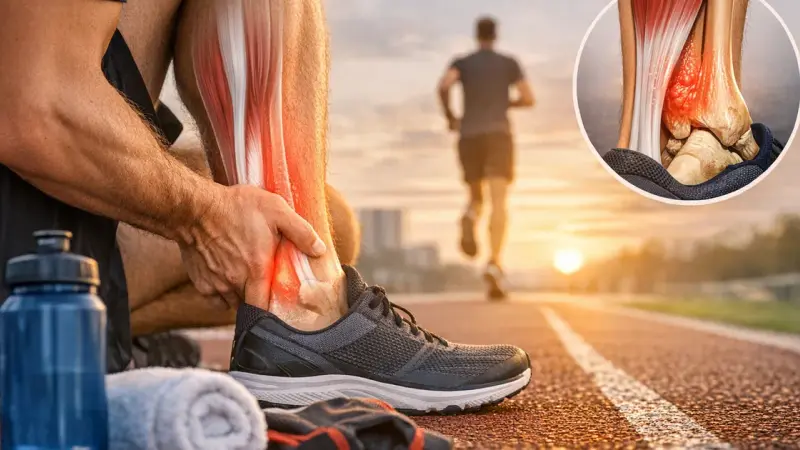
That nagging pain at the back of your ankle? Don't ignore it. Here's everything you need to know.
This guide is educational and cannot diagnose an injury or replace individualized clinical care. The injury-aware running library organizes conservative guidance on symptoms, training load, return to running, and footwear boundaries.
What Is Achilles Tendinitis?
The Anatomy
The Achilles tendon:
- Largest and strongest tendon in your body
- Connects calf muscles (gastrocnemius, soleus) to heel bone
- Handles forces of 6-8x body weight during running
- Essential for push-off and propulsion
Tendinitis vs. Tendinopathy
What we used to think: The tendon gets inflamed (tendinitis)
What we now know: Most Achilles issues involve tendon degeneration, not inflammation (tendinopathy)
Why this matters:
- Anti-inflammatory medications alone don't fix it
- The tendon needs load to heal, not just rest
- Active rehabilitation (eccentric exercises) is essential
Types of Achilles Issues
Insertional:
- Pain where tendon attaches to heel bone
- Often associated with bone spur
- More common in older runners
Midportion:
- Pain 2-6 cm above heel
- More common overall
- Often develops nodule or thickening
Both respond to similar treatment, though insertional may be more stubborn.
Causes and Risk Factors
Why the Achilles Fails
Training errors (most common):
- Sudden increase in mileage
- Adding hills or speed work too quickly
- Returning too fast after time off
- Not enough recovery between hard efforts
Biomechanical factors:
- Tight calf muscles
- Weak calf muscles
- Overpronation
- Limited ankle mobility
Equipment:
- Worn-out shoes
- Sudden shoe changes (especially drop height)
- Transitioning too fast to minimalist shoes
Who's at Risk
Higher risk if you:
- Are male (more common in men)
- Are over 40 (tendon becomes stiffer)
- Have had previous Achilles issues
- Recently increased training
- Have tight or weak calves
- Run on hills frequently
Symptoms and Diagnosis
Early Warning Signs
Don't ignore:
- Stiffness in the morning (first steps)
- Pain at start of run that "warms up"
- Tenderness when you squeeze the tendon
- Mild swelling around tendon
These are signals to reduce training and start prevention measures.
Progressive Symptoms
Getting worse:
- Pain during running that doesn't warm up
- Pain that persists after running
- Thickening or nodule in tendon
- Difficulty walking normally
This requires active treatment and likely time off from running.
Red Flags
See a doctor immediately if:
- Sudden sharp pain (possible tear)
- Popping sound with sudden onset pain
- Inability to point toes
- Significant swelling
- Gap you can feel in the tendon
These may indicate partial or complete rupture requiring urgent evaluation.
Self-Assessment
The pinch test:
Pinch the tendon between thumb and forefinger along its length. Tenderness at a specific spot suggests tendinopathy.
Morning stiffness:
If the first few steps each morning are painful or stiff for more than a week, take it seriously.
Treatment
Phase 1: Reduce Load (Weeks 1-2)
Modify activity:
- Stop running or reduce significantly
- Avoid activities that aggravate
- Walking should be pain-free; if not, consider heel lift
Pain management:
- Ice after activity (15-20 min)
- Over-the-counter pain relief if needed
- Avoid prolonged anti-inflammatory use (may impair healing)
Protect but don't immobilize:
- Heel lifts can reduce tendon strain
- Avoid barefoot walking initially
- Keep moving—complete rest slows healing
Phase 2: Load the Tendon (Weeks 2-12)
Eccentric heel drops—the gold standard:
Research strongly supports eccentric loading for Achilles tendinopathy.
Protocol (Alfredson protocol):
- Stand on a step, heels hanging off
- Rise up on both feet
- Transfer weight to injured leg
- Slowly lower heel below step level (3 seconds)
- Rise back up on both feet
Dosage:
- 3 sets of 15 repetitions
- Twice daily
- Both straight leg (targets gastrocnemius) and bent knee (targets soleus)
- Progress by adding weight when pain-free
Expect mild discomfort during exercises (pain up to 5/10 is acceptable). Avoid if pain is severe.
Phase 3: Progress Loading (Weeks 6-12)
As symptoms improve:
- Bilateral calf raises → single leg calf raises
- Slow controlled → faster movements
- Bodyweight → weighted
- Flat ground → step edge
Add complementary exercises:
- Ankle mobility work
- Calf stretching (gentle)
- Hip strengthening (reduces compensations)
- Hamstring strengthening
Professional Treatment Options
Physical therapy:
A PT can assess biomechanics, provide manual therapy, and progress exercises appropriately. Highly recommended.
Shockwave therapy:
Some evidence for chronic cases. May stimulate healing.
Injection therapies:
PRP (platelet-rich plasma) has mixed evidence. Cortisone injections are generally avoided for Achilles (can weaken tendon).
Surgery:
Rarely needed. Reserved for cases that fail 6+ months of conservative treatment.
Prevention
Training Management
Progress gradually:
Increase weekly volume by max 10%. Less if you've had Achilles issues before.
Hill caution:
Hills load the Achilles heavily. Add gradually. Downhill is particularly stressful.
Shoe transitions:
Changing to lower-drop shoes? Transition over months, not weeks.
Recovery time:
Older runners especially need adequate recovery between hard efforts.
Calf Strength
Regular calf strengthening prevents issues:
Single leg calf raises:
- 3 sets of 15-20
- Progress to edge of step
- Build to weighted
Include bent-knee calf raises:
Targets soleus specifically. Both muscles matter.
Flexibility and Mobility
Calf stretching:
- Gastrocnemius stretch (straight leg)
- Soleus stretch (bent knee)
- Hold 30 seconds, multiple times daily
Ankle mobility:
- Ankle circles
- Knee-to-wall stretch
- Important for preventing excess tendon strain
Equipment
Shoes:
- Replace at 300-500 miles
- Adequate cushioning
- Appropriate drop height for you
If prone to Achilles issues:
- Higher drop shoes (10-12mm) reduce tendon load
- Consider heel lifts during recovery
- Avoid very flat or minimalist shoes
Return to Running
When You're Ready
Signs you can start returning:
- Minimal morning stiffness (under 1 minute)
- No pain with walking, stairs, single leg calf raises
- Eccentric exercises pain-free
- Been consistent with rehab for 4-6+ weeks
Return Protocol
Week 1:
- Walk/run 1 min run : 2 min walk
- Total 15-20 minutes
- Every other day
- Continue eccentric exercises
Week 2:
- Walk/run 2 min run : 1 min walk
- Total 20-25 minutes
- Every other day
Week 3:
- Walk/run 3 min run : 1 min walk
- Building toward continuous running
Progress if:
- No increase in symptoms during or after
- Morning stiffness not increasing
- No pain the day after
Regress if:
- Symptoms increase
- Pain during running that doesn't resolve
Maintaining Tendon Health
After returning:
- Continue calf strengthening 2-3x/week
- Regular calf stretching
- Gradual mileage progression
- Monitor for warning signs
The tendon is "remodeled" but vulnerable. Maintenance work is ongoing.
Achilles tendinopathy is one of running's most stubborn injuries—but it's treatable. The key is catching it early, loading the tendon appropriately (not just resting), and being patient with recovery. Most runners return to full activity with proper treatment. Ignore it, and you risk months or years of problems.
For more on injury prevention and recovery, see the Complete Running Injuries Guide.
Track your return to running on your dashboard.
Key Takeaway
Achilles tendinopathy is common but treatable. Don't ignore it—early intervention leads to faster recovery. Eccentric heel drops are proven effective. Avoid complete rest; controlled loading promotes healing. With proper treatment, most runners return to full activity within 3-6 months.
Frequently Asked Questions
What does Achilles tendinitis feel like?
Can I run through Achilles pain?
How long does Achilles tendinopathy take to heal?
What's the difference between tendinitis and tendinopathy?
When should I see a doctor for Achilles pain?
References
- Sports medicine research
- Achilles tendinopathy studies
- Physical therapy protocols