
Contents
Hip Strengthening for Runners: Prevent Injuries and Run Stronger
Weak hips cause most running injuries. Learn the essential hip exercises every runner needs to prevent knee pain, IT band issues, and more.

Quick Hits
- •Weak hips cause or contribute to most running injuries—IT band, runner's knee, shin splints
- •The gluteus medius (side hip muscle) is the most commonly weak muscle in injured runners
- •Hip drop during running is the visible sign of hip weakness
- •10 minutes of targeted hip work 3-4x per week significantly reduces injury risk
- •Single-leg exercises are essential because running is a single-leg sport
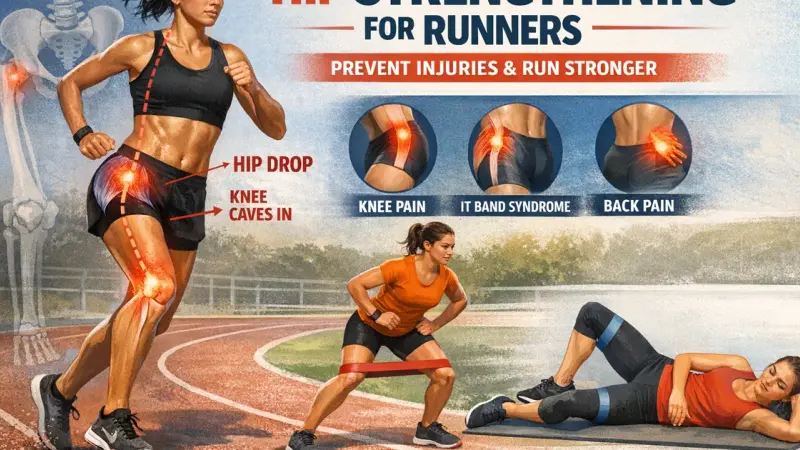
Most running injuries can be traced back to weak hips.
IT band syndrome? Hip weakness. Runner's knee? Often hip weakness. Shin splints? Hip weakness contributes.
Here's why your hips are likely weaker than you think—and how to fix it.
Why Hips Matter for Running
The Single-Leg Sport
Running is a series of single-leg hops. With every stride:
- One leg supports your entire body weight
- Hips must stabilize the pelvis
- Weak hips → pelvis drops → cascading problems
The Hip Drop Problem
What happens with weak hips:
- Foot strikes the ground
- Hip can't support pelvis
- Opposite hip drops
- Knee caves inward
- IT band stretches, kneecap tracks poorly
- Injury develops
This is visible in slow-motion video. Film yourself running and look for hip drop.
The Injury Chain
| Weak Muscle | Leads To |
|---|---|
| Gluteus medius | Hip drop, IT band syndrome |
| Gluteus maximus | Hamstring overload, hip pain |
| Hip external rotators | Knee valgus, patellofemoral pain |
| Hip flexors (weak + tight) | Anterior pelvic tilt, back pain |
Key Hip Muscles
Gluteus Medius (The Star)
Location: Side of hip, under gluteus maximus.
Function: Hip abduction (leg moving away from body), pelvic stability.
Why it's weak: Not challenged by forward running.
If it's weak: Hip drop, IT band issues, knee pain.
Gluteus Maximus
Location: The main buttock muscle.
Function: Hip extension, power production.
Why it matters: Primary propulsion muscle for running.
If it's weak: Hamstrings compensate → hamstring injuries, reduced power.
Hip External Rotators
Location: Deep in buttock, behind gluteus maximus.
Function: Rotate thigh outward, stabilize hip.
If they're weak: Knee caves inward during running.
Hip Flexors
Location: Front of hip, connecting pelvis to thigh.
Function: Lift thigh, flex hip.
If they're weak (and tight): Poor hip extension, anterior pelvic tilt, back pain.
Essential Exercises
For Gluteus Medius
Clamshells
- Lie on side, knees bent, feet together
- Keep feet together, lift top knee
- Don't let hips roll back
- 15-20 reps per side, 2-3 sets
Side-Lying Leg Raises
- Lie on side, legs straight
- Lift top leg, keeping it in line with body (not forward)
- Control the descent
- 15 reps per side, 2-3 sets
Monster Walks / Lateral Band Walks
- Band around ankles or above knees
- Quarter-squat position
- Step sideways, maintaining tension
- 15 steps per direction, 2-3 sets
Single-Leg Stance
- Stand on one leg
- Keep hips level (don't let standing hip drop)
- Hold 30-60 seconds per side
For Gluteus Maximus
Glute Bridges
- Lie on back, feet flat, knees bent
- Drive hips up, squeeze glutes at top
- 15 reps, 2-3 sets
Single-Leg Glute Bridges
- Same as above, one leg extended
- Push through planted foot only
- 12 reps per side, 2-3 sets
Hip Thrusts
- Shoulders on bench, barbell across hips
- Drive hips up, squeeze glutes
- 8-12 reps, 3 sets
For External Rotators
Clamshells (already covered)
Seated External Rotation
- Sit with band around thighs
- Feet together, push knees outward
- 15-20 reps, 2-3 sets
Fire Hydrants
- On hands and knees
- Lift knee outward (like a dog at a fire hydrant)
- Keep hips level
- 12-15 reps per side, 2-3 sets
For Hip Flexors
Standing Hip Flexor March
- Stand tall, lift knee above hip level
- Controlled movement, no momentum
- 10-12 per side, 2 sets
Dead Bug Hip Focus
- Standard dead bug, emphasize hip flexor control
- Press lower back into floor
- 10 per side, 2-3 sets
Quick Hip Routine (10 minutes)
Do this 3-4 times per week:
| Exercise | Sets × Reps |
|---|---|
| Clamshells | 2 × 15/side |
| Side-Lying Leg Raises | 2 × 12/side |
| Single-Leg Glute Bridge | 2 × 12/side |
| Fire Hydrants | 2 × 12/side |
| Monster Walks | 2 × 15/direction |
Full Hip Routine (20 minutes)
For dedicated sessions:
| Exercise | Sets × Reps |
|---|---|
| Clamshells | 3 × 15/side |
| Side-Lying Leg Raises | 3 × 15/side |
| Single-Leg Glute Bridge | 3 × 12/side |
| Fire Hydrants | 2 × 12/side |
| Monster Walks | 3 × 15/direction |
| Hip Thrusts | 3 × 10 |
| Single-Leg Stance | 2 × 45 sec/side |
Common Hip Issues
IT Band Syndrome
The problem: Pain on outside of knee or hip.
The cause: Often weak gluteus medius allowing hip drop and IT band overload.
The fix:
- Monster walks, clamshells, side-lying leg raises
- Reduce running volume temporarily
- Focus on hip level while running
Runner's Knee (Patellofemoral Pain)
The problem: Pain around or under kneecap.
The cause: Often weak hips allowing knee to cave inward, tracking issues.
The fix:
- All gluteus medius exercises
- Single-leg squats with knee control focus
- May need temporary running modification
Hip Bursitis
The problem: Pain on outside of hip, worse with running.
The cause: Often hip weakness plus overuse.
The fix:
- Gentle hip strengthening (may need to start non-weight-bearing)
- Address training load
- See a physical therapist if persistent
Lower Back Pain
The problem: Ache in lower back during or after running.
The cause: Often weak glutes causing anterior pelvic tilt and excessive back extension.
The fix:
- Glute strengthening (bridges, hip thrusts)
- Core work (dead bugs, planks)
- Hip flexor stretching
Programming Hip Work
Frequency
Minimum: 3 times per week Optimal: 4-5 times per week Duration: 10-15 minutes
Timing
Best times:
- After easy runs (warm muscles)
- Rest days (standalone)
- Before strength training (activation)
Avoid:
- Before hard running sessions
- When genuinely exhausted
Progression
Week 1-2: Bodyweight only, focus on form.
Week 3-4: Add resistance band for clamshells, monster walks.
Week 5-6: Increase band resistance, add holds at end-range.
Week 7+: Progress to weighted exercises (hip thrusts, step-ups).
Integration with Running
Prehab approach: Light activation before runs (5 minutes).
Strengthening approach: After runs or on rest days (10-15 minutes).
Injury recovery: May be primary focus, running secondary.
Signs of Improvement
Early signs (2-4 weeks):
- Better balance on single-leg exercises
- Less fatigue during hip work
- Reduced hip tightness
Medium-term (4-8 weeks):
- Less hip drop visible when running
- Reduced post-run soreness
- Fewer injury warning signs
Long-term (8+ weeks):
- Faster running without extra effort
- Sustained injury-free running
- Stronger finishing in races
Your hips are probably weaker than you think. Running doesn't strengthen them the way they need—you have to do the work separately. Ten minutes, three to four times a week. The exercises are simple. The payoff is running without injury.
Track your training with our Running Training Log.
Key Takeaway
Hip weakness is the hidden cause of most running injuries. The gluteus medius (side hip muscle) is typically the weakest link. Target it with clamshells, side-lying leg raises, and single-leg work. Ten minutes, 3-4 times per week, prevents injuries and makes you stronger.
Frequently Asked Questions
Why are my hips weak if I run a lot?
How do I know if my hips are weak?
How long until hip strengthening helps my running?
Can hip exercises fix IT band syndrome?
Should I do hip exercises before or after running?
References
- Running biomechanics
- Injury prevention research
- Physical therapy literature