
Contents
How to Modify a Training Plan When Life Gets in the Way
Real life doesn't follow training schedules. Learn how to adjust your running plan when you miss runs, get sick, travel, or face unexpected challenges.

Quick Hits
- •Training plans are guidelines, not laws—adaptation is expected and healthy
- •Priority order if you must skip: skip easy runs before quality sessions, but never skip rest
- •Missing 2-3 days? Pick up where you left off. Missing a week? Repeat or modify that week
- •Some workouts matter more than others—protect the key sessions
- •Arriving at race day 90% fit but healthy beats arriving 100% fit but injured or sick
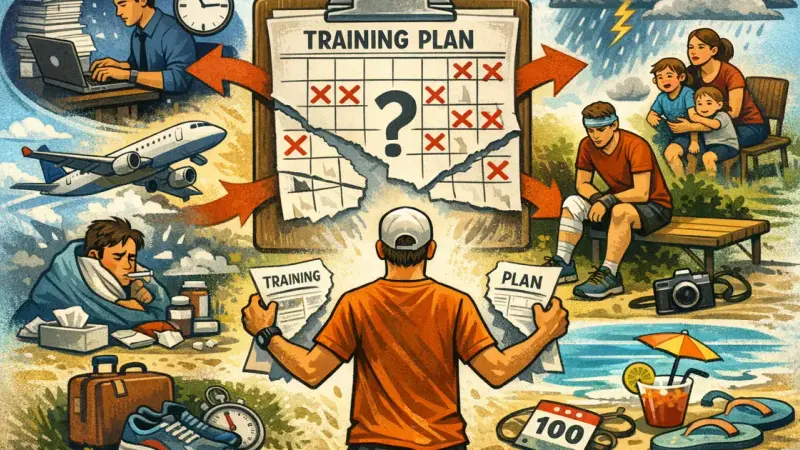
No training plan survives contact with real life.
Work emergencies. Travel. Illness. Family demands. The question isn't whether you'll need to modify your plan—it's how.
When to Adjust
Minor Adjustments (Daily)
Normal variations:
- Moving a run from morning to evening
- Swapping days (tempo Thursday instead of Tuesday)
- Cutting a few minutes from an easy run
- Running easier than planned when tired
These don't require formal plan changes—they're just life.
Moderate Adjustments (Weekly)
Situations requiring thought:
- Missing 2-3 days in a week
- Unable to do a key workout
- Feeling notably fatigued
- Travel disrupting normal schedule
Response: Move or consolidate workouts, possibly repeat week.
Major Adjustments (Multi-Week)
Situations requiring plan revision:
- Missing a full week
- Illness lasting 5+ days
- Injury requiring time off
- Life crisis affecting multiple weeks
Response: Modify remaining plan, potentially adjust race goals.
The Priority Hierarchy
What to Protect
Most important to least important:
- Long runs (endurance foundation)
- Key quality sessions (tempo, intervals)
- Moderate easy runs (volume)
- Short easy runs (recovery, habit)
Never skip:
- Rest days (recovery is training)
- Taper before race
If You Can Only Do 3 Runs This Week
Keep:
- One long run (maybe shortened)
- One quality session (maybe modified)
- One easy run
Skip:
- Additional easy runs
- Second quality session
If You Can Only Do 2 Runs
Keep:
- Modified long run
- Easy run with strides
Save the quality work for weeks when you have more time.
Handling Missed Time
Missed 1-2 Days
What happens: Almost nothing.
What to do:
- Continue with the next scheduled workout
- Don't try to make up missed runs
- Don't double up
Example: Missed Monday and Tuesday easy runs. Wednesday is tempo. Do the tempo.
Missed 3-4 Days
What happens: Slight freshness (might actually feel good).
What to do:
- Rejoin plan where you left off
- If you missed a key session, consider doing a modified version
- Don't add extra volume to "catch up"
Missed 5-7 Days
What happens: Minimal fitness loss. May feel stiff.
What to do:
- Repeat the week you missed (or part of it)
- First runs back should be easy
- Don't jump straight into hard workouts
- Reassess remaining schedule
Missed 1-2 Weeks
What happens: Some aerobic fitness decline. Speed may feel harder.
What to do:
- Reduce race goal expectations slightly
- Build back with 3-5 days of easy running
- Then resume modified plan
- May need to shorten remaining plan focus
Missed 3+ Weeks
What happens: Significant fitness decline.
What to do:
- Seriously reassess race goals
- May need to postpone or change race
- Don't try to cram a compressed plan
- Prioritize returning to running safely
Common Scenarios
Work Travel
The challenge: Different time zone, no familiar routes, hotel gym.
Solutions:
- Run easy on travel days (stress already high)
- Use hotel treadmill for quality sessions
- Explore new routes for easy runs (can be fun)
- Accept some runs may be shorter
- Maintain consistency over quality
Vacation
The challenge: Relaxation vs. training, family expectations.
Solutions:
- Reduce volume but maintain some running
- One quality session + long run may be enough
- Morning runs before family wakes
- Integrate running into sightseeing
- Don't feel guilty about modified plan
Illness
Minor (head cold):
- Easy running often okay if below the neck
- Skip hard workouts
- Listen to body, stop if feeling worse
Significant (fever, chest, body aches):
- Complete rest until fever-free 24+ hours
- Return with easy running only
- Wait several days before hard efforts
Rule: Don't rush back. Illness + hard training = worse illness.
Minor Injury
The approach:
- Assess if you can run (truly run, not hobble)
- If painful, stop
- Cross-train if possible
- Don't try to run through worsening pain
- See professional if not improving
Return:
- Easy running first
- Rebuild gradually
- Don't immediately resume hard training
Motivation Loss
Signs:
- Dreading every run
- Going through motions
- No joy in training
Solutions:
- Take a few days off
- Run without a watch
- Change routes
- Run with others
- Reassess your goals
- Possibly take a full week easy
Schedule Shifts
Moving key workout by 1 day: Usually fine.
Stacking hard days: Avoid. Keep rest between quality sessions.
Missing the long run day: Do it within 2 days if possible, or shorten it.
Modifying for Fatigue
Normal Tiredness
Signs: Legs feel heavy but loosen up, energy okay overall.
Response: Proceed with plan, maybe slightly easier.
Concerning Fatigue
Signs: Not improving with warmup, elevated resting HR, poor sleep, can't hit paces.
Response:
- Easy run instead of workout
- Or rest day entirely
- Assess if pattern continues
Overreaching
Signs: Multiple weeks of declining performance, persistent fatigue, mood changes.
Response:
- Reduce volume 30-50% for a week
- All easy running
- Prioritize sleep and nutrition
- Restart building slowly
When to Scrap the Plan
Time to Pivot When:
- Injury requires 3+ weeks off
- You genuinely can't complete 50%+ of planned runs
- The plan is consistently too hard (can't hit paces, always fatigued)
- Race gets cancelled or postponed
- Your goals have changed
Pivoting Options
To a shorter race: Find a closer race, use current fitness.
To a maintenance phase: Run consistently without a rigid plan.
To a new cycle: Start a fresh plan for a later race.
To recovery: Take time off, rebuild base.
It's Not Failure
Changing plans isn't failure—it's intelligence. Forcing a plan that doesn't fit leads to injury, burnout, or poor performance.
The Meta-Principle
The goal of training isn't to complete a plan perfectly.
The goal is to arrive at race day:
- Healthy (not injured or sick)
- Fit (appropriately trained)
- Fresh (tapered, ready)
- Confident (mentally prepared)
If modifying your plan helps you arrive in this state, modify away.
Training plans are tools, not masters. Use them to guide your training, but adapt them to your reality. Consistency over the long term matters more than perfection in any single week.
Track your actual training on your dashboard.
Key Takeaway
Plans are frameworks, not commandments. When life interferes, prioritize key workouts over easy runs, don't try to make up missed training, and adjust expectations when significant time is lost. Arriving healthy and somewhat undertrained beats arriving sick, injured, or burned out.
Frequently Asked Questions
What do I do if I miss a workout?
How many days can I miss before my plan is ruined?
Should I skip easy runs or workouts when short on time?
What if I'm too tired to hit planned paces?
When should I abandon a training plan entirely?
References
- Coaching experience
- Training adaptation research
- Real-world runner feedback