
Contents
Returning to Running After Injury: A Complete Guide to Coming Back Stronger
Learn how to safely return to running after injury. Get a structured comeback plan, warning signs to watch for, and strategies to prevent re-injury.

Quick Hits
- •Don't return until you can walk pain-free for 30+ minutes—walking is the first test
- •The 10-minute test: if pain increases after 10 minutes of easy running, stop and wait
- •Expect 2-4 weeks to return to pre-injury mileage for every week you were out
- •Run-walk intervals are your best friend: they manage load while rebuilding fitness
- •Cross-train during comeback—you can maintain fitness while limiting running stress
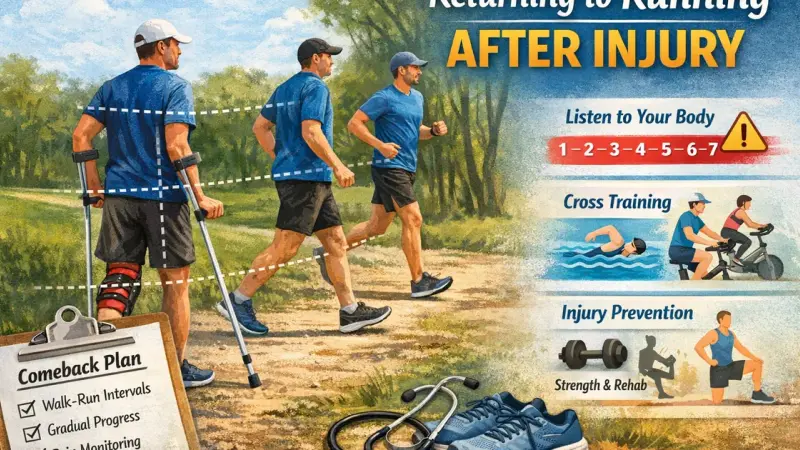
The injury happened. You did the rehab. Now the question every injured runner asks: when and how do I start running again?
The comeback is often harder than the injury itself—not physically, but mentally. You want to run. You remember your fitness. You're impatient.
But rushing the comeback is how small injuries become chronic problems.
Here's how to do it right.
Before You Start: The Readiness Checklist
Don't lace up until you can check all of these boxes:
Physical Readiness
☐ No pain during daily activities for at least 5-7 days ☐ Pain-free walking for 30+ minutes on varied terrain ☐ Full range of motion in the affected area ☐ Strength returning (can do injury-specific exercises without pain) ☐ Sleep is normal (no pain waking you up)
Medical Clearance
☐ Doctor/PT approval (if you've been seeing one) ☐ Understood the cause of the original injury ☐ Addressed contributing factors (weakness, imbalance, gear, training error)
Mental Readiness
☐ Accepted starting slow (this is the hardest one) ☐ Committed to the comeback plan (not your old training plan) ☐ Prepared to stop if needed (no ego)
If you can't check these boxes, you're not ready. Wait.
The Comeback Framework
The 50% Rule
When returning from injury, your body can handle about 50% of your pre-injury load initially. From there, increase gradually.
Example:
- Pre-injury: 30 miles per week
- Week 1 comeback: 15 miles maximum
- Build back by 10-20% per week
The Pain Scale
Use this to guide every comeback run:
| Level | Description | Action |
|---|---|---|
| 0 | No pain | Continue as planned |
| 1-2 | Aware of area, not painful | Okay to continue, monitor |
| 3-4 | Mild pain, doesn't worsen | Okay to finish, reduce tomorrow |
| 5-6 | Moderate pain, worsening | Stop the run, walk home |
| 7+ | Significant pain | Stop immediately, reassess with medical professional |
The rule: If pain increases during a run, stop. If pain is present the next morning, you did too much.
The Time Equation
Rough guideline for comeback duration:
Time off = 2-4× that time to return to full training
| Time Off | Expected Comeback |
|---|---|
| 1 week | 2-4 weeks |
| 2 weeks | 4-8 weeks |
| 4 weeks | 8-16 weeks |
| 8+ weeks | 4-6 months |
This feels slow. But it's reality. Plan for it.
The Walk-Run Comeback Protocol
This is the safest, most effective way to return to running.
Phase 1: Walking (Pre-Running)
Duration: Until you can walk 30-45 minutes pain-free
Protocol:
- Start with 15-20 minutes of brisk walking
- Increase by 5 minutes every 2-3 days
- Walk on varied terrain (hills, uneven surfaces)
- If pain occurs, reduce duration
Goal: Prove your body can handle weight-bearing locomotion.
Phase 2: Walk-Run Intervals
Duration: 2-4 weeks
Week 1:
- Run 1 minute, walk 4 minutes
- Repeat 4-6 times
- Total: 20-30 minutes
- Every other day maximum
Week 2:
- Run 2 minutes, walk 3 minutes
- Repeat 4-6 times
- Total: 25-30 minutes
- Every other day
Week 3:
- Run 3 minutes, walk 2 minutes
- Repeat 5-6 times
- Total: 25-30 minutes
- Can add a third day
Week 4:
- Run 4 minutes, walk 1 minute
- Repeat 5-6 times
- Total: 25-30 minutes
- Three days per week
Pace: Very easy. Slower than your old easy pace. This is recovery running.
Phase 3: Continuous Running
Duration: 3-6 weeks
Week 5:
- Run 15-20 minutes continuous
- Very easy pace
- 3 days per week
Week 6:
- Run 20-25 minutes continuous
- 3-4 days per week
Week 7:
- Run 25-30 minutes continuous
- 4 days per week
Week 8:
- Run 30-40 minutes
- 4-5 days per week
- One longer run (45-60 min)
Phase 4: Building Volume
Duration: 4-8 weeks
Goals:
- Return to pre-injury weekly mileage
- Add 10-15% per week maximum
- Maintain easy intensity
- Include one longer run
Do not add intensity yet. This phase is about volume only.
Phase 5: Adding Intensity
Duration: 3-4 weeks
Week 1 of intensity:
- Add strides (4-6 x 20 seconds) at end of easy runs
- 2-3 times per week
- Not intervals—just accelerations
Week 2:
- Add tempo segments: 5-10 minutes at tempo effort within an easy run
- Once per week only
Week 3:
- Extend tempo to 15-20 minutes
- Can add light fartlek play
Week 4:
- First real workout (conservative intervals)
- Continue building base volume
Cross-Training During Comeback
You don't have to lose fitness while you're not running.
Best Options
Pool running:
- Most running-specific
- Zero impact
- Can replicate running workouts
- Boring but effective
Cycling:
- Similar cardiovascular demand
- Easy to control intensity
- Works quads and glutes
- Low learning curve
Swimming:
- Full-body, zero impact
- Great for active recovery
- Different muscles = running legs rest
Elliptical:
- Running-like motion
- Easy intensity control
- Available at most gyms
Cross-Training Protocol
During injury:
- Match cross-training to what your running would have been
- Include "hard" and "easy" days
- Maintain volume where possible
During comeback:
- Continue cross-training on non-running days
- Gradually shift time from cross-training to running
- Keep 1-2 cross-training days even when fully back
Warning Signs: When to Stop
During a Comeback Run
Stop immediately if:
- Sharp pain
- Pain that worsens as you run
- Limping or gait change
- Swelling visible during or after
- Pain rating above 4-5/10
Between Runs
Take extra rest day if:
- Pain present the morning after
- Stiffness doesn't resolve with walking
- Swelling appears
- Sleep is disrupted by discomfort
Restart the Phase
Go back a phase if:
- Pain occurs two runs in a row
- You can't complete the prescribed workout
- Pain during daily activities returns
Preventing Re-Injury
Find the Root Cause
Every injury has a cause. Find it or you'll get hurt again.
Common causes:
| Injury Type | Likely Causes |
|---|---|
| Bone stress (stress fractures) | Too much too soon, low energy availability, inadequate rest |
| Tendon issues (Achilles, patellar) | Rapid volume increase, weakness, inflexibility |
| Muscle strains | Insufficient warmup, weakness, fatigue |
| IT band | Hip weakness, overstriding, cambered roads |
| Plantar fasciitis | Calf weakness/tightness, rapid mileage increase |
Address Weaknesses
Most running injuries stem from weakness or imbalance. During comeback:
Add strength training:
- 2-3 sessions per week
- Focus on glutes, hips, core
- Include single-leg exercises
- Continue after return to running
Common deficits to address:
- Weak glutes → hip drops, knee cave
- Weak calves → Achilles and foot issues
- Weak core → poor running posture
- Hip inflexibility → compensatory patterns
Modify Training Going Forward
After injury recovery:
- Keep one rest day per week minimum
- Build mileage slowly (10% rule)
- Include cutback weeks every 3-4 weeks
- Don't add mileage AND intensity simultaneously
- Monitor for early warning signs
Mental Aspects of Comeback
Dealing with Lost Fitness
Reality check:
- You will be slower at first
- Your easy pace will feel hard
- This is temporary
Mindset shifts:
- "I'm building back" not "I used to be faster"
- Focus on the trend, not single runs
- Celebrate each successful run
Impatience
The biggest obstacle to successful comeback is doing too much too soon.
Strategies:
- Write your comeback plan and follow it
- Have someone hold you accountable
- Remember: rushing = re-injury = more time off
Fear of Re-Injury
Some anxiety is normal and even protective.
Healthy caution:
- Paying attention to body signals
- Adjusting when something feels off
- Following a gradual plan
Unhealthy fear:
- Avoiding running despite being cleared
- Extreme anxiety during every run
- Changing gait to "protect" the area (often causes new issues)
If fear is significant, consider sports psychology resources.
Sample 8-Week Comeback Plan
For a runner returning after 4 weeks off:
Week 1
- Mon: Cross-train 30 min easy
- Tue: Walk 30 min
- Wed: Cross-train 30 min
- Thu: Walk-run (1 min run/4 min walk x 6)
- Fri: Rest
- Sat: Walk-run (1 min run/4 min walk x 6)
- Sun: Cross-train 40 min
Week 2
- Mon: Walk 30 min
- Tue: Walk-run (2 min run/3 min walk x 6)
- Wed: Cross-train 30 min
- Thu: Walk-run (2 min run/3 min walk x 6)
- Fri: Rest
- Sat: Walk-run (2 min run/3 min walk x 6)
- Sun: Cross-train 40 min
Week 3
- Mon: Cross-train 30 min
- Tue: Walk-run (3 min run/2 min walk x 6)
- Wed: Cross-train 30 min
- Thu: Walk-run (3 min run/2 min walk x 6)
- Fri: Rest
- Sat: Walk-run (4 min run/1 min walk x 6)
- Sun: Cross-train 45 min
Week 4
- Mon: Rest
- Tue: Run 15 min continuous easy
- Wed: Cross-train 30 min
- Thu: Run 15 min continuous easy
- Fri: Rest
- Sat: Run 20 min continuous easy
- Sun: Cross-train 45 min
Week 5
- Mon: Rest
- Tue: Run 20 min easy
- Wed: Cross-train 30 min
- Thu: Run 25 min easy
- Fri: Rest
- Sat: Run 30 min easy
- Sun: Cross-train 40 min
Week 6
- Mon: Run 20 min easy
- Tue: Cross-train 30 min
- Wed: Run 25 min easy
- Thu: Rest
- Fri: Run 25 min easy
- Sat: Run 35 min easy
- Sun: Rest or cross-train
Week 7
- Mon: Run 25 min easy
- Tue: Run 20 min easy
- Wed: Cross-train 30 min
- Thu: Run 30 min easy
- Fri: Rest
- Sat: Run 45 min easy
- Sun: Rest
Week 8
- Mon: Run 25 min easy
- Tue: Run 30 min with 4x20 sec strides
- Wed: Run 20 min easy
- Thu: Rest
- Fri: Run 30 min easy
- Sat: Run 50 min easy
- Sun: Rest
Week 9 and beyond: Continue building, add first workout.
The comeback isn't about getting back to where you were as fast as possible. It's about building a stronger foundation so you never have to come back from this injury again.
Be patient. Be consistent. Be smart. You'll get there.
For more on injury prevention and management, see the Complete Running Injuries Guide.
Track your recovery with the Training Log Template.
Key Takeaway
A successful comeback requires patience and structure. Return too fast and you'll re-injure; return too slow and you'll lose unnecessary fitness. Follow a gradual progression, listen to your body, and address the root cause of the original injury. Most runners come back stronger when they treat the comeback as seriously as training for a race.
Frequently Asked Questions
How long should I wait before running again after injury?
Should I run through minor pain during comeback?
How much fitness do I lose during injury?
Can I do speedwork during my comeback?
What if the injury comes back when I start running?
References
- Sports medicine research
- Physical therapy protocols
- Running injury studies