
Contents
Running with Music: Evidence, Listening Choices and a Comparison Worksheet
Decide when audio fits your run, what music studies actually measured, and how to compare enjoyment and awareness without chasing a performance promise.

Quick Hits
- •Music-study outcomes include endurance tests, pacing, mood and perceived effort; these are not interchangeable.
- •There is no universal playlist BPM or headphone safety ranking in this guide.
- •Event instructions and the attention required by your surroundings take priority over listening.
- •Compare enjoyment and awareness on ordinary easy outings; do not turn the worksheet into a time trial.
- •Music, spoken audio and no audio are preferences, not required training equipment.
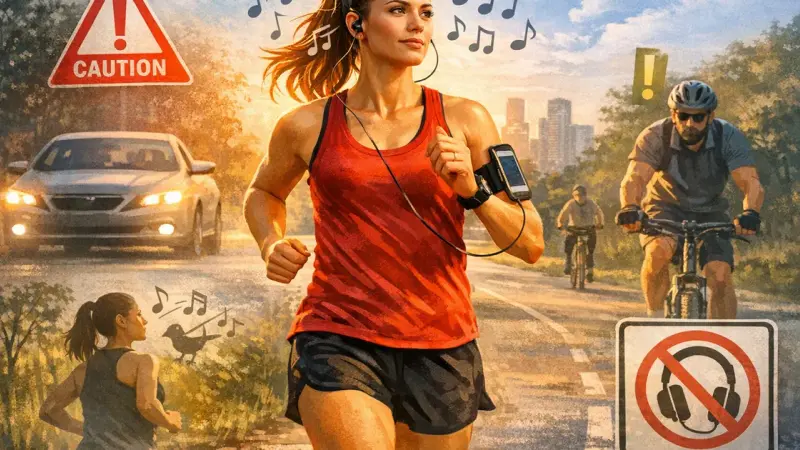
Music can be part of a run you enjoy. It can also compete with conversation, instructions or the attention a route requires. The useful question is whether audio fits this outing, not whether every runner should listen or unplug.
This guide preserves both choices. You do not need paid headphones, a subscription, a wearable or a public activity upload to use the observation worksheet below.
What the research actually measured
“Performance,” perceived effort and enjoyment describe different outcomes. A longer laboratory endurance test does not mean the same percentage improvement in a road race.
| Study and participants | Protocol and measured outcome | What it supports—and its limit |
|---|---|---|
| Terry and colleagues, 2012: 11 elite triathletes | Repeated-measures treadmill experiment with beat-synchronized motivational music, neutral music and no music; submaximal and exhaustive running | Time to exhaustion was 18.1% longer with motivational music and 19.7% longer with neutral music than without music. These are endurance-test results in a small elite sample, not race-time improvements or a promise for recreational easy runs. |
| Lima-Silva and colleagues, 2012: 15 participants in simulated 5K trials | Two control trials, then counterbalanced trials with music in the first or last 1.5 km; measured pace, attentional focus and perceived effort | Early music was associated with faster opening running velocity than the fastest control trial. Perceived effort did not differ significantly between conditions. Music timing and the specific protocol matter; this is not an instruction to start your race faster. |
The first study also measured mood and other responses; those measures should not be collapsed into a single “percent easier” claim. The second illustrates why a change in pace need not mean a lower effort rating. The summaries above follow the published abstracts; they do not certify that the protocols apply to every age, runner or setting.
Practical interpretation: liking a playlist is a sufficient reason to consider it when the setting permits. You do not need to justify enjoyment with a predicted finish-time gain. Equally, a neutral or distracting experience is a useful reason to change or skip audio.
Decide whether audio fits this run
| Context | Listening decision | What to check |
|---|---|---|
| Familiar easy outing with few competing demands | Preferred audio is optional | Can you attend to the route, other people and how the effort feels? Pause if that changes. |
| Traffic, crossings, unfamiliar route or poor visibility | Choose no audio when attention is already stretched | Removing headphones is not a substitute for looking, following local rules and selecting an appropriate route. |
| Shared path, group run or conversation | Agree whether audio fits; pause for others and instructions | Do not assume another person has heard you or that you have heard every approach. |
| Treadmill or supervised session | Follow facility and coach instructions | Keep controls accessible without reaching or looking away at a difficult moment; avoid loose equipment around moving parts. |
| Structured workout | Decide whether audio helps or disrupts the intended effort and cues | No blanket rule says all hard running must include or exclude music. Do not use a song as a reason to ignore symptoms or alter the session. |
| Race | Check current event and participant-category rules before packing | Permission is not an assurance that listening is suitable at every point on the course. Hear and follow officials. |
As a specific rule example, the Boston Athletic Association athlete information page, checked September 8, 2026, lists headphones as discouraged but permitted. Recheck the instructions for your own race edition and category; do not infer a universal headphone ban from sanctioning or the presence of an elite field. Record the relevant rule in your race-week checklist.
No headphone design establishes a universally safe run. Leaving the ear canal open, using one earbud or selecting an ambient mode does not prove that you will notice and respond to everything around you. There is no “hear a shout from ten feet away” safety test here. If listening competes with the attention the situation requires, pause and put the equipment away when you can do so appropriately.
Tempo is a choice, not a cadence prescription
Song tempo is measured in beats per minute; running cadence counts steps per minute. They can have different relationships: one step per beat, two steps per beat, or no deliberate synchronization. For example, 80 beats per minute with two steps per beat is 160 steps per minute by arithmetic. It is not a recommendation that you change your cadence to 160.
There is no single playlist BPM range that defines an appropriate easy, tempo or interval effort for every runner:
- Start with songs you enjoy; a varied playlist is acceptable.
- Notice whether a track makes you accelerate away from the effort you intended.
- Change or pause it if needed rather than forcing a stride pattern to match the song.
- Keep race pacing decisions grounded in the course, conditions and your plan; use the pacing strategy guide for that task.
Podcasts and audiobooks are alternatives if you enjoy them, but speech is not automatically less distracting or a way to guarantee steady pace. Choose silence when following the content competes with following the route or session.
Equipment decisions without a safety ranking
If you already have equipment that fits the setting, no purchase is needed for this exercise. If comparing options, inspect the specific model's official documentation rather than assuming every product of one type has the same properties.
| Decision | What to inspect |
|---|---|
| Fit and comfort | Whether it stays comfortable during your normal movement; pressure, slipping and controls you must repeatedly adjust |
| Environmental sound | What the design/mode actually allows you to hear, with the reminder that audibility does not guarantee attention |
| Power and connection | Stated battery conditions, your planned outing and an acceptable no-audio fallback |
| Weather and care | The model's actual water-resistance and cleaning instructions; do not assume one rating covers every exposure |
| Controls and carrying | Whether you can pause without an awkward reach; store wires and loose items appropriately |
| Cost and preference | Whether the available option serves the task; price and audio quality do not establish outdoor safety |
This article has not performed a comparative collision-risk study or hands-on test of headphone models. It therefore names no “safest” product and supplies no minimum battery-life or water-resistance claim for all runners.
Optional personal observation worksheet
Use two ordinary easy outings that already fit your schedule, one with preferred audio and one without. Keep route, intended effort and approximate duration reasonably comparable when practical. Do not add mileage, repeat a run while unwell or choose a hazardous setting to complete a comparison. If useful, try the reverse order on later normal outings; order, weather, company and expectations can still influence the observations.
Use paper or your own private notes. Route labels such as “park loop” are enough: there is no need to record home coordinates, account details, health information or a shareable activity link.
| Record after the outing | With preferred audio | Without audio |
|---|---|---|
| Date / private route label | [enter] | [enter] |
| Intended easy outing / approximate actual duration | [enter] | [enter] |
| Weather, company, interruptions and recent context | [enter] | [enter] |
| Audio choice / no audio; changes during outing | [enter] | [enter] |
| Perceived effort in your own words | [enter] | [enter] |
| Enjoyment in your own words | [enter] | [enter] |
| Awareness: instructions, people or route demands noticed; uncertainty | [enter] | [enter] |
| Decision for a future similar outing | [enter] | [enter] |
Hypothetical example: On two planned easy park outings of about 25 minutes, one runner writes “more enjoyable with my playlist” for the audio day, but also notes more interruptions and different weather on the other day. Their next decision is “audio optional on this familiar route; pause when it gets busy.” It is not “music improved my performance” or “these headphones are safe.” Not noticing a missed cue does not establish that nothing was missed.
A few observations cannot establish causation, training benefit or collision risk. You may prefer one option even when effort feels similar. No score, app upload or repeated test is needed to validate that preference.
Keep the music-free option available
Choose no audio when you want conversation, quiet, environmental sounds or fewer things to manage. You can also rehearse an event's no-headphone requirement during an otherwise appropriate outing. There is no compulsory weekly quota, and liking music is not a diagnosis of dependency.
For the broader task of making running fit your life, use the running motivation guide. Audio preference is one small choice within that plan, not a substitute for appropriate rest or a reason to push through concerning symptoms.
Key Takeaway
Use audio when it fits your preferences, surroundings and event rules. Observe enjoyment, effort and awareness without treating a playlist as a guaranteed performance intervention.
Frequently Asked Questions
Does music make everyone run faster?
What BPM should I choose?
Are headphones allowed in races?
Which headphone type is safest?
Do I need to run without music every week?
References
- Terry et al. 2012, PMID 21803652
- Lima-Silva et al. 2012, PMID 22592542
- Boston Athletic Association athlete information, checked September 8 2026