
Contents
Stroller Running: The Complete Guide for Running Parents
Everything you need to know about running with a jogging stroller. From gear and safety to form adjustments and making peace with slower paces.

Quick Hits
- •Wait until baby is 6-8 months old with good head control before stroller running
- •A proper jogging stroller with fixed front wheel is essential—regular strollers aren't safe for running
- •Expect to run 30-90 seconds per mile slower with a stroller—that's normal
- •Recent research shows stroller running may actually reduce impact forces on your body
- •One hand on the stroller at all times. Safety first.
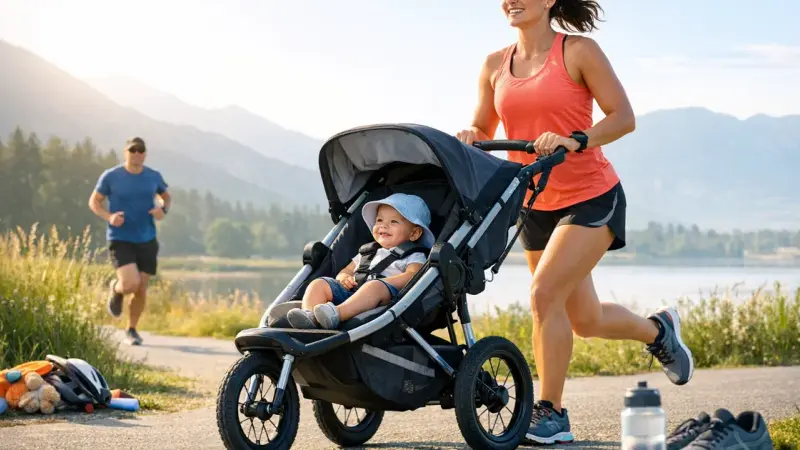
No childcare? No problem. Here's how to run with your little one in tow.
When to Start Stroller Running
Baby Readiness
Minimum age: 6-8 months
Your baby needs:
- Good head and neck control
- Ability to sit supported
- Strong enough core to handle bumps
Why this matters: Running creates more jarring motion than walking. Baby's developing spine and neck need strength to handle it safely.
Check your stroller's guidelines. Some manufacturers specify 6 months; others recommend 8-9 months.
Starting Progression
First stroller runs:
- Start on smooth, flat surfaces
- Keep initial runs short (15-20 minutes)
- Watch baby for signs of distress
- Avoid extreme temperatures
Build gradually as baby adjusts to the motion.
Choosing a Jogging Stroller
Essential Features
Fixed or lockable front wheel:
Running requires stability. A swiveling front wheel is dangerous at running pace. Look for:
- Permanently fixed front wheel, or
- Wheel that locks straight for running
Large wheels:
Bigger wheels handle terrain better. Look for 16"+ front wheel, 16"+ rear wheels.
Suspension:
Absorbs bumps for baby's comfort. Essential for anything other than perfectly smooth surfaces.
Hand brake:
For controlling speed on hills. Should be easy to reach and operate while running.
Five-point harness:
Keeps baby secure. Non-negotiable.
Wrist strap:
Attaches stroller to you in case you trip. Should be used every run.
What to Avoid
Never run with:
- Regular strollers (umbrella strollers, travel systems)
- Strollers with swiveling front wheel unlocked
- Strollers without hand brakes
- Car seat adapters (baby should be in stroller seat)
Popular Options
Budget-friendly: BOB Rambler, Chicco Activ3
Mid-range: BOB Alterrain, Thule Urban Glide
Premium: BOB Wayfinder, Thule Glide 2
Hands-free option: KidRunner (pulls behind you)
Test before buying if possible. Handlebar height and maneuverability vary.
Safety Essentials
Every Run Safety
Always use:
- Wrist strap (attached to you)
- Five-point harness (on baby)
- Locked front wheel
- One hand on stroller at all times
Never:
- Run with hands off the handlebar
- Run with earbuds in both ears (need to hear baby)
- Run in extreme heat or cold with baby
Route Planning
Choose routes with:
- Smooth surfaces (asphalt, concrete paths)
- Minimal traffic crossings
- Shade if hot
- Escape routes (in case baby needs out)
Avoid:
- Technical trails
- Crowded areas
- Narrow paths
- Busy road crossings
Weather Considerations
Heat:
- Baby overheats faster than you
- Use sun canopy
- Run early morning or evening
- Watch for signs of overheating
Cold:
- Bundle baby appropriately
- Cover extremities
- Limit exposure time
- If you're cold, baby is colder
Rain:
- Use weather shield
- Shorter runs
- Watch for slippery surfaces
Form and Technique
Hand Position
One-handed vs. two-handed:
Most runners alternate one hand on stroller, one arm swinging. Some prefer both hands, especially uphill.
Grip:
Light but secure. Death-gripping creates tension.
Hand switching:
Alternate regularly to avoid asymmetric fatigue.
Posture
Stay upright:
Resist leaning into the stroller. Push from tall posture.
Core engaged:
Strong core helps maintain form while pushing.
Eyes forward:
Look ahead, not down at baby. Glance down periodically.
Stride
Expect shorter strides:
The stroller naturally limits stride length. That's okay.
Foot landing:
Keep feet under hips. Avoid overstriding behind the stroller.
Cadence:
May naturally increase with shorter stride. This can actually be more efficient.
Pushing Technique
Push from arms:
Drive the stroller forward rather than fighting it.
Relax shoulders:
Tension creeps in. Consciously relax periodically.
Flow with it:
The stroller has momentum. Work with it, not against it.
Pace Expectations
How Much Slower?
Typical slowdown: 30-90 seconds per mile
Factors affecting pace:
- Stroller weight (baby + stroller = 30-50+ lbs)
- Terrain (hills hurt more)
- Wind (stroller catches wind)
- Baby's age/weight
- Arm restriction
This is normal. Stroller miles are still real miles.
Effort-Based Running
Forget pace. Run by effort.
Your easy pace is whatever pace feels easy while pushing the stroller.
Heart rate running works well—effort stays consistent even if pace varies.
Perceived effort is your friend. Conversational pace still applies.
The Surprising Benefit
Research shows stroller running may be easier on your body:
A Penn State study found vertical impact forces reduced 8-17% when running with a stroller. The stroller provides stability that may actually protect your joints.
Workout Ideas
Easy Runs
Best use for stroller runs. Easy effort, whatever pace that means today.
Tempo Runs
Works well with a stroller. Sustained harder effort for 15-25 minutes. Pace will be slower than solo tempo pace.
Fartlek
Great option. Pick up pace between landmarks, recover, repeat. Baby enjoys the variation.
Example:
- Easy 10 minutes
- 2 min harder / 2 min easy × 4
- Easy 10 minutes cooldown
Long Runs
Possible but challenging. Plan around:
- Feeding schedule
- Diaper needs
- Baby's tolerance
- Your energy for pushing
Tip: Bring snacks, toys, and backup entertainment.
Intervals
More difficult but doable. Track intervals are awkward. Straight paths work better.
Alternative: Hill repeats (push hard up, easy down)
Making It Work
Timing
Best timing options:
- After baby's morning feed (often happy)
- During typical nap time (may sleep through it)
- Before getting too tired
Avoid:
- When baby is hungry
- Close to nap time (overtired = unhappy)
- Extreme temperatures
Entertainment
For baby:
- Toys that attach (won't drop/throw)
- Snacks (age-appropriate)
- Music or talking to baby
- Pointing out things you see
The motion itself often entertains or soothes babies.
Logistics
Bring:
- Phone
- Water (for you)
- Snacks (for both)
- Diapers and wipes
- Extra clothes for baby
- Sun protection
Pack light but prepared.
The Mental Game
Embrace the difference:
Stroller running isn't the same as solo running. It's its own thing—valuable in its own way.
Benefits:
- Outdoor time for baby
- No childcare needed
- Quality time together
- Teaching healthy habits
- Running when you otherwise couldn't
Challenges:
- Slower paces
- Less freedom
- Weather limitations
- Baby's mood dictates everything
Perspective: These miles count. This phase is temporary. Running with your kid is pretty amazing.
Stroller running lets you maintain your running life while being present for your child. It's slower, more logistically complex, and completely dependent on a tiny human's mood—but it's also a way to share something you love with someone you love. Invest in proper gear, prioritize safety, let go of pace expectations, and enjoy the miles you can get.
Track your stroller runs on your dashboard.
Key Takeaway
Stroller running lets you maintain fitness while parenting. Wait for proper baby readiness, invest in a quality jogging stroller, accept slower paces, and prioritize safety. The miles you run pushing a stroller count just as much as any other miles.
Frequently Asked Questions
How old does my baby need to be for stroller running?
Can I use a regular stroller for running?
Why am I so much slower with the stroller?
Is stroller running bad for my body?
Can I do speed work with a stroller?
References
- Jogging stroller safety guidelines
- Running biomechanics research
- Penn State stroller running study