
Contents
Core Exercises for Runners: Build Stability, Not a Six-Pack
Learn the best core exercises for running performance. Focus on stability, anti-rotation, and hip control—not crunches.

Quick Hits
- •Running core work is about stability and control, not six-pack aesthetics
- •Anti-rotation and anti-extension exercises transfer best to running
- •10-15 minutes of core work 3x per week is sufficient
- •Crunches and sit-ups are the least useful core exercises for runners
- •Hip strength is core strength—they're inseparable for runners
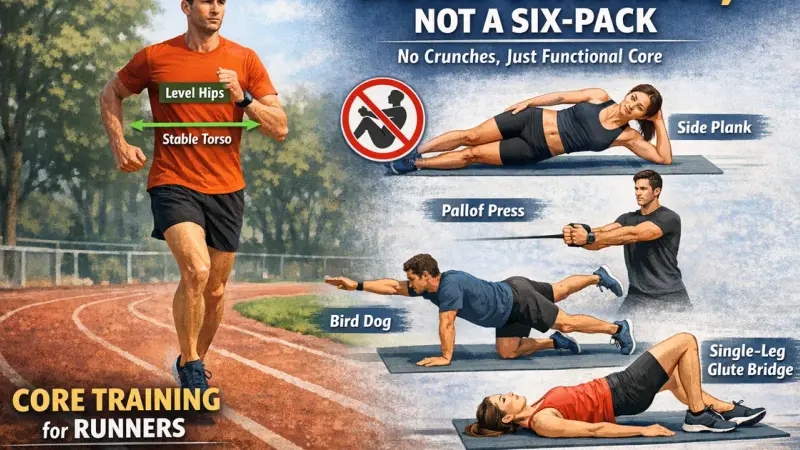
"Do more crunches" is the wrong advice for runners.
Running doesn't require spinal flexion—it requires stability. Here's how to train your core for actual running performance.
Why Core Matters for Running
The Stability Function
Your core connects your upper and lower body. When you run:
- One leg pushes off
- The other swings forward
- Your torso stays stable
Without core stability, energy leaks. You waste motion. You're less efficient.
What Core Stability Looks Like
Good core stability:
- Hips stay level (minimal drop)
- Torso stays quiet (minimal rotation)
- Arms drive forward, not across body
- Energy transfers efficiently to forward motion
Poor core stability:
- Visible hip drop with each stride
- Excessive torso rotation
- Compensatory arm swing
- Energy wasted on stabilization
The Injury Connection
Weak core → Poor stability → Compensatory movements → Overload → Injury
Common injuries linked to core weakness:
- IT band syndrome
- Runner's knee
- Hip pain
- Lower back pain
- Shin splints
The Right Kind of Core Training
Anti-Rotation
The concept: Resist rotation when forces try to twist you.
Running application: When left leg pushes off, core resists rotating left.
Key exercises:
- Pallof press (cable or band)
- Single-arm carries
- Single-arm farmer's walk
- Dead bug variations
Anti-Extension
The concept: Resist arching the lower back when forces try to extend it.
Running application: Maintain neutral spine under running demands.
Key exercises:
- Front plank
- Dead bugs
- Ab wheel rollouts
- Body saw
Anti-Lateral Flexion
The concept: Resist bending to the side when forces try to tilt you.
Running application: Keep hips level, prevent excessive lateral trunk lean.
Key exercises:
- Side plank
- Suitcase carry
- Single-leg stance work
Hip Stability (Part of Core)
The concept: Hips are part of the core complex.
Running application: Control hip drop, maintain pelvic stability.
Key exercises:
- Single-leg glute bridge
- Clamshells
- Bird dogs
- Fire hydrants
The Essential Exercises
Plank (Done Right)
Why: Foundational anti-extension.
How:
- Forearms and toes
- Body in straight line
- Squeeze glutes and core
- Don't let hips sag or pike
Common mistakes:
- Sagging lower back
- Piking hips up
- Holding breath
- Going too long with bad form
Duration: 30-60 seconds, quality over time.
Dead Bugs
Why: Trains core to stabilize while limbs move—exactly like running.
How:
- Lie on back, arms toward ceiling, knees at 90°
- Press lower back into floor
- Lower opposite arm and leg, alternating
- Maintain back position throughout
Reps: 10-12 per side.
Bird Dogs
Why: Trains anti-rotation and hip extension together.
How:
- Hands and knees, neutral spine
- Extend opposite arm and leg simultaneously
- Keep hips square (no rotation)
- Controlled movement, no momentum
Reps: 10-12 per side.
Side Plank
Why: Anti-lateral flexion, hip stability.
How:
- Forearm and side of foot
- Body in straight line
- Hips stacked, top hip not rolling back
- Don't let hip sag toward ground
Duration: 30-45 seconds per side.
Pallof Press
Why: Best anti-rotation exercise.
How:
- Stand perpendicular to cable or anchored band
- Hold handle at chest
- Press straight out, resist rotation
- Return to chest
Reps: 10-12 per side.
Single-Leg Glute Bridge
Why: Hip stability, glute activation.
How:
- Lie on back, one foot flat, other leg extended
- Push through planted foot
- Lift hips, keep them level
- Squeeze glute at top
Reps: 12-15 per side.
Core Routine for Runners
Quick Routine (10 minutes)
Do after easy runs or as standalone:
| Exercise | Duration/Reps |
|---|---|
| Plank | 45 sec |
| Dead Bugs | 12 per side |
| Bird Dogs | 10 per side |
| Side Plank | 30 sec per side |
| Single-Leg Glute Bridge | 12 per side |
Full Routine (15-20 minutes)
For dedicated core sessions:
| Exercise | Duration/Reps |
|---|---|
| Plank | 3 × 45 sec |
| Dead Bugs | 2 × 12 per side |
| Bird Dogs | 2 × 10 per side |
| Side Plank | 2 × 30 sec per side |
| Pallof Press | 2 × 10 per side |
| Single-Leg Glute Bridge | 2 × 12 per side |
| Clamshells | 2 × 15 per side |
Integration Options
Post-run: Quick 10-minute routine while still warm.
Pre-strength: Before lifting as activation.
Rest days: Full routine as standalone work.
Morning: Quick routine to start the day.
Programming Core Work
Frequency
Minimum: 2-3 times per week Optimal: 4-5 times per week Duration: 10-15 minutes per session
Consistency matters more than volume.
Progression
Week 1-4: Master basic exercises with good form.
Week 5-8: Increase duration or add resistance.
Week 9+: Progress to harder variations.
Example plank progression:
- Basic plank →
- Plank with arm lift →
- Plank with leg lift →
- Plank with opposite arm/leg lift
When to Do It
Best options:
- After easy runs (while warm)
- Before strength training (as activation)
- On rest days (standalone)
Avoid:
- Before hard workouts (don't pre-fatigue)
- When genuinely exhausted
Common Core Mistakes
1. Crunches and Sit-Ups
Why they don't help: Train spinal flexion, not stability. Running doesn't require crunching.
Instead: Planks, dead bugs, pallof press.
2. Quantity Over Quality
The mistake: 5-minute plank with sagging form.
Better: 3 × 30 seconds with perfect form.
3. Ignoring Hips
The mistake: All abs, no hips.
Problem: Hips are part of core complex. Weak hips = poor running stability.
Fix: Include glute bridges, clamshells, hip work.
4. Too Infrequent
The mistake: One long session per week.
Problem: Core endurance doesn't build this way.
Fix: Shorter, more frequent sessions.
5. Same Routine Forever
The mistake: Same 5 exercises for years.
Problem: Body adapts. Progress stalls.
Fix: Progressively overload. Vary exercises.
Signs of Core Improvement
Visual indicators:
- Less hip drop when running (video yourself)
- Smoother, less "wobbly" gait
- Better form in late miles
Physical indicators:
- Less lower back fatigue after long runs
- Reduced tightness in hip flexors
- Better posture throughout the day
Performance indicators:
- Faster times without perceived extra effort
- Better ability to maintain pace when tired
- Reduced injury occurrence
Core for Specific Issues
Hip Drop
Focus on: Side planks, clamshells, single-leg balance work.
Extra: Practice single-leg stance, watching hip level in mirror.
Lower Back Pain
Focus on: Dead bugs, bird dogs, glute activation.
Avoid: Anything that hyperextends spine.
Excessive Rotation
Focus on: Pallof press, anti-rotation holds, single-arm work.
Practice: Running with minimal arm crossover.
Core training for runners is simple: stability, not crunches. Master the basics—plank, dead bugs, bird dogs, side planks—and do them consistently. Ten minutes three times a week makes a bigger difference than you might expect.
Track your training with our Running Training Log.
Key Takeaway
Core training for runners means stability, not sit-ups. Focus on planks, dead bugs, pallof press, and hip stability exercises that teach your torso to resist movement while your legs propel you forward. 10-15 minutes, 3-4 times per week.
Frequently Asked Questions
Do crunches help running?
How often should runners train core?
Can core work replace running?
What are signs of weak running core?
How long until core training improves my running?
References
- Biomechanics research
- Core stability studies
- Athletic training literature