
Contents
10 Beginner Running Mistakes (And How to Avoid Them)
New to running? Avoid the most common mistakes that derail beginners. Learn what NOT to do—and what to do instead—as you start your running journey.

Quick Hits
- •Most beginner mistakes involve doing too much too soon
- •Running too fast on every run is the #1 error—slow down
- •Proper shoes matter but don't need to be expensive
- •Rest days are where adaptation happens—don't skip them
- •Patience is the hardest skill but most important for long-term success
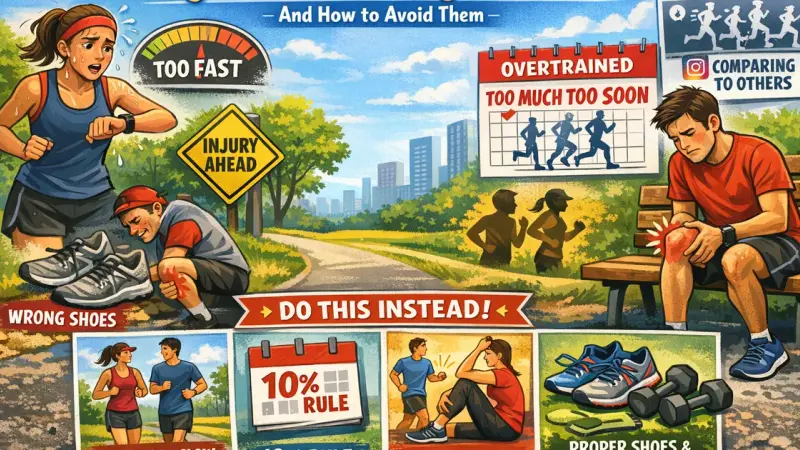
Every experienced runner made these mistakes as a beginner.
You don't have to. Here's what to avoid—and what to do instead.
Mistake #1: Running Too Fast
The Problem
Every run is a race against yourself. Easy pace feels too slow. You push to hit a certain pace.
Why It Happens
- Running feels like it should be hard
- You want to improve quickly
- Ego (even competing against yourself)
- Don't know what "easy" actually means
The Reality
80% of your runs should be conversational pace.
Easy running builds aerobic fitness without excessive stress. Hard running has its place, but it's not every run.
The Fix
The talk test: If you can't speak in full sentences while running, slow down.
Don't look at pace. Run by effort. If it feels easy, you're probably running right.
Mistake #2: Too Much Too Soon
The Problem
Week 1: Run 2 miles Week 2: Run 5 miles Week 3: Run 10 miles Week 4: Injured
Why It Happens
- Excitement and motivation
- Impatience for results
- "More is better" mentality
The Reality
Your cardiovascular system adapts faster than your bones, tendons, and ligaments.
You feel ready before your body is structurally ready.
The Fix
The 10% rule: Increase weekly mileage by no more than 10%.
Take a cutback week (reduce mileage 20-30%) every 3-4 weeks.
Be patient. Consistency over months beats intensity over weeks.
Mistake #3: Skipping Rest Days
The Problem
You rest only when forced. Rest feels like laziness. You worry about losing fitness.
Why It Happens
- Enthusiasm (wanting to run every day)
- Guilt (feeling lazy on rest days)
- Misconception about how fitness builds
The Reality
Adaptation happens during rest, not during training.
Training provides the stimulus. Rest provides the response.
The Fix
Schedule rest days in advance. Treat them as training days where the workout is "rest."
For beginners: 2-3 rest days per week minimum.
Mistake #4: Wrong Shoes
The Problem
Running in old sneakers. Running in whatever's cheapest. Running in shoes that don't fit properly.
Why It Happens
- Not knowing shoes matter
- Budget concerns
- Not understanding fit
The Reality
Running shoes are your primary equipment. Bad fit → blisters, pain, injury.
The Fix
Go to a running store. Get fitted properly.
Good fit means:
- Comfortable immediately (no "breaking in" needed)
- Thumb's width of room at toe
- No rubbing or pinching
- Appropriate support for your gait
You don't need the most expensive shoe—you need the right fit.
Mistake #5: Ignoring Pain
The Problem
"I'll run through it." "It's just a twinge." "I'll rest when it gets really bad."
Why It Happens
- Desire to maintain momentum
- Not knowing what's normal
- Tough-guy mentality
The Reality
Small pains become big injuries.
Running through pain prolongs injury. What could be 3 days off becomes 3 months.
The Fix
Pain rules:
- Sharp pain = stop immediately
- Pain that changes your gait = stop
- Pain that's getting worse = don't run
- Pain that persists after a few rest days = see a professional
Early rest beats forced rest later.
Mistake #6: No Warm-Up
The Problem
Start running immediately from a standstill. Skip warm-up because you're short on time. First mile is "the warm-up."
Why It Happens
- Time pressure
- Impatience
- Not knowing why warm-up matters
The Reality
Cold muscles are injury-prone muscles.
A good warm-up prepares cardiovascular and muscular systems for effort.
The Fix
Before running:
- Walk for 3-5 minutes
- Light dynamic stretches (leg swings, hip circles)
- First 5-10 minutes of running should be very easy
For speed work or races, the warm-up should be longer and include strides.
Mistake #7: Comparing to Others
The Problem
"Why am I so slow?" "That person started running after me and is already faster." "I'll never be a 'real' runner at this pace."
Why It Happens
- Social media
- Running groups
- Competitive nature
The Reality
Everyone's journey is different.
That fast person might have years of athletic background. Or different genetics. Or fewer life constraints.
The Fix
Compare yourself to your past self, not others.
Your only competition is who you were yesterday.
Your pace doesn't define whether you're a runner. If you run, you're a runner.
Mistake #8: Neglecting Strength Training
The Problem
Only running, no strength work. Assuming running is enough.
Why It Happens
- Running takes all available time
- Not knowing strength matters
- Gym intimidation
The Reality
Running-specific strength work:
- Prevents injury
- Improves running economy
- Builds power
The Fix
Minimum effective dose: 2 sessions per week, 20-30 minutes.
Focus on:
- Squats
- Lunges
- Core work
- Calf raises
- Hip strengthening
You don't need a gym—bodyweight exercises work.
See our guide: Strength Training for Runners
Mistake #9: Chasing Gadgets Instead of Miles
The Problem
Waiting for the perfect watch. Analyzing every metric obsessively. Buying gear instead of running.
Why It Happens
- Gear is exciting
- Data feels like progress
- Procrastination disguised as preparation
The Reality
Miles matter more than metrics.
A $50 watch and $100 shoes are enough for years.
The Fix
What you actually need:
- Decent shoes (properly fitted)
- Comfortable clothes
- A simple way to track time/distance (phone is fine)
That's it. Everything else is optional.
Run first. Optimize later.
Mistake #10: Impatience
The Problem
Expecting rapid improvement. Getting discouraged when progress is slow. Quitting when results don't come quickly.
Why It Happens
- Modern instant-gratification culture
- Unrealistic expectations
- Not understanding how adaptation works
The Reality
Running fitness builds over months and years.
The runners who succeed are the ones who stick with it through the slow periods.
The Fix
Mindset shift:
- Think in months, not days
- Celebrate consistency, not just performance
- Trust the process
Your 3-month goal isn't to be fast—it's to still be running.
Your 3-year goal? That's when you'll see real transformation.
The Right Approach
What Successful Beginners Do
- Start slow and stay slow on easy days
- Progress gradually (10% rule)
- Rest properly and without guilt
- Get properly fitted shoes
- Stop at first sign of injury
- Warm up every time
- Focus on their own journey
- Include strength training
- Keep gear simple
- Practice patience
The Big Picture
Consistency trumps intensity.
The beginner who runs 3 times per week for 5 years will be far ahead of the beginner who runs intensely for 3 months and burns out.
Every experienced runner was once a beginner making these mistakes. You have the advantage of learning from others' errors. Start slow, build gradually, rest well, and stay patient. The running journey is long—enjoy the process.
Track your beginner progress on your dashboard.
Key Takeaway
Most beginner mistakes come from enthusiasm exceeding patience. Slow down, progress gradually, rest properly, and trust that consistency over months beats intensity over weeks. The runners who succeed long-term are those who avoid injury by respecting the adaptation process.
Frequently Asked Questions
What's the biggest mistake beginners make?
How do I know if I'm progressing too fast?
Do I need expensive running shoes?
Why do my shins hurt when I run?
Is it normal to feel terrible when starting to run?
References
- Running coaching experience
- Beginner runner research
- Common injury patterns