
Contents
How to Choose Running Shoes: The Complete Guide
Choose running shoes by intended use, fit, preference and budget. Compare two pairs with a practical worksheet and understand what injury studies can show.

Quick Hits
- •One suitable pair can be a valid outcome; a rotation is optional.
- •Compare fit, intended terrain, preference, price and return conditions.
- •Comfort is useful feedback, not a guarantee against injury.
- •Shoe-rotation evidence is observational; buying more pairs does not guarantee protection.
- •Wear patterns and mileage alone cannot diagnose the cause of pain.
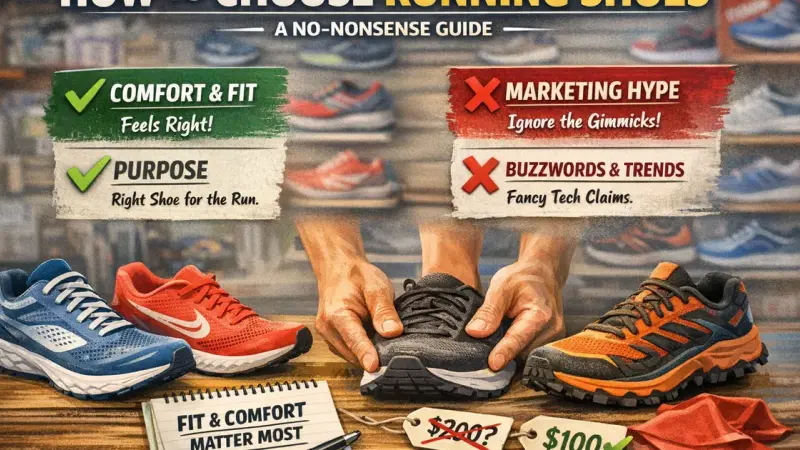
How to Choose Running Shoes
Updated October 2, 2026. This is a research-based buying framework, not a report of firsthand testing of every model. Your own try-on observations belong in the comparison worksheet below.
Quick start: the decision you need to make
| Question | Practical starting point |
|---|---|
| What running will this pair do? | Name the usual surface and purpose before comparing specifications. |
| Does it fit? | Check length, width, heel security and pressure points on both feet. |
| Does it feel comfortable? | Use that feedback while recognizing that comfort cannot guarantee injury prevention. |
| Do I need another pair? | A specific unmet use or preference can justify one; a rotation is optional. |
| What is my budget? | Include delivery and return costs; compare the exact model and size available. |
| Is my current pair still useful? | Inspect its condition and performance in your actual use; mileage alone is not a verdict. |
One suitable pair can be the complete answer. Keeping a pair that already meets your needs is also an option.
What the evidence does—and does not—show
Rotation is an association, not a purchase prescription
Malisoux and colleagues followed 264 recreational runners for 22 weeks. Multiple-pair use was associated with a lower adjusted injury hazard: HR 0.614, with a 95% confidence interval of 0.389–0.969. The paper was published online in 2013 and in a 2015 journal issue, not 2020. This was prospective observational follow-up, not random assignment to buy extra shoes. The result does not establish that buying two or three pairs causes a 39% reduction for an individual. Original rotation study
Comfort is useful feedback, not an injury test
Nigg and colleagues' 2015 paper proposed the “comfort filter” and “preferred movement path” as paradigms. It was not a randomized trial proving that comfortable shoes prevent injury. Original proposal
A later secondary analysis found associations between perceived cushioning/global appreciation and injury risk. Although the parent study was randomized, the comfort perception itself was not a randomized shoe-selection intervention. That distinction matters when interpreting the result. 2025 secondary analysis
Stability features are not automatically wrong—or universally needed
A six-month randomized trial of 372 recreational runners compared standard and motion-control versions of one shoe model. The motion-control group had lower overall injury hazard, HR 0.55 (95% CI 0.36–0.85). This contradicts a blanket claim that motion-control features cannot help, but does not establish that every runner needs them or that all current stability shoes behave alike. Motion-control trial
Use fit, preference and your history in the decision. Do not discard an individual clinical recommendation because an online guide says everyone should start neutral. Equally, a brief retail observation should not be presented as a diagnosis or a guarantee.
Shoe categories: decide what job you need done
These are shopping categories, not standardized specifications. Features overlap and change between model versions. Verify the exact pair rather than assuming a category determines its weight, price or lifespan.
| Category | Job to consider | What to compare when trying it |
|---|---|---|
| Daily trainer | General road running, including easy and longer runs | Fit and comfort across the running you normally do |
| Lightweight trainer | A lighter-feeling option for workouts or preference | Whether reduced weight or different geometry actually feels useful to you |
| Racing shoe | A shoe intended for racing or specific race preparation | Comfort, familiarity and whether the expense serves your intended use |
| Stability/support-oriented shoe | An option with guidance or support features | Your response to the actual design, rather than a universal foot-type rule |
| Trail shoe | Off-road use | Outsole, terrain suitability, fit on descents and protection offered by the specific model |
| Road-to-trail or gravel shoe | Mixed surfaces | Whether its traction and road feel suit your particular route |
A model marketed for trails is not automatically right for every trail. For route planning and surface context, see the trail-running guide and gravel-running guide.
What about carbon-plated racing shoes?
One laboratory comparison tested a prototype and two established racing shoes in 18 high-caliber athletes at 14, 16 and 18 km/h. The prototype reduced average energetic cost relative to those comparators. This supports a finding about those shoes and conditions, not a guarantee of minutes saved in your marathon. Original laboratory comparison
Do not convert a laboratory percentage directly into a promised finish time, or assume a universal pace cutoff determines who can benefit. Try the actual shoe and assess whether it has a useful role for you. This guide does not assign generic model prices, race-shoe lifespans or current foam-technology rankings.
Choice tree
- Describe your usual run. Road, mixed surface or technical trail? General training, a particular session, or racing?
- Check what you already own. If a pair meets that use comfortably and remains in suitable condition, an additional purchase may not solve a problem.
- Set a real budget. Include return costs. A discounted model only helps if the available fit works.
- Try appropriate options. Compare fit and your response; neither a category label nor the highest specification wins automatically.
- Choose, keep looking, or keep your current pair. All three are valid outcomes. If symptoms are driving the decision, separate the shopping question from getting an appropriate assessment.
Fit checklist
Use your normal running socks and any usual orthotics. Check both feet, and walk or jog where the retailer permits. AAOS advises measuring both feet, checking toe space and width, and trying shoes rather than relying solely on the marked size. AAOS fitting guidance
- Length: room beyond the longest toe; no toe contact at the front during the allowed trial.
- Width: no side pressure or excessive sliding.
- Heel: secure without an uncomfortable pressure point.
- Toe box: room for toes without rubbing above or beside them.
- Both feet: assess each, not just the foot used for the first try-on.
- Usual setup: socks and orthotics match what you intend to use.
- Movement: note what changes from standing to walking or jogging.
- Return conditions: understand whether an outdoor trial is allowed before doing one.
Do not automatically size up by a fixed amount. A larger size can change heel security and length without fixing width. Compare widths and shapes as well as sizes. AAOS specifically notes that a larger size in the same brand may not solve a fit problem. AAOS fit discussion
Two-shoe comparison worksheet
Copy this into a note or print the page. Record observations from your own trial; retailer descriptions and review findings should be labeled separately.
| Compare | Shoe A | Shoe B |
|---|---|---|
| Exact model/version, size and width | ||
| Intended runs and terrain | ||
| Length and toe room on each foot | ||
| Width, heel security and pressure points | ||
| Standing versus walking/jogging observations | ||
| Socks/orthotics used in trial | ||
| Current price, currency and date checked | ||
| Delivery cost and return conditions | ||
| What I observed versus what a review claims | ||
| Unresolved questions or reasons to keep looking |
If both fit, choose by the intended use and your budget. If neither fits, “neither” is more useful than choosing the less uncomfortable one.
Optional rotation templates
The templates describe possible roles for shoes; they do not prescribe a training week or require a purchase at a particular ability level.
| Setup | Roles | When it may make practical sense |
|---|---|---|
| One pair | Suitable daily trainer for your usual road runs | Your current running needs are covered |
| Two pairs | Daily shoe plus a shoe for a distinct terrain or preference | You can name a use the first pair does not serve well |
| Three pairs | General running, a distinct workout/race preference, and trail use | All three roles occur in your actual running and fit the budget |
| More pairs | Specific additional uses or personal interest | A choice you value, not evidence of being a more advanced runner |
You do not need a different pair for every intensity, a fixed percentage of mileage in each category, or a second pair solely because you run on consecutive days. Record why you use each pair. Drying logistics can be a practical reason for another pair; this guide does not claim that foam “needs a day off” or that rotation increases total lifespan by a proven amount.
Replacement: inspect, then decide
Mileage can help you remember when and how a shoe has been used. It is not a universal expiry date, and a thumb-press test is not a validated assessment of remaining cushioning.
- Inspect outsole condition and whether traction still suits your route.
- Check for upper damage, separation or a change in fit.
- Record changes you notice during use and their circumstances.
- Consult care and replacement information for the actual model rather than applying one category-wide lifespan.
If pain appears, do not diagnose its cause from mileage, an outsole photograph or the timing of a new purchase alone. Reassess the situation and seek appropriate professional help for persistent symptoms. Buying another pair should not stand in for that assessment.
Troubleshooting without diagnosing from the shoe
| Observation | Useful next check |
|---|---|
| Toe contact or rubbing in a trial | Compare length, width, toe-box shape and lacing; do not assume length alone is responsible |
| Heel movement | Recheck size, shape and fastening rather than accepting it as inevitable |
| Uneven outsole wear | Record the wear and inspect condition; do not infer leg-length difference or a pronation diagnosis |
| New discomfort after a shoe change | Note when it occurs and other changes; do not treat the shoe as a proven cause |
| No comfortable option so far | Try different widths/shapes and ask for fitting help; an expensive insole is not an automatic next step |
When symptoms are part of the decision, our shoe choices with IT band symptoms and shoe choices with Achilles symptoms compare comfort, fit, and geometry with explicit clinical limits. Use them alongside an appropriate assessment; neither guide prescribes a treatment shoe.
Avoid making race day the first opportunity to discover how an unfamiliar pair feels. Use any trial period in accordance with the retailer's conditions and the running you already planned.
Your next step
Write down the job your current shoe does, one unresolved fit or use question, and your budget if a purchase is needed. Complete the two-shoe worksheet only if there is a decision to make. A comfortable, suitable existing pair does not need replacing to complete this guide.
Key Takeaway
Start with the running you actually do, compare fit and comfort, and respect your budget. One suitable pair is legitimate. Treat injury studies as evidence with limits, not promises attached to a shoe category or extra purchase.
Frequently Asked Questions
Do I need stability shoes?
How should running shoes fit?
Do I need multiple pairs?
When should I replace shoes?
Will carbon-plated shoes improve my marathon time?
What does uneven outsole wear tell me?
References
- https://pubmed.ncbi.nlm.nih.gov/24286345/
- https://pubmed.ncbi.nlm.nih.gov/26221015/
- https://pubmed.ncbi.nlm.nih.gov/26746907/
- https://pubmed.ncbi.nlm.nih.gov/41122014/
- https://pubmed.ncbi.nlm.nih.gov/29143929/
- https://www.orthoinfo.org/staying-healthy/shoes-finding-the-right-fit/