
Contents
Case Study: Two Runners, Same VO2max – Why Economy Won the Race
When two runners have identical aerobic capacity, what determines who's faster? This case study explores how running economy separates performance.

Quick Hits
- •VO2max has a 'ceiling effect'—among trained runners, it stops predicting performance
- •Running economy (oxygen cost at submaximal pace) often determines race outcomes
- •Economy can improve 2-8% with targeted training in 6-20 weeks
- •East African runners often excel due to exceptional economy, not just high VO2max
- •Drills, plyometrics, and hill sprints are proven economy improvers
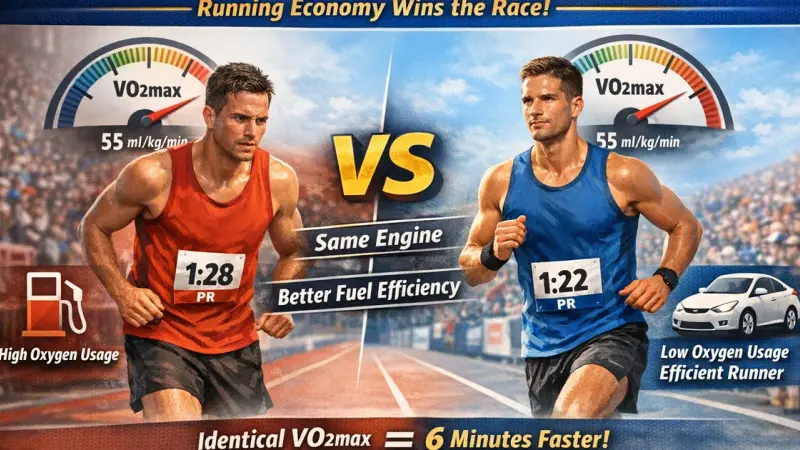
Two runners stand at the start line. Lab tests show identical VO2max values. Yet one will finish minutes ahead of the other. What gives?
The answer: running economy.
The Comparison
The Scenario
Runner A:
- VO2max: 55 ml/kg/min
- Training: High volume, mostly steady state
- Race focus: Half marathon
- Current PR: 1:28
Runner B:
- VO2max: 55 ml/kg/min (identical to Runner A)
- Training: Moderate volume with drills and plyometrics
- Race focus: Half marathon
- Current PR: 1:22
Six minutes faster with the same aerobic capacity. How?
The Difference: Running Economy
Runner B consumes less oxygen at any given pace. They're more efficient—getting more speed from the same aerobic engine.
If Runner A uses 200 ml O2/kg/km at half marathon pace, and Runner B uses 180 ml O2/kg/km, Runner B can sustain a faster pace at the same relative effort.
Understanding Running Economy
What It Is
Running economy measures how much oxygen you need to run at a specific pace. Think of it like fuel efficiency in a car:
- VO2max = Engine size (maximum power)
- Running economy = MPG (how efficiently you use that power)
A Prius and a sports car might have similar engines, but one goes much farther on the same tank.
Why It Matters
At recreational levels, VO2max often correlates with performance—bigger engine, faster running.
But among trained runners, VO2max clusters in a narrow range. The variation that explains performance differences shifts to economy.
Elite marathon runners often have VO2max values between 70-80 ml/kg/min. The range is small. But their economy varies significantly—and this correlates with their race times.
Research Evidence
The University of Exeter Study
In a 2012 study, a group of new runners trained on their own for 10 weeks without any technique instruction.
Result: Despite making no conscious effort to improve their form, they achieved an average improvement of 8.4 percent in running economy, related to subtle changes in biomechanics.
Running itself improves economy. The body naturally finds efficient movement patterns.
The Italian Runner Tracking
An Italian runner named Roberto Veneziani tracked his stride rate and race performance for a full season.
Though he made no conscious effort to increase his stride rate, it increased naturally as he got fitter—and his race times improved correspondingly.
Economy improvements happen automatically with consistent training.
Plyometric Training Study
Research shows significant improvements from plyometric training[^3][^4]. One study showed a 5% improvement in VO2max and a 3% improvement in 3km race performance after just 6 weeks of plyometric training[^4].
Jumping and bounding exercises improved running efficiency—translating directly to faster times. Studies found that 6 weeks of plyometric training improves running economy in trained distance runners through increased musculotendinous stiffness[^3].
Hill Sprint Research
A comprehensive study on hill training found that short hill repetitions of 10-12 seconds led to the greatest improvement in running economy.
Short, explosive efforts develop the power and stiffness that make running more efficient.
What Makes Running Economy Better
Biomechanical Factors
- Lighter lower limbs: Less mass to swing forward and back
- Efficient stride: Not overstriding, not shuffling
- Elastic energy return: Tendons that spring back like rubber bands
- Vertical oscillation: Not bouncing too much
Neuromuscular Factors
- Motor unit recruitment: Using the right muscles efficiently
- Relaxation: Not tensing muscles unnecessarily
- Coordination: Smooth, automatic movement patterns
Structural Factors
- Tendon stiffness: Stiffer tendons return more elastic energy
- Muscle fiber composition: More slow-twitch fibers can be more economical
- Body proportions: Shorter lower legs relative to thighs may help
How to Improve Your Economy
Proven Methods
1. Plyometrics (6 weeks minimum)
- Box jumps
- Bounding
- Single-leg hops
- Jump squats
Performed 2-3 sessions per week, running economy can improve in as little as six weeks.
2. Running Drills
- High knees
- Butt kicks
- A-skips, B-skips
- Cariocas
Running form drills can naturally increase stride length without forcing the issue, leading to faster paces at the same effort level.
3. Short Hill Sprints
- 8-12 second sprints
- Full recovery between reps
- 6-10 repetitions
- Once or twice per week
The explosive uphill effort develops power and economy.
4. Heavy Strength Training
- Squats, deadlifts, lunges
- Heavy loads (≥80% 1RM)
- Lower volume (3-5 reps)
Research shows strength training with heavy loads has positive effects on running economy and time-trial performance.
5. Consistent Running
The simplest intervention: run consistently for years.
Running at least three times per week (and doing 4-6 runs if you can tolerate it) will naturally make you a fitter runner and improve your running economy.
The Timeline
Neural adaptations take 4-6 weeks minimum. Commit to 8 weeks of economy-focused work, track progress weekly, and trust the process.
The East African Advantage
Why do Kenyan and Ethiopian runners dominate distance running?
While they often have good VO2max values, their running economy is frequently exceptional. Proposed explanations:
- Running from childhood: Years of running to school develops efficiency
- Light lower limbs: Biomechanical advantage
- Altitude training: May improve economy through various mechanisms
- Natural selection: Generations of runners
The lesson: economy can be developed over a lifetime.
Practical Application
For Recreational Runners
- Keep running consistently: Economy improves naturally over years
- Add drills after easy runs: 5 minutes, 2-3 times per week
- Include short hill sprints: Once per week during base phase
- Consider plyometrics: If injury-free and looking for an edge
For Competitive Runners
- Structured plyometric program: 2x per week during base/build phases
- Regular drills routine: Before quality sessions
- Heavy strength training: 2x per week during off-season/base
- Hill sprint blocks: 4-6 week cycles
For Masters Runners
Economy often maintains well with age, even as VO2max declines. Focus on:
- Maintaining running frequency
- Gentle plyometrics and drills
- Strength training for injury prevention
- Consistent training over years
The Bottom Line
When VO2max is equal, economy determines the race.
The good news: economy is trainable. Through drills, plyometrics, hills, strength training, and simply years of consistent running, you can become a more efficient runner.
A bigger engine helps. But a more efficient engine might be even better.
Improve your running efficiency with targeted training. Use our Running Economy Calculator to estimate your current economy, and track your improvement on your dashboard.
Key Takeaway
When VO2max is similar, running economy determines the winner. Fortunately, economy is trainable—through plyometrics, drills, hills, and simply years of consistent running. The most efficient runner isn't always the one with the biggest engine.
Frequently Asked Questions
What's more important—VO2max or running economy?
How do you measure running economy?
Can you improve running economy?
Why do Kenyan and Ethiopian runners dominate distance running?
References
- Moore, I.S. et al. (2012). Is There an Economical Running Technique? A Review of Modifiable Biomechanical Factors Affecting Running Economy. Sports Medicine, 42(11), 903-921.
- Saunders, P.U. et al. (2004). Factors Affecting Running Economy in Trained Distance Runners. Sports Medicine, 34(7), 465-485.
- Spurrs, R.W. et al. (2003). The effect of plyometric training on distance running performance. European Journal of Applied Physiology, 89(1), 1-7. https://pubmed.ncbi.nlm.nih.gov/12580657/
- Turner, A.M. et al. (2003). Improvement in running economy after 6 weeks of plyometric training. Journal of Strength and Conditioning Research, 17(1), 60-67.