
Contents
Case Study: The Runner Who Slowed Down to Get Faster
How one runner broke through a plateau by slowing easy runs and embracing polarized training—dropping from 7:25 to 6:50 5K pace in months.

Quick Hits
- •Runner was stuck at 7:25/mile 5K pace despite consistent training
- •Switched to heart-rate based easy running—much slower than before
- •5K pace dropped to 6:50/mile over several months
- •Age 49—proving this approach works even for masters runners
- •Secret: making easy days truly easy allows hard days to be truly hard
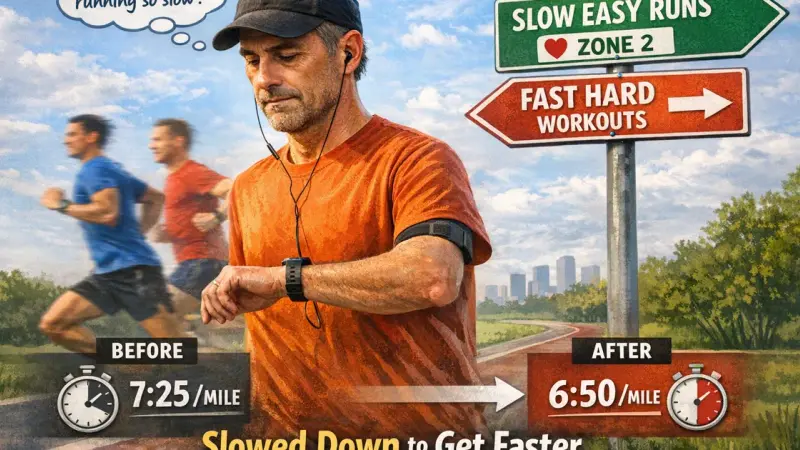
"I get funny looks in the club because I seem to be training so slow when everyone else is hammering around. But I don't want to tell them what I'm doing as it's my secret."
This quote captures the experience of a 49-year-old runner who broke through years of plateau by doing the counterintuitive: slowing down.
The Problem: Stuck at the Same Pace
Background
- Age: 49 years old
- Experience: Multiple years of consistent running
- Training: Running "hard" most days
- 5K pace: Stuck at 7:25/mile for years
- Frustration level: High
The Pattern
Like many runners, this athlete fell into the "gray zone" trap:
- Easy runs weren't easy (moderate effort)
- Hard runs weren't hard (moderate effort)
- Every run felt like work
- No improvement despite consistent training
This pattern is remarkably common. Runners push easy days because they feel "too slow," then can't push hard days because they're fatigued from never recovering.
The Intervention: Heart Rate Training
The Switch
After hitting the wall on improvement, the runner made a dramatic change:
Old approach: Run by feel (which meant "comfortably hard" most days)
New approach: Run by heart rate, keeping easy runs in Zone 2
What This Meant
Zone 2 running felt absurdly slow at first. Paces that seemed embarrassing. Walking up hills to keep heart rate down. Getting passed by everyone.
But the runner committed to the experiment.
The Training Changes
Easy Days: Truly Easy
- Heart rate monitor guiding every easy run
- Pace didn't matter—only heart rate
- Zone 2 (aerobic) exclusively on easy days
- Initially 2+ minutes per mile slower than before
Hard Days: Actually Hard
With energy preserved from easy days:
- Quality sessions felt better
- Could push intervals harder
- Better recovery between repeats
- More sustainable workout efforts
The Distribution
Following the polarized model:
- ~80% of running at easy/aerobic effort
- ~20% at high intensity (tempo, intervals)
- Almost nothing in the middle "gray zone"
The Results
Over Several Months
| Metric | Before | After | Change |
|---|---|---|---|
| 5K pace | 7:25/mi | 6:50/mi | -35 sec/mi |
| 5K time | ~23:00 | ~21:15 | -1:45 |
| Easy run pace | 8:00/mi | 9:30/mi | Slower |
| Race day feel | Struggled | Strong | Much better |
The Key Insight
The runner's reflection says it all:
"I have been training almost exclusively aerobically (using a heart rate monitor) and over that time my 5K pace has come down from 7:25 to 6:50. You might not think that's much, but I'm delighted and I'm continuing to improve steadily."
A 35-second per mile improvement at age 49, after years of plateau, by running slower most of the time.
Why This Works
The Science
Pushing constantly provides initial improvement, but progress soon stagnates. New PRs become rare. The body never fully recovers, never fully adapts.
Polarized training solves this by:
- Building aerobic base: Easy running develops the cardiovascular foundation
- Allowing recovery: Low stress on easy days means actual recovery
- Enabling quality: Rested legs can push harder on hard days
- Preventing burnout: Sustainable long-term approach
The Research
Stephen Seiler's research on elite endurance athletes found they naturally gravitate toward polarized distributions[^1][^3]—not because a coach told them, but because it works.
Studies consistently show that 80/20 or even more polarized approaches (90/10) outperform threshold-heavy training for endurance improvement[^2]. In a controlled study, polarized training produced the greatest improvements in VO2max (+11.7%) and time to exhaustion (+17.4%) compared to threshold, high-intensity, or high-volume training approaches[^2].
Common Mistakes (And How to Avoid Them)
Mistake 1: "Slow Is Embarrassing"
Reality: Nobody cares about your training pace. They care about your race times.
Mistake 2: "I Feel Fine Going Harder"
Reality: You might feel fine today. But accumulated fatigue shows up weeks later as plateau or injury.
Mistake 3: "More Hard Work = Better Results"
Reality: Training stress + recovery = adaptation. Without recovery, there's no adaptation.
Mistake 4: "Heart Rate Training Is Too Complicated"
Reality: It's simple: keep easy days in Zone 2. That's it.
How to Apply This
Step 1: Find Your Zones
Use our Heart Rate Zone Calculator to establish your training zones.
Step 2: Commit to the Experiment
Give polarized training 8-12 weeks. The first few weeks will feel frustratingly slow.
Step 3: Trust the Process
Your easy pace will naturally speed up over time as your aerobic fitness improves. Don't force it.
Step 4: Make Hard Days Count
When you do run hard, run hard. Your recovered legs will thank you.
Signs It's Working
- Easy runs feel easier at the same heart rate
- You have energy left after easy runs
- Hard workouts feel more sustainable
- Race times improve despite "slower" training
- You look forward to running
Signs You're Still in the Gray Zone
- Every run feels like moderate effort
- You're always a little tired
- Hard workouts feel like a slog
- Race times stagnate
- Running feels like a grind
The runner in this case study discovered something profound: sometimes less is more. By slowing down most runs, they ran faster when it mattered. Check if you're stuck in the gray zone and track your training distribution on your dashboard.
Key Takeaway
Running easy on easy days isn't just recovery—it's training. This case study demonstrates that slowing down easy runs can unlock faster race times by building aerobic capacity while preserving energy for quality hard sessions.
Frequently Asked Questions
How slow should easy runs actually be?
Won't running slow make me slower?
How long before I see results from polarized training?
What percentage should be easy vs. hard?
References
- Seiler, S. (2010). What is best practice for training intensity and duration distribution in endurance athletes? International Journal of Sports Physiology and Performance, 5(3), 276-291. https://pubmed.ncbi.nlm.nih.gov/20861519/
- Stöggl, T. & Sperlich, B. (2014). Polarized training has greater impact on key endurance variables than threshold, high intensity, or high volume training. Frontiers in Physiology. https://pmc.ncbi.nlm.nih.gov/articles/PMC3912323/
- Seiler, K.S. & Kjerland, G.Ø. (2006). Quantifying training intensity distribution in elite endurance athletes: is there evidence for an optimal distribution? Scandinavian Journal of Medicine & Science in Sports, 16(1), 49-56.