
Contents
Heart Rate Zones: Identify the Method Before Calculating
Understand maximum-heart-rate and reserve formulas, threshold-based systems and why zone numbers do not transfer between methods.

Quick Hits
- •Identify the method and its inputs before interpreting a zone number.
- •Percentage of maximum HR and percentage of HR reserve use different formulas.
- •An arithmetic band does not locate a measured physiological threshold.
- •Use the same definitions when comparing sessions or devices.
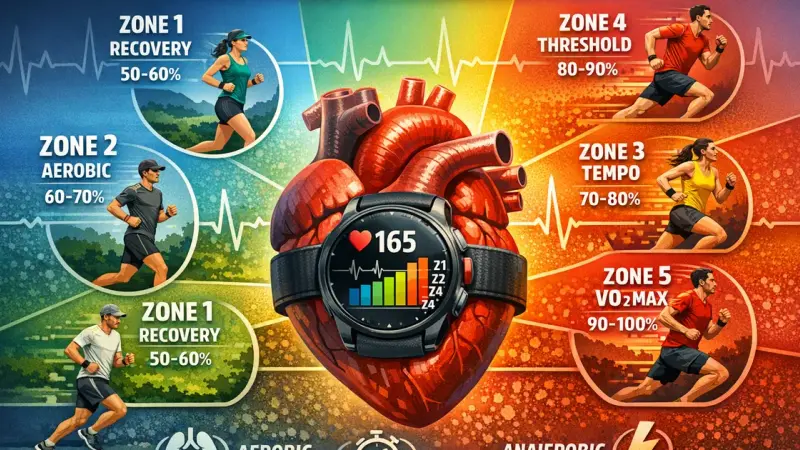
A heart-rate zone is a range defined by a method. Its number only makes sense alongside that method's reference value and boundaries. This page explains the calculations; the application guide covers unexpected readings, long-run drift and short intervals.
Name the Reference Value
| Method | What defines the ranges | Input question |
|---|---|---|
| Percentage of maximum HR | Selected percentages of maximum HR | Was the maximum estimated or appropriately assessed? |
| Heart rate reserve (Karvonen) | Selected percentages of maximum minus resting HR, added to resting HR | Where did both supplied values come from? |
| Threshold-based system | A specified threshold measurement and that system's boundaries | Which threshold, protocol and interpretation are being used? |
| Three-zone physiological model | A specified lower and upper threshold | How were those two boundaries identified? |
Do not substitute threshold HR for maximum HR. Likewise, the middle zone of a threshold-defined three-zone model does not inherit the meaning of Zone 2 on a five-zone watch. Adding more subdivisions does not make different reference measurements interchangeable.
For a concrete research example, Seiler and Kjerland (2006) used ventilatory thresholds when classifying training in eleven male junior cross-country skiers. That illustrates a threshold-based method; it does not establish a universal training distribution for runners.
Two Formulas, One Set of Inputs
Use maximum 180 bpm and resting 50 bpm as synthetic examples. They are not recommended personal values.
Percentage of maximum: target = fraction × maximum.
Reserve: target = resting + fraction × (maximum − resting).
Here the reserve is 180 − 50 = 130 bpm. Applying the same 60–70% interval gives:
- Maximum method: 180 × 0.60 to 180 × 0.70 = 108–126 bpm.
- Reserve method: 50 + 130 × 0.60 to 50 + 130 × 0.70 = 128–141 bpm.
That difference is mathematical. It is not evidence of a change in fitness, and this comparison does not establish which method is appropriate for you.
The Existing Calculator's Five Bands
Our heart-rate band calculator supports those two methods. The following reproduces its output for the supplied 180/50 example. Bands are numbered without claims that a particular boundary measures threshold or VO2max.
| Band | Percentage interval | Maximum method | Reserve method |
|---|---|---|---|
| 1 | 50–60% | 90–108 bpm | 115–128 bpm |
| 2 | 60–70% | 108–126 bpm | 128–141 bpm |
| 3 | 70–80% | 126–144 bpm | 141–154 bpm |
| 4 | 80–90% | 144–162 bpm | 154–167 bpm |
| 5 | 90–100% | 162–180 bpm | 167–180 bpm |
These are this tool's chosen arithmetic intervals, not a universal physiological zone map. Endpoints are rounded to the nearest whole bpm. Shared endpoints do not imply a physiological switch at one beat.
Rounding example: maximum 185, resting 50 gives reserve 135. The 60–70% reserve interval is 131–144.5 bpm, displayed as 131–145 bpm. A device with different rounding or boundaries can disagree even when the inputs match.
Audit Your Settings
Record the method name, sport profile, maximum, resting value if used, custom boundaries and date of any assessment or estimate. If comparing a watch with a calculator, compare those settings before deciding either is wrong.
A largest recorded watch value is not automatically a validated maximum. This reference does not provide an unsupervised maximal test. If you need an assessment, establish an appropriate protocol and suitability with a qualified professional rather than attempting an all-out effort to satisfy a calculator.
The calculator requires explicit inputs and has interface bounds; those bounds are not normal-heart-rate definitions. A missing resting value in reserve mode produces an error rather than an invented value.
Keep Categories Separate From Training Decisions
A calculated range does not guarantee a particular adaptation, recovery state or safe intensity. Do not assign fixed physiological benefits to every beat range or label a whole numbered zone as wasted training.
When summarizing training, state whether you count distance, time or sessions and how you assigned the categories. The intensity-distribution tool counts distance using your category assignments; it does not derive threshold zones from HR data.
For comparing heart rate with pace and effort, use the training-metric guide. For what to check during an actual run, use the three troubleshooting scenarios. Neither a reassuring number nor an easy feeling automatically resolves an unusual reading.
Key Takeaway
Identify the method and its inputs before interpreting a zone number.