
Contents
Foot and Ankle Strengthening for Runners
Build stronger feet and ankles to prevent plantar fasciitis, Achilles tendinitis, and shin splints. A complete guide to lower leg strengthening for runners.

Quick Hits
- •Your feet absorb 2-3x your body weight with every running stride
- •Weak foot intrinsic muscles contribute to plantar fasciitis
- •Eccentric calf work is key to preventing Achilles issues
- •Single-leg calf raises build running-specific strength
- •10-15 minutes 3-4x per week significantly reduces injury risk
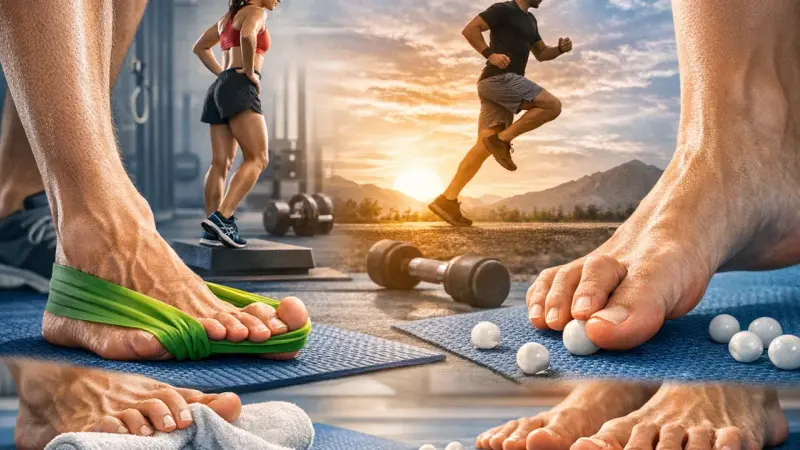
Your feet hit the ground 1,500-2,000 times per mile.
Each impact delivers 2-3 times your body weight through a small area.
Weak feet and ankles can't handle this demand. The result: plantar fasciitis, Achilles tendinitis, shin splints, and more.
Here's how to build strength from the ground up.
Why Lower Leg Strength Matters
The Impact Problem
Running forces:
- 2-3x body weight per stride
- 1,500-2,000 strides per mile
- Cumulative load measured in tons per run
What absorbs this:
- Foot arch (needs intrinsic muscle support)
- Ankle joint (needs stability)
- Calf muscles (need strength and flexibility)
- Achilles tendon (needs load tolerance)
Weakness Consequences
| Weak Area | Common Result |
|---|---|
| Foot intrinsics | Plantar fasciitis, arch pain |
| Ankle stabilizers | Sprains, instability, shin splints |
| Calf muscles | Achilles tendinitis, calf strains |
| Combined weakness | Chronic lower leg issues, compensation |
Why Running Alone Isn't Enough
Running loads the lower leg but doesn't comprehensively strengthen it. Specific muscles remain weak:
- Foot intrinsics (rarely challenged by cushioned shoes)
- Ankle evertors/invertors (mostly sagittal plane running)
- Tibialis posterior (undertrained in most runners)
Targeted exercises fill these gaps.
Foot Intrinsic Exercises
Short Foot Exercise (Foot Doming)
Purpose: Strengthen arch-supporting muscles.
Sets/Reps: 3 x 10 per foot, 5-second holds
How:
- Sit with foot flat on floor
- Without curling toes, draw ball of foot toward heel
- Create an arch dome
- Hold 5 seconds
- Release fully
Technique cues:
- Toes stay flat on ground
- Only the arch lifts
- Feel the muscles under your arch working
- This is subtle - no visible toe gripping
Progression: Standing, then single-leg stance.
Toe Yoga
Purpose: Develop independent toe control.
Sets/Reps: 2 x 10 per movement
How:
- Sit with foot flat
- Lift big toe while pressing other toes down
- Hold 3 seconds, release
- Press big toe down while lifting other toes
- Hold 3 seconds, release
Technique cues:
- This is hard at first - that's the point
- Control improves with practice
- Work both feet simultaneously or separately
Towel Scrunches
Purpose: Strengthen toe flexors and arch muscles.
Sets/Reps: 3 x 15 scrunches per foot
How:
- Place towel flat on floor
- Sit with foot on towel
- Scrunch towel toward you using toes
- Release and repeat
- Complete full towel length
Technique cues:
- Use toes actively, not whole foot
- Feel arch muscles engaging
- Keep heel on ground
Progression: Add weight to far end of towel.
Marble Pickup
Purpose: Fine motor control of toe flexors.
Sets/Reps: 2 x 10 pickups per foot
How:
- Scatter marbles (or small objects) on floor
- Pick up one marble at a time with toes
- Transfer to a cup
- Use different toes
Technique cues:
- Focus on control, not speed
- Works well with golf balls, small stones
- Great for developing dexterity
Toe Spreading
Purpose: Strengthen toe abductors (often neglected).
Sets/Reps: 3 x 10, 5-second holds
How:
- Sit with foot flat
- Spread all toes apart as far as possible
- Hold 5 seconds
- Release
Technique cues:
- Space should appear between each toe
- Harder than it sounds for most people
- Improves foot splay during running
Ankle Stability Exercises
Single-Leg Balance
Purpose: Foundation ankle stability.
Sets/Reps: 3 x 30-60 seconds per leg
How:
- Stand on one foot
- Maintain balance without excessive wobbling
- Eyes forward, core engaged
- Progress to eyes closed
Technique cues:
- Don't lock knee
- Feel small corrections from ankle/foot
- If easy, progress to unstable surface
Ankle Circles
Purpose: Mobility plus controlled movement.
Sets/Reps: 2 x 10 each direction, each ankle
How:
- Lift foot slightly off ground
- Draw circles with big toe
- Full range of motion
- Controlled speed
- Both directions
Technique cues:
- Move from ankle, not whole leg
- Make circles as large as possible
- Feel each position
Heel Walking
Purpose: Strengthen tibialis anterior (front of shin).
Sets/Reps: 3 x 20 meters
How:
- Walk on heels only, toes pointed up
- Maintain dorsiflexion throughout
- Control each step
- Don't let toes drop
Technique cues:
- Feel burn in front of shin
- Important for shin splint prevention
- Slow and controlled
Toe Walking
Purpose: Strengthen calves in shortened position.
Sets/Reps: 3 x 20 meters
How:
- Walk on balls of feet
- Stay as high on toes as possible
- Don't let heels drop
- Control each step
Technique cues:
- Maintain height throughout
- Feel calves working
- Keep good posture
Ankle Alphabet
Purpose: Full range ankle mobility and control.
Sets/Reps: 1-2 alphabets per ankle
How:
- Sit with leg extended
- Draw each letter of alphabet with big toe
- Move from ankle only
- Make letters as large as possible
Technique cues:
- Takes 2-3 minutes per ankle
- Great for mobility and control
- Can do during desk work
Calf Strengthening
Bilateral Calf Raise
Purpose: Foundation calf strength.
Sets/Reps: 3 x 15
How:
- Stand on edge of stair, heels hanging off
- Rise onto toes as high as possible
- Pause at top
- Lower below stair level (stretch)
- Full range of motion
Technique cues:
- Slow and controlled (2 up, 2 down)
- Full range - both top and bottom
- Feel calf engagement throughout
Single-Leg Calf Raise
Purpose: Running-specific strength (you run on one leg).
Sets/Reps: 3 x 12-15 per leg
How:
- Same setup, single leg
- Other foot hooked behind
- Full range of motion
- Control especially on lowering
Technique cues:
- This is the gold standard for runners
- Build to 25 clean reps per leg
- Add weight when 25 is easy
Eccentric Calf Lower
Purpose: Achilles tendon health and strength.
Sets/Reps: 3 x 10 per leg
How:
- Rise on both feet
- Transfer weight to one foot
- Lower slowly over 4-5 seconds
- Push back up with both feet
- Repeat
Technique cues:
- Eccentric (lowering) phase is key
- Especially important for Achilles health
- Start with straight knee, then add bent-knee version
Bent-Knee Calf Raise
Purpose: Target soleus muscle (deeper calf).
Sets/Reps: 3 x 12 per leg
How:
- Single-leg calf raise setup
- Bend knee 20-30 degrees and hold
- Perform calf raise in this position
- Maintain knee bend throughout
Technique cues:
- Bent knee shifts work to soleus
- Feel difference from straight-leg version
- Important for complete calf development
Seated Calf Raise
Purpose: Soleus isolation.
Sets/Reps: 3 x 15
How:
- Sit with balls of feet on elevated surface
- Place weight across knees
- Raise heels as high as possible
- Lower with control
Technique cues:
- Seated = soleus emphasis
- Can use dumbbell, barbell, or machine
- Full range of motion
Complete Routine
Quick Routine (10 minutes)
For maintenance and pre-run activation.
| Exercise | Sets x Reps |
|---|---|
| Short Foot | 2 x 8/side |
| Single-Leg Balance | 2 x 30 sec/side |
| Heel Walking | 1 x 20m |
| Toe Walking | 1 x 20m |
| Single-Leg Calf Raise | 2 x 12/side |
Full Routine (15-20 minutes)
For dedicated strengthening sessions.
| Exercise | Sets x Reps |
|---|---|
| Short Foot | 3 x 10/side |
| Toe Yoga | 2 x 8/movement |
| Towel Scrunches | 2 x 15/side |
| Single-Leg Balance | 2 x 45 sec/side |
| Heel Walking | 2 x 20m |
| Toe Walking | 2 x 20m |
| Single-Leg Calf Raise | 3 x 15/side |
| Eccentric Calf Lower | 2 x 10/side |
| Bent-Knee Calf Raise | 2 x 12/side |
Frequency
Minimum: 3 times per week
Optimal: 4-5 times per week
Duration: 10-20 minutes per session
Progression Schedule
Weeks 1-2: Foundation
- Bodyweight only
- Master technique
- Focus on feeling target muscles
- Short foot exercise is priority
Weeks 3-4: Building
- Increase reps
- Add balance challenges (eyes closed, unstable surface)
- Focus on single-leg calf raise form
- Introduce eccentric calf work
Weeks 5-6: Loading
- Add weight to calf raises (dumbbell, weighted vest)
- Progress balance to eyes closed, unstable surface
- Increase eccentric duration (slower lowers)
- Build toward 25 single-leg calf raises
Weeks 7+: Maintenance and Progression
- Continue 3x per week
- Progressive overload on calf raises
- Maintain intrinsic and balance work
- Reduce volume if running volume increases significantly
Integration with Running
Best Timing
After easy runs: Muscles warm, good blood flow.
Rest days: Standalone session.
Before strength training: As activation.
Avoid
Before hard workouts: Pre-fatigued lower legs alter mechanics.
When injured: See professional for modifications.
Injury-Specific Focus
Plantar Fasciitis Prevention/Recovery
Emphasize:
- Short foot (3x daily)
- Towel scrunches
- Eccentric calf work
- Toe spreading
Achilles Tendinitis Prevention/Recovery
Emphasize:
- Eccentric calf lowers (primary treatment)
- Single-leg calf raises (progressive loading)
- Both straight and bent-knee versions
- See dedicated guide
Shin Splints Prevention
Emphasize:
- Heel walking
- Toe walking
- Ankle stability work
- Calf flexibility
Strong feet and ankles are non-negotiable for runners. Ten to fifteen minutes, three to four times per week. The exercises are simple; the payoff is significant. Build from the ground up and your running builds on a solid foundation.
Track your progress with our Training Log.
Key Takeaway
Strong feet and ankles are the foundation of injury-free running. This routine targets foot intrinsic muscles, ankle stability, and calf strength with exercises that take 10-15 minutes, 3-4 times per week. Build from bodyweight to loaded exercises progressively.
Frequently Asked Questions
How do I know if my feet are weak?
Can foot exercises prevent plantar fasciitis?
How long until I see results from foot strengthening?
Should I do these exercises barefoot?
Will barefoot running help my foot strength?
References
- Lower leg biomechanics research
- Running injury studies
- Physical therapy protocols