
Contents
The Future of Running Training: Where AI Coaching Is Headed
AI running coaching is just beginning. Here's where the technology is heading and how future developments will transform how we train.

Quick Hits
- •Current AI coaching represents early-stage technology with enormous room for improvement
- •Near-term advances include better data integration, natural language interaction, and injury prediction
- •Medium-term possibilities include comprehensive health integration, social learning, and biomechanical analysis
- •Long-term vision encompasses truly personalized physiology models and preventive health integration
- •Core principles—consistency, effort, patience—will remain essential regardless of technology
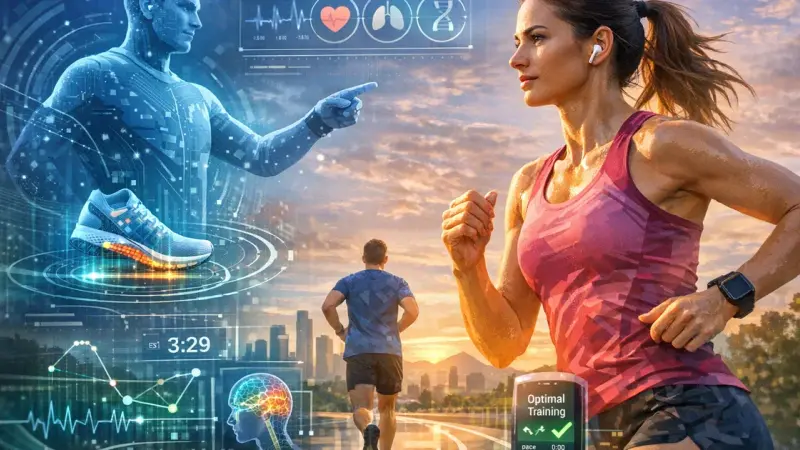
We're at the beginning of AI coaching, not the end. Here's where it's going.
Current State of AI Coaching
What We Have Now
Current AI coaching capabilities:
- Training plan generation from goals and fitness data
- Workout prescription and adjustment
- Basic recovery monitoring (HRV, resting HR)
- Performance tracking and prediction
- Load management and injury risk flagging
Limitations:
- Limited data integration
- Rule-based elements alongside ML
- Imperfect personalization
- Narrow focus on training data
The Foundation Is Set
Today's AI coaching demonstrates:
- Personalization is valuable
- Data-driven adjustment works
- Automation can handle routine decisions
- Accessibility to quality training guidance
This foundation enables future development.
Near-Term Developments (1-3 Years)
Better Data Integration
Coming soon:
- Sleep quality integration (not just duration)
- Stress detection from wearables
- Nutrition tracking connection
- Environmental condition automation
Result: More comprehensive picture of your state, better-informed decisions.
Natural Language Interaction
Current: Click buttons, view dashboards.
Coming: "How should I adjust my training this week? I have a big work deadline."
Conversational AI that understands context and provides nuanced guidance.
Improved Injury Prediction
Advancing:
- More sophisticated pattern recognition
- Earlier warning signals
- More accurate risk quantification
- Better preventive recommendations
Goal: Catching injury risk weeks earlier with higher accuracy.
Race Prediction Refinement
Improvements:
- Tighter confidence intervals
- Better condition adjustment
- More accurate course-specific predictions
- Dynamic updating as race approaches
Result: Race predictions you can trust for pacing decisions.
Medium-Term Possibilities (3-7 Years)
Comprehensive Health Integration
Beyond training:
- Sleep optimization recommendations
- Nutrition timing and composition
- Stress management guidance
- Recovery practice suggestions
AI becomes holistic performance coach, not just training planner.
Social and Community Learning
Leveraging collective data:
- "Runners similar to you improved most with this approach"
- "This workout works well for people in your situation"
- Community-driven training insights
Your individual data combined with millions of others for better recommendations.
Biomechanical Analysis
Currently difficult: Running form analysis requires specialized equipment.
Future:
- Phone camera form analysis
- Wearable gait sensors
- Real-time form feedback
- Injury risk from movement patterns
Form coaching becomes accessible to every runner.
Predictive Health Monitoring
Beyond training optimization:
- Early disease detection from training patterns
- Cardiovascular health tracking
- Fatigue and recovery biological markers
- Integration with medical care
Running data as health monitoring tool.
Voice Coaching During Runs
Real-time guidance: "You're 10 seconds fast for this interval. Ease back slightly." "Your cadence has dropped. Try picking it up." "Good pacing. 2 miles to go at current effort."
AI coach in your ear providing live feedback.
Long-Term Vision (10+ Years)
True Individualized Physiology Models
Current: Population models with individual calibration.
Future: Deeply personalized models of YOUR specific physiology—your mitochondrial density, your fiber type distribution, your enzymatic efficiency.
Training prescription at cellular level.
Genetic Integration
Possibility: Genetic testing informs training approach.
- Your specific response tendencies
- Optimal training types for your genes
- Injury predispositions
- Recovery characteristics
Controversial but powerful personalization potential.
Brain-Training Integration
Mental aspects:
- Motivation optimization
- Focus training
- Pain tolerance development
- Race-day mental preparation
AI coaching addresses mental performance, not just physical.
Longevity Optimization
Beyond race performance:
- Maximizing healthy years of running
- Preventing long-term damage
- Optimizing running for overall lifespan
- Sustainable lifetime athletic practice
AI optimizes for decades, not just next race.
Seamless Integration
Technology disappears: No apps to check, no data to enter. AI just knows—from ambient sensors, integrated devices, passive monitoring.
Training guidance appears when needed, without management overhead.
What Won't Change
The Fundamentals
No technology changes:
- You have to actually run
- Consistency matters most
- Adaptation takes time
- Effort is required
- Recovery is essential
AI makes these more efficient. It doesn't replace them.
The Experience
Running will still be:
- Physical effort
- Mental challenge
- Outdoor (or treadmill) movement
- Community and social activity
- Personal achievement
Technology enhances the journey. It doesn't replace the experience.
Human Elements
AI won't replace:
- The satisfaction of achievement
- The joy of a good run
- The community of running
- The personal challenge
- The human coach relationship (for those who want it)
Running remains fundamentally human.
The Simple Option
You can always: Just run. No watch, no app, no AI.
Running predates all technology and will outlast any specific implementation.
Technology is optional. Running is not.
Preparing for the Future
Embrace Data Collection
Start now: Consistent tracking creates valuable history.
Future AI will be more powerful with more data.
Stay Informed
Technology evolves: New tools and capabilities emerge regularly.
Understanding options helps you use them effectively.
Keep Perspective
Technology serves training. Training serves running. Running serves life.
Don't lose sight of the hierarchy.
Enjoy the Journey
Running is already good. Future improvements make it better, but today's running is worth doing.
Don't wait for perfect technology to enjoy your running now.
The Opportunity
Democratization of Coaching
What's coming: Elite-level training guidance available to everyone.
- Personalized coaching without premium cost
- Expert-level analysis from your phone
- Injury prevention that actually works
- Optimal training regardless of location
The gap between recreational and elite training resources narrows.
Better Health Outcomes
Running as medicine: AI optimization maximizes health benefits while minimizing risks.
- Fewer injuries
- Better cardiovascular outcomes
- Sustainable lifetime practice
- Running that enhances rather than damages
More Runners Succeeding
Ultimate result: More people achieving their running goals.
- First-timers completing races
- Age-groupers setting PRs
- Masters runners staying healthy
- Everyone training smarter
AI coaching raises the tide for all runners.
The future of running training is bright—more personalized, more integrated, more effective. AI coaching will become more powerful, more accessible, and more comprehensive. But the essence of running—the effort, the journey, the achievement—remains unchanged. Technology enhances the path; you still have to walk (or run) it.
Start your AI-powered running journey on your dashboard.
Key Takeaway
AI coaching technology is evolving rapidly, with improvements in data integration, prediction accuracy, and personalization on the horizon. While the tools will become more powerful, the fundamentals of running—effort, consistency, patience—will remain unchanged. Technology enhances the journey; it doesn't replace it.
Frequently Asked Questions
Will AI replace human coaches entirely?
How soon will these advances happen?
Will AI coaching become mandatory for competitive runners?
What about data privacy concerns?
Will running become too technological?
References
- Technology trend research
- Sports science developments
- TrainingPlan methodology