
Contents
Nutrition for Long Runs: What to Eat Before, During, and After
Master long run fueling with specific guidelines for what to eat before, during, and after runs over 90 minutes. Includes timing, amounts, and product recommendations.

Quick Hits
- •Eat 2-3 hours before: 50-100g carbs with minimal fat/fiber (toast, banana, oatmeal)
- •Start fueling at 45-60 minutes for runs over 90 minutes—don't wait until you're depleted
- •Aim for 30-60g carbs per hour during runs over 90 minutes (1-2 gels or equivalent)
- •Practice race nutrition in training: your gut needs training just like your legs
- •Post-run window matters: eat carbs + protein within 30-60 minutes for optimal recovery
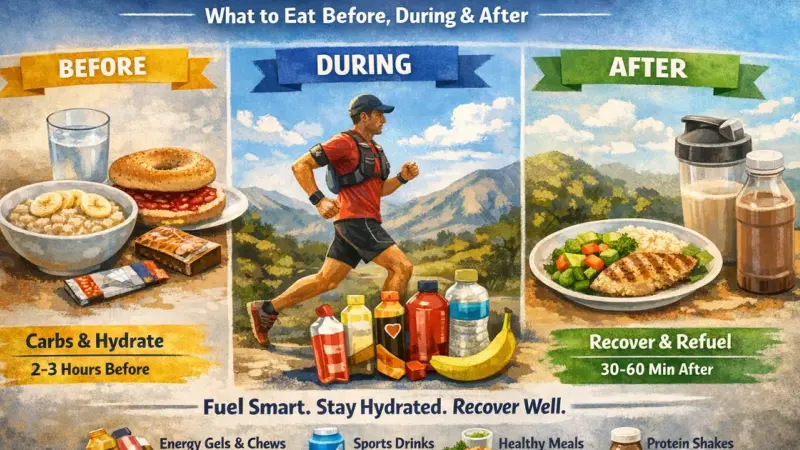
The long run is the cornerstone of distance training. But the best long run in the world won't help you if you bonk halfway through because you didn't eat, or spend the afternoon on the bathroom floor because you ate the wrong thing.
Fueling long runs is a skill. Here's how to do it right.
Why Long Run Nutrition Matters
The Energy Problem
Your body stores about 2,000 calories of glycogen (carbohydrates) in muscles and liver. During running, you burn roughly:
- Easy pace: 80-100 calories per mile
- Moderate pace: 100-120 calories per mile
- Hard pace: 120+ calories per mile
A 20-mile long run at easy pace burns ~2,000 calories. That's your entire glycogen store.
The math is simple: Without additional fueling, you'll run out of easily accessible energy during runs over 90-120 minutes. When glycogen depletes, you "bonk"—that sudden wall of fatigue, confusion, and inability to continue.
Beyond Energy
Proper nutrition also affects:
- Performance: Fueled runs feel better and go faster
- Recovery: Well-fed runs cause less muscle damage
- Adaptation: Your body needs fuel to adapt to training
- Immune function: Underfueled training suppresses immunity
- Injury risk: Chronic underfueling increases bone stress injuries
Before the Long Run
Timing
Ideal: 2-3 hours before the run
This allows time for digestion while ensuring glycogen stores are topped off.
If you only have 1-2 hours: Eat less, keep it simple.
If you only have 30-60 minutes: Small snack only (banana, few crackers).
What to Eat
Goals:
- 50-100g of carbohydrates
- Minimal fat (slows digestion)
- Minimal fiber (can cause GI issues)
- Moderate protein is okay
- Familiar foods only
Good Pre-Long Run Options:
| Food | Carbs | Notes |
|---|---|---|
| 2 slices toast + jam | ~50g | Classic, easy to digest |
| Medium bagel | ~50g | Dense carbs, low fiber |
| Oatmeal (1 cup cooked) + banana | ~50g | Warm, settling |
| Banana + small granola bar | ~45g | Quick option |
| Rice + eggs | ~45g | Great for sensitive stomachs |
| Pancakes (2 medium) | ~40g | Race morning favorite |
| English muffin + honey | ~35g | Light option |
Foods to Avoid Before Long Runs:
- High-fiber cereals
- Vegetables (especially raw)
- Fatty foods (bacon, sausage, fried foods)
- High-fat dairy
- Spicy foods
- Excessive coffee (beyond your normal amount)
- New foods you haven't tested
Hydration Before
The night before:
- Hydrate normally through the evening
- Stop 2-3 hours before bed
- Urine should be light yellow
Morning of:
- 8-16 oz with breakfast
- 8 oz 30-60 minutes before start
- Stop drinking ~30 minutes before to avoid full bladder
You should start the run hydrated but not waterlogged.
During the Long Run
When to Start Fueling
The 45-60 minute rule:
Begin consuming carbohydrates at 45-60 minutes into runs that will exceed 90 minutes total.
Why not wait?
- Absorption takes time—fuel consumed at 45 minutes hits your system around 60-75 minutes
- Starting early prevents the glycogen hole
- Playing catch-up never works as well as staying ahead
Why not earlier?
- Under 45 minutes, your pre-run stores are sufficient
- Too early can cause GI issues
- Unnecessary for shorter runs
How Much to Consume
General guideline: 30-60g carbs per hour
| Run Duration | Carbs/Hour | Practical Amount |
|---|---|---|
| 90-120 min | 30-45g | 1 gel + water, or sports drink |
| 2-3 hours | 45-60g | 1.5-2 gels/hour, or gel + sports drink |
| 3+ hours | 60-90g | 2-3 gels/hour (trained gut required) |
The absorption limit:
Most runners can only absorb ~60g/hour of a single carb type (glucose). To exceed 60g/hour, you need a mix of glucose AND fructose (different absorption pathways). Many gels and drinks are formulated for this.
What to Consume
Gels
- Convenient, measured portions
- ~20-25g carbs per gel
- Requires water to digest properly
- Many options: GU, Maurten, Science in Sport, Huma, etc.
Chews/Gummies
- Easier on stomach for some
- ~25-30g per serving
- Takes longer to consume
- Options: Clif Bloks, GU Chews, Skratch Chews
Sports Drinks
- Hydration + carbs combined
- ~15-25g per 8oz
- Easier to consume while running
- Watch for excessive sugar concentration
Real Food
- Bananas (half = ~15g carbs)
- Dates (2-3 = ~20g carbs)
- Rice balls (~30g carbs)
- Fig bars (~20g each)
- Baby food pouches (seriously—they work)
What works best varies by person. Some runners can only tolerate gels. Others need real food. The only way to know is to practice.
Hydration During
General guideline: 4-8 oz every 15-20 minutes
Factors that increase needs:
- Hot/humid conditions
- Heavy sweating
- Faster pace
- Larger body size
Factors that decrease needs:
- Cool weather
- Light sweater
- Slower pace
- Access to shade
Electrolytes:
For runs over 90 minutes, add sodium:
- Sports drinks contain electrolytes
- Electrolyte tablets/powder for plain water
- Salt tabs for heavy sweaters
- Many gels contain sodium
Target: ~300-500mg sodium per hour for long efforts in heat.
Fueling Timing Strategy
Example for 2.5-hour long run:
| Time | Action |
|---|---|
| 0:00 | Start run (well-fueled from breakfast) |
| 0:20 | Sip water |
| 0:45 | First gel + 4-6 oz water |
| 1:00 | Sip water or sports drink |
| 1:15 | Sip water |
| 1:30 | Second gel + 4-6 oz water |
| 1:45 | Sip water or sports drink |
| 2:00 | Third gel (optional, if feeling depleted) |
| 2:15 | Sip water |
| 2:30 | Finish |
Key principle: Consistent, small amounts beat large, infrequent amounts.
Common During-Run Mistakes
1. Waiting too long to start
- By the time you feel depleted, it's too late
- Start at 45-60 minutes, not when you're tired
2. Taking gels with sports drink
- Creates very high sugar concentration
- Often causes stomach distress
- Gel = water, not sports drink
3. Not practicing in training
- Your race nutrition should be tested many times before race day
- Every long run is a nutrition rehearsal
4. Forgetting electrolytes
- Water alone dilutes blood sodium over time
- Can cause hyponatremia (dangerous low sodium)
- Add sodium for anything over 90 minutes
5. Eating too much at once
- Your stomach can only process so much
- Small, frequent beats large, occasional
After the Long Run
The Recovery Window
The first 30-60 minutes after a long run is when your body is most receptive to nutrition.
During this window:
- Glycogen synthesis is enhanced
- Muscle repair is accelerated
- Rehydration is more effective
Don't skip this window. Even if you're not hungry, get something in.
What to Eat Post-Long Run
Goals:
- Carbohydrates to replenish glycogen (0.5-0.7g per lb body weight)
- Protein for muscle repair (15-25g)
- Fluids to rehydrate
- Sodium to replace sweat losses
Immediate (0-30 minutes):
If you can't eat a meal right away:
- Chocolate milk (carbs + protein)
- Recovery shake
- Banana + protein drink
- Greek yogurt + granola
Within 60-90 minutes:
A real meal with:
- Complex carbs (rice, pasta, bread, potatoes)
- Lean protein (chicken, fish, eggs, tofu)
- Some fat is fine
- Vegetables
Good Recovery Meal Examples:
| Meal | Carbs | Protein | Notes |
|---|---|---|---|
| Scrambled eggs + toast + fruit | ~50g | ~20g | Breakfast classic |
| Chicken rice bowl | ~60g | ~30g | Easy to prepare |
| Pasta with meat sauce | ~70g | ~25g | Runner favorite |
| Burrito/burrito bowl | ~60g | ~25g | Convenient option |
| Pancakes + eggs + bacon | ~50g | ~25g | Reward meal |
| Smoothie bowl with protein | ~45g | ~25g | Easy if appetite is low |
Rehydration After
How much to drink:
Weigh yourself before and after a long run. For every pound lost:
- Drink 16-24 oz of fluid
- Include some sodium (food or electrolyte drink)
For practical purposes: Drink steadily until urine is light yellow. This usually takes 2-4 hours.
Signs of dehydration to watch:
- Dark urine
- Headache
- Continued fatigue
- Dizziness
Training Your Gut
Why Practice Matters
Your gastrointestinal system adapts to training just like your cardiovascular system. A gut that's never practiced digesting while running will rebel on race day.
Gut training adaptations:
- Increased blood flow to GI tract during exercise
- Better tolerance of food while running
- More efficient absorption of carbohydrates
- Reduced risk of GI distress
How to Train Your Gut
Start small:
- Week 1-2: Take a few sips of sports drink during long runs
- Week 3-4: Add a small amount of gel (half a gel)
- Week 5-6: Full gel at appropriate timing
- Week 7+: Practice your full race-day strategy
Build gradually:
- Increase amounts slowly
- Note what causes issues
- Give your gut time to adapt
Consistency matters:
- Practice every long run
- Use the same products you'll use on race day
- Same timing, same amounts
Finding What Works for You
Variables to test:
- Gel brand (formulations vary significantly)
- Gel vs. chews vs. real food
- Sports drink vs. water + gel
- Timing intervals
- Total amounts
Keep a fueling log:
- What you consumed
- When you consumed it
- How you felt
- Any GI issues
After several long runs, patterns emerge. Some runners do great on gels; others need real food. Some can handle 60g/hour; others max out at 40g. There's no universal answer—only what works for you.
Special Considerations
Fasted Long Runs
The case for occasional fasted long runs:
- Trains fat oxidation
- Teaches body to spare glycogen
- Some runners feel better running on empty stomach
The case against regular fasted long runs:
- Impairs performance
- Increases muscle breakdown
- Can lead to chronic underfueling
- Reduces training quality
Practical approach:
- Easy long runs under 90 minutes: fasted is okay occasionally
- Long runs over 90 minutes: fuel them
- Quality long runs (with tempo, progression): always fuel
Hot Weather
Heat increases both fluid and fueling needs:
Hydration: Increase intake by 25-50% in hot conditions
Fueling: Heat can suppress appetite but you still need carbs. Liquid carbs (sports drinks) may be easier than gels.
Sodium: Increase significantly—heavy sweaters can lose 1,000+ mg sodium per hour.
Early Morning Long Runs
If you run early and can't eat 2-3 hours before:
Option 1: Wake early enough
- Set alarm for 2.5-3 hours before
- Eat, go back to sleep (or rest)
- This works for many race-morning situations
Option 2: Dinner prep
- Eat a larger, carb-heavy dinner the night before
- Wake up and have a small snack (banana, toast)
- Start fueling during the run earlier than usual
Option 3: Fasted start, early fueling
- Start with just water or a few sips of sports drink
- Begin gel intake at 30-40 minutes instead of 45-60
Sensitive Stomach
If you struggle with GI issues during long runs:
Product choices:
- Try multiple gel brands (ingredients vary)
- Consider real food (often gentler)
- Maltodextrin-based products may be easier than fructose-heavy ones
- Maurten hydrogel technology works for some sensitive stomachs
Strategies:
- Always take fuel with plain water
- Slow down slightly while consuming
- Smaller, more frequent amounts
- Avoid high-fiber foods the day before
Root causes to investigate:
- Are you running too hard? (Intensity diverts blood from gut)
- Are you dehydrated when you start?
- Have you practiced enough?
Product Recommendations by Category
Gels
Popular options:
- GU Energy Gel (original, widely available)
- Maurten Gel 100 (hydrogel technology, easy on stomach)
- Science in Sport (thinner consistency)
- Huma Chia Energy Gel (real food-based)
- Precision Hydration PF 30 (mild flavor)
Chews
- Clif Bloks (widely available, multiple flavors)
- GU Energy Chews
- Skratch Labs Energy Chews
Sports Drinks
- Gatorade/Powerade (widely available)
- Skratch Labs (lower sugar)
- Nuun Endurance (lighter taste)
- Maurten Drink Mix (hydrogel)
- Tailwind (all-in-one fuel)
Electrolytes
- Nuun tablets
- LMNT packets
- Precision Hydration tablets
- Salt Stick capsules
Remember: What works for someone else may not work for you. The only way to find your ideal fueling is to test during training.
Long run nutrition doesn't need to be complicated. Eat before, fuel during runs over 90 minutes, recover after. Practice your race-day strategy every single long run.
When race day comes, you'll know exactly what to eat, when to eat it, and how your body will respond. That confidence is worth all the practice.
For the complete guide to nutrition for runners, see the Running Nutrition Complete Guide.
Plan your race-day nutrition with our Race Nutrition Plan Template.
Key Takeaway
Long run nutrition isn't complicated, but it is essential. Eat easily digestible carbs before, fuel every 45-60 minutes during runs over 90 minutes, and prioritize carbs plus protein within an hour after. The most important principle: practice your race-day nutrition strategy during training long runs. Your stomach needs as much training as your legs.
Frequently Asked Questions
Should I eat before a long run?
Can I do long runs fasted?
How much should I drink during a long run?
What if gels upset my stomach?
Do I need sports drinks or is water enough?
References
- Sports nutrition research
- Endurance fueling studies
- Marathon nutrition guidelines