
Contents
Improving Running Economy: How to Run Faster with Less Effort
Running economy is the secret weapon of elite runners. Learn what it is, why it matters, and the proven methods to improve your efficiency.

Quick Hits
- •Running economy is how much oxygen you use at a given pace—lower is better
- •Two runners with identical VO₂max can differ 30% in race performance due to economy
- •Economy improves with consistent training, strength work, and accumulated mileage
- •Intentionally changing form is tricky—most improvements happen naturally over time
- •Lightweight shoes and racing flats directly improve economy (less weight to move)
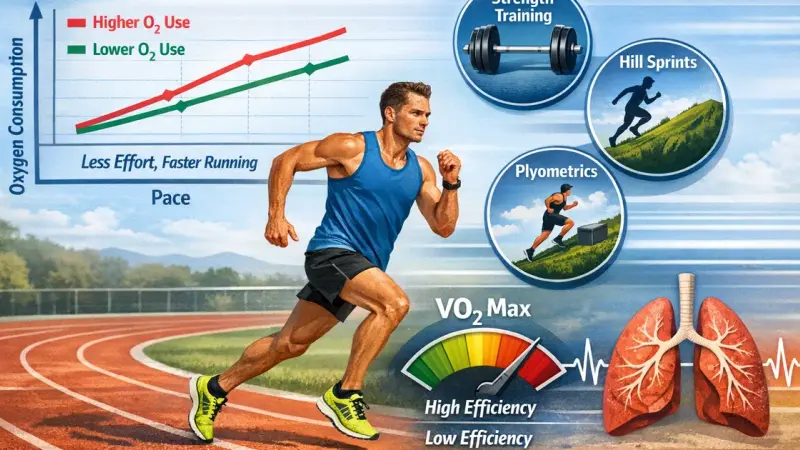
You can have a huge VO₂max and still lose to someone with better running economy.
Here's why this metric matters and how to improve it.
What Is Running Economy?
The Definition
Running economy (RE): The oxygen cost to run at a given speed.
Think of it as: Fuel efficiency. How much energy do you burn to maintain a pace?
The Measurement
Measured in lab as oxygen consumption (VO₂) at submaximal pace.
Better economy = lower oxygen use at same pace
Example:
- Runner A uses 45 ml/kg/min at 7:00/mile
- Runner B uses 40 ml/kg/min at 7:00/mile
- Runner B has better economy (uses less oxygen for same pace)
Why It Matters
The performance equation:
Performance = VO₂max × Lactate Threshold × Running Economy
Two runners with identical VO₂max can differ 30% in race times based on economy alone.
Elite runners often don't have the highest VO₂max values—they have exceptional economy.
Factors That Affect Economy
Things You Can't Change
Biomechanical traits:
- Limb length proportions
- Tendon elasticity (partially genetic)
- Achilles tendon moment arm
- Joint flexibility range
Some genetic advantages are real. But trainable factors matter more for most runners.
Things You Can Change
Accumulated training (huge factor):
- Years of consistent running
- Total lifetime mileage
- Neuromuscular adaptations
Strength and power:
- Muscle stiffness (good for running)
- Ground contact efficiency
- Force production
Running form elements:
- Cadence optimization
- Vertical oscillation
- Ground contact time
External factors:
- Shoe weight
- Body weight
- Altitude acclimatization
How Economy Improves
The Natural Adaptation
With consistent training:
- Muscles become more efficient
- Tendons store and return energy better
- Nervous system optimizes firing patterns
- Form naturally refines
This is why veterans often outperform younger runners with higher VO₂max.
The Timeline
| Experience | Economy Status |
|---|---|
| Beginner (0-2 years) | Improving rapidly |
| Intermediate (2-5 years) | Steady improvement |
| Experienced (5-10 years) | Approaching optimization |
| Elite/lifetime runner | Highly optimized |
Economy can continue improving for 10+ years of running.
Training Methods to Improve Economy
1. Consistent Mileage
The foundation.
More miles = more neuromuscular repetitions = better efficiency.
This is why simply running consistently for years improves economy, even without specific interventions.
2. Strength Training
Particularly effective:
- Heavy resistance training (squats, deadlifts)
- Improves muscle-tendon stiffness
- Better force production per stride
Research shows: 8-12 weeks of strength training can improve economy 4-8%.
Key exercises:
- Squats
- Deadlifts
- Lunges
- Step-ups
- Calf raises
3. Plyometrics
Explosive jump training improves:
- Tendon elasticity
- Ground reactive force
- Power generation
Examples:
- Bounding
- Box jumps
- Single-leg hops
- Depth jumps
Caution: Plyometrics are high-impact. Progress gradually.
4. Hill Sprints
Short, maximal efforts uphill:
- Build power
- Improve running-specific strength
- Reinforce drive phase mechanics
Protocol:
- 8-10 seconds all-out uphill
- Full recovery walk back
- 6-10 repetitions
- 1-2 times per week
5. Strides
Regular inclusion of strides:
- Reinforces efficient mechanics at speed
- Neuromuscular recruitment practice
- Keeps fast-twitch fibers engaged
After easy runs: 4-6 x 20-30 seconds at controlled fast pace.
6. Interval Training
Running at varied paces:
- Develops efficiency across speed range
- Improves neuromuscular coordination
- Different than pure aerobic benefits
Form Considerations
The Caution on Form Changes
Your body has optimized its movement pattern over thousands of miles.
Deliberate changes:
- Can temporarily worsen economy
- Require cognitive effort
- May not be appropriate for your body
Better approach: Let form improve naturally through strength and drills.
Elements Worth Considering
Cadence:
- Very low cadence (< 160) might benefit from increase
- Small increases (5-10%) are safer than dramatic changes
- Many runners naturally have appropriate cadence
Vertical oscillation:
- Excessive bouncing wastes energy
- Strength training often reduces this naturally
- Don't force changes—it resolves with fitness
Arm swing:
- Should complement leg action
- Excessive cross-body motion wastes energy
- Usually self-corrects with experience
The Role of Drills
Running drills can improve:
- Proprioception
- Coordination
- Range of motion
- Neural patterns
Examples:
- High knees
- Butt kicks
- A-skips, B-skips
- Straight leg bounds
When: After warm-up, 2-3 times per week.
External Factors
Shoe Weight
Real and measurable impact:
- Each 100g reduction ≈ 1% economy improvement
- Racing flats vs. training shoes = significant difference
- Why super shoes have revolutionized racing
Application: Train in moderately heavy shoes, race in light ones.
Body Weight
Each pound costs energy.
But caution:
- Unhealthy weight loss harms performance
- Under-fueling impairs training adaptation
- Optimal race weight ≠ lowest weight
Focus on: Healthy body composition, not minimum weight.
Altitude
Economy improves with altitude acclimatization:
- Better oxygen utilization
- Improved muscle efficiency
- Why altitude camps exist
Testing Economy
Lab Testing
Gold standard:
- VO₂ measured at submaximal pace
- Requires metabolic cart
- Precise but expensive
Field Indicators
Proxy measures:
- Heart rate at standard pace (lower is better economy)
- Perceived effort at pace over time
- Race performances vs. training metrics
Progress Tracking
Signs of improved economy:
- Same pace feels easier
- Lower heart rate at same pace
- Better race results without higher training load
- Longer time to fatigue at same pace
Use your dashboard to track pace vs. heart rate trends over time.
Program Integration
Sample Economy-Focused Week
| Day | Workout | Economy Element |
|---|---|---|
| Monday | Strength training | Muscle stiffness |
| Tuesday | Easy + strides | Neuromuscular |
| Wednesday | Tempo run | Running-specific |
| Thursday | Easy + drills | Coordination |
| Friday | Rest | Recovery |
| Saturday | Long run | Mileage accumulation |
| Sunday | Easy + hill sprints | Power development |
Long-Term Approach
Economy improvement is measured in months and years, not weeks.
Priorities:
- Consistent mileage (primary driver)
- Regular strength training
- Strides and drills
- Patience
Running economy may be the most undertrained aspect of running fitness. While everyone focuses on VO₂max and threshold, economy improvements can continue for a decade or more. Build it through consistent training, targeted strength work, and trust that your body is becoming more efficient with every mile.
Track your efficiency metrics on your dashboard.
Key Takeaway
Running economy—how efficiently you use oxygen at race pace—can be the difference between two equally fit runners. Improve it through consistent training, strength work (especially plyometrics), strides and drills, and patience. Unlike VO₂max which has genetic limits, economy can improve throughout your running career.
Frequently Asked Questions
What exactly is running economy?
Can running economy be improved?
Does body weight affect running economy?
Should I change my running form for better economy?
How long does it take to improve economy?
References
- Running economy research
- Biomechanics studies
- Elite athlete analysis