
Contents
Periodization for Normal Humans: Base → Build → Peak Without Overthinking
A practical guide to structuring your training year. Learn how to move from base building through race preparation without complicated periodization schemes.

Quick Hits
- •Periodization means organizing training into phases that build toward a goal race
- •Base → Build → Peak → Race → Recovery is the fundamental pattern
- •Base phase is all about volume and easy running; speed comes later
- •Most runners should only peak for 1-2 races per year; you can't stay peaked forever
- •Keep it simple: you don't need complicated schemes to run faster
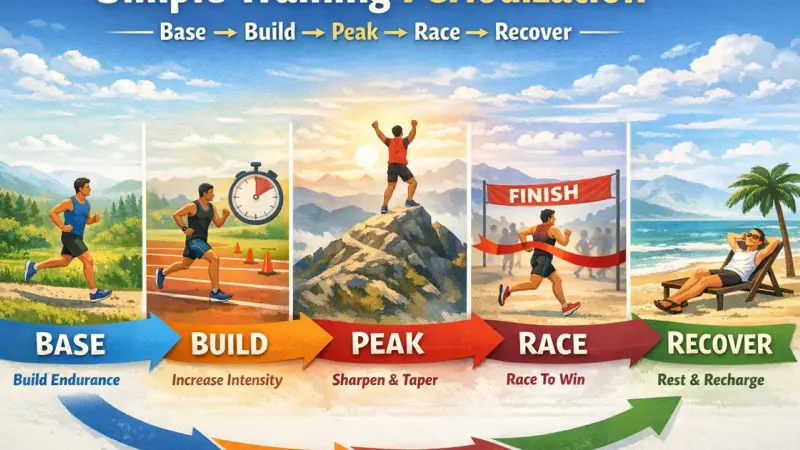
The word "periodization" sounds intimidating—like something only elite coaches understand. But at its core, it's just organized training: easy stuff first, hard stuff later, peak for race day.
You don't need a sports science degree to structure your training well. You just need a framework.
What Is Periodization?
Periodization is dividing your training into phases (periods) that build on each other to produce peak performance at a target race.
The fundamental insight: you can't train everything at once. Different fitness qualities require different training stimuli, and trying to develop all of them simultaneously produces mediocre results.
Instead, you train in phases:
- Build general fitness first
- Add race-specific work later
- Peak at the right moment
- Recover before starting again
The Basic Pattern
One simplified way to picture a training cycle is:
BASE → BUILD → PEAK → RACE → RECOVER → (repeat)
The labels and order can differ between programmes. For a concrete software example, see how TrainingPlan chooses phases, including what changes when fewer weeks are available and why a scheduled phase is not a readiness assessment.
Phase 1: Base Building
The base phase is the foundation. Skip it or rush it, and everything built on top is shaky.
What Happens in Base Phase
Focus:
- Easy running volume
- Aerobic development
- Structural adaptation (muscles, tendons, bones)
- Consistency and habit building
What you're doing:
- Lots of easy miles
- Long runs building progressively
- Minimal to no structured speedwork
- Strides and light faster running okay
What you're NOT doing:
- Interval workouts
- Tempo runs at race-specific intensity
- Racing (except for fun, not performance)
Duration
- New runners: 8-12+ weeks
- Returning from time off: 6-8 weeks
- Between race cycles: 4-6 weeks
For more on building your aerobic foundation, see Aerobic Base 101.
Signs You're Ready to Move On
- Easy runs feel genuinely easy
- You're recovering well between runs
- Mileage is consistent and sustainable
- No lingering injuries or chronic fatigue
Phase 2: Build Phase
The build phase is where training gets more specific. You're developing the fitness qualities needed for your goal race.
What Happens in Build Phase
Focus:
- Adding race-relevant intensity
- Developing threshold and VO2max
- Continuing long run progression
- Maintaining volume while adding quality
What you're doing:
- One tempo or threshold workout per week
- One interval session per week (later in phase)
- Long runs becoming more race-specific
- Easy runs for recovery between quality
What you're NOT doing:
- All-out racing (save it for peak phase)
- Maximum volume AND maximum intensity
- Neglecting recovery
Build Phase Intensity Distribution
| Week in Phase | Easy | Moderate | Hard |
|---|---|---|---|
| Week 1-2 | 85% | 10% | 5% |
| Week 3-4 | 80% | 12% | 8% |
| Week 5-6 | 78% | 12% | 10% |
| Week 7-8 | 75% | 15% | 10% |
Even at peak quality, 75%+ of your running is still easy.
Duration
- Short races (5K-10K): 6-8 weeks
- Half marathon: 8-10 weeks
- Marathon: 10-14 weeks
Common Build Phase Mistakes
Too much, too fast: Adding intervals, tempo, AND long runs all at once. Build in one quality session first, add the second after 2-3 weeks.
Neglecting easy running: Getting excited about workouts and running "medium" on easy days. This leads to fatigue without optimal adaptation.
Skipping cutback weeks: The build phase is demanding. Plan recovery weeks every 3-4 weeks.
Phase 3: Peak Phase
The peak phase is about sharpening—not building more fitness. The hay is in the barn; now you're preparing to race.
What Happens in Peak Phase
Focus:
- Race-specific workouts at goal pace
- Maintaining (not building) volume
- Mental preparation
- Fine-tuning race execution
What you're doing:
- Workouts that simulate race effort
- Practicing race-day nutrition and gear
- Tune-up races (optional)
- Staying fresh while staying sharp
What you're NOT doing:
- Building more base (too late)
- Maximum volume training
- Major fitness experiments
Duration
- 5K-10K: 2-3 weeks
- Half marathon: 3-4 weeks
- Marathon: 3-4 weeks
Peak Phase Reality Check
Here's what many runners get wrong: you can't stay peaked forever.
Peak performance is a temporary state. Your body can only maintain it for a few weeks before fatigue catches up or fitness starts to fade.
This is why elite runners don't race all-out every weekend. They peak for major championships and treat other races as preparation.
Phase 4: Taper
The taper is the final preparation: reducing training volume while maintaining enough intensity to stay sharp.
What Happens in Taper
Focus:
- Reducing volume significantly (40-60% by race week)
- Maintaining some intensity for sharpness
- Rest, sleep, and recovery
- Mental preparation
What you're doing:
- Shorter versions of your regular workouts
- Easy runs with occasional strides
- Lots of rest
- Trusting your training
What you're NOT doing:
- Major workouts
- Experimenting with anything new
- Adding miles because you feel too good
Taper Duration by Race
| Race Distance | Taper Length |
|---|---|
| 5K | 5-7 days |
| 10K | 7-10 days |
| Half Marathon | 10-14 days |
| Marathon | 14-21 days |
Use the Taper Calculator to plan your specific reduction.
The Taper Crazies
Almost every runner feels weird during taper:
- Paranoid they're losing fitness
- Antsy with extra energy
- Convinced something is wrong
This is normal. The taper is working. Trust it.
Phase 5: Recovery
After your race, you need to recover before starting the next cycle.
What Happens in Recovery
Focus:
- Physical recovery from race stress
- Mental refreshment
- Easy, unstructured running
- Enjoying the accomplishment
What you're doing:
- Complete rest (1-3 days)
- Very easy running when ready
- No structured workouts
- Reflection on what worked
Recovery Duration by Race
| Race Distance | Recovery Phase |
|---|---|
| 5K | 1 week |
| 10K | 1-2 weeks |
| Half Marathon | 2-3 weeks |
| Marathon | 3-4 weeks |
See the Race Recovery Calculator for personalized recovery timelines.
Putting It All Together
Sample Year Structure
For a runner targeting two goal races—a spring half marathon and a fall marathon:
November-January: Base Phase 1 (8 weeks)
- Build mileage gradually
- Easy running focus
- Holiday break flexibility
February-March: Build Phase 1 (8 weeks)
- Add threshold workouts
- Long runs building to 12-14 miles
- One interval session late in phase
April: Peak + Taper (3 weeks)
- Race-specific workouts
- 2-week taper
- Spring half marathon
May: Recovery + Transition (3 weeks)
- Easy running
- Enjoy spring weather
- Restart base work
June-July: Base Phase 2 (6 weeks)
- Rebuild to higher volume
- Summer heat adaptation
August-September: Build Phase 2 (10 weeks)
- Marathon-specific training
- Long runs to 20-22 miles
- Quality threshold and tempo work
October: Peak + Taper (3 weeks)
- Final marathon prep
- 3-week taper
- Fall marathon
November: Recovery (3-4 weeks)
- Full recovery
- Reflection and planning
- Restart cycle
Simplified Structure
If you race more casually, here's an even simpler approach:
- Always running easy? → Add a long run
- Long runs feeling good? → Add one quality session
- Quality sessions going well? → You're in build phase
- Race coming up? → Reduce volume, maintain sharpness
- Just raced? → Rest and recover
- Ready to start over? → Back to base
What About Running Year-Round?
Not everyone follows a structured racing calendar. If you just run for fitness and fun, periodization still applies loosely:
- Higher volume, lower intensity seasons (base-like phases)
- Lower volume, higher quality seasons (build-like phases)
- Race when you feel like it (just be ready to recover after)
The key insight remains: you can't do everything at once. Even without goal races, alternating between volume focus and intensity focus produces better results than "medium everything, all the time."
Common Periodization Mistakes
Racing Too Often
Every hard race requires recovery. Racing every weekend means you're never fully recovered—and never fully peaked.
Fix: Designate 1-3 races per year as "A" races (go all out). Others are "B" races (solid effort) or "C" races (training runs in a race environment).
Peaking Too Long
Trying to maintain peak fitness for months doesn't work. You'll either fade, get injured, or burn out.
Fix: Peak for 2-3 weeks maximum. Plan your "A" races with recovery time between.
Skipping Base
Excitement about goal races leads to jumping straight into quality work. Without a base, the quality work is less effective and more risky.
Fix: Even if it means a shorter build phase, do SOME base work before adding intensity.
Over-Complicating It
Some training plans have six phases with specific names and complex progressions. For most recreational runners, this is overkill.
Fix: Stick to Base → Build → Peak → Race → Recover. That's sufficient for virtually everyone.
How Periodization Applies to Your Goals
Goal: PR in a 5K
- Base: 6-8 weeks, focus on consistent mileage
- Build: 6-8 weeks, add VO2max intervals and threshold
- Peak: 2-3 weeks, 5K-specific workouts
- Taper: 5-7 days
- Recover: 1 week
Goal: First Half Marathon
- Base: 8-10 weeks, build to 30+ miles/week
- Build: 8-10 weeks, long runs to 12-14 miles
- Peak: 3 weeks, race-pace work
- Taper: 10-14 days
- Recover: 2-3 weeks
Goal: BQ Marathon
- Base: 8-12 weeks, build to 45-55+ miles/week
- Build: 10-14 weeks, long runs to 20-22 miles
- Peak: 3-4 weeks, marathon-pace sessions
- Taper: 2-3 weeks
- Recover: 3-4 weeks
Periodization isn't complicated—it's just common sense organized. Build your base, add intensity gradually, peak for your race, then recover before starting again. Following this simple framework will get you further than any elaborate scheme you won't stick to.
Key Takeaway
Periodization doesn't need to be complicated. Follow a simple progression from easy volume to race-specific intensity, peak for your goal race, then recover before starting again. The structure matters more than the specific details.
Frequently Asked Questions
How long should each training phase be?
Can I skip the base phase if I'm already fit?
How many races can I peak for in a year?
What if my race is only 8 weeks away?
Should I periodize differently for 5K vs. marathon?
References
- Tudor Bompa periodization theory
- Joe Friel's Training Bible
- Daniels Running Formula