
Contents
Running Form 101: Posture, Cadence, and Foot Strike
Master the fundamentals of good running form. Learn about posture, cadence, foot strike, and arm swing to run more efficiently and reduce injury risk.

Quick Hits
- •Good form reduces injury risk and improves efficiency—but don't overthink it
- •Run tall with a slight forward lean from the ankles, not the waist
- •Aim for 170-180 steps per minute; most recreational runners are too low
- •Foot strike matters less than where your foot lands relative to your body
- •Relaxed arms at 90 degrees, swinging forward and back (not across your body)
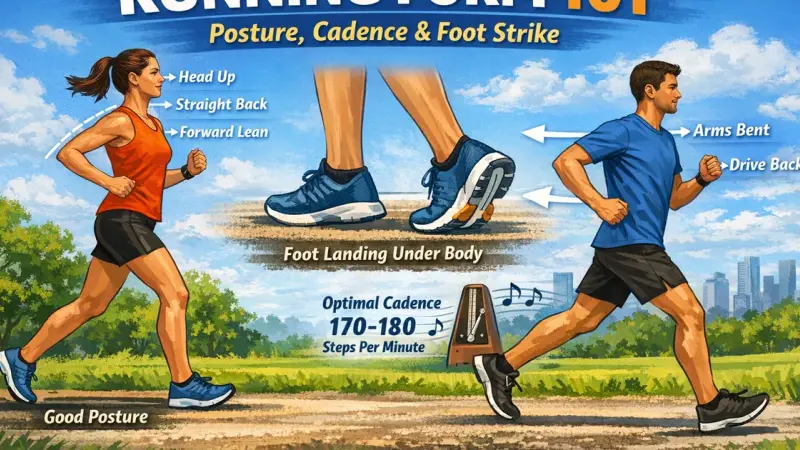
Running looks simple—one foot in front of the other. But small form differences compound over thousands of steps, affecting efficiency, injury risk, and enjoyment.
The good news: you don't need perfect form. You need good-enough form that lets you run comfortably for years.
Why Form Matters (and When It Doesn't)
The Case for Good Form
Efficiency: Poor form wastes energy. Extra vertical bounce, overstriding, tense shoulders—these all cost you speed for the same effort.
Injury prevention: Many common running injuries trace back to form issues. Overstriding increases impact forces. Weak hip stability causes knee problems. Poor posture strains the lower back.
Longevity: Runners with efficient form can train more volume with less breakdown. Over years, this adds up to significantly more training and better results.
When to Leave Form Alone
If it ain't broke: Healthy runners with consistent training might have unconventional form that works for them. Don't fix what isn't causing problems.
During races: Race day is not the time to think about form. Trust your training and run.
When overly focused: Constant form monitoring creates tension—the opposite of what you want. Practice form deliberately, then let it become automatic.
Posture: Run Tall
The Foundation
Good running posture starts from the ground up:
Head position:
- Look ahead, not down (except on technical terrain)
- Chin neutral, not jutting forward
- Imagine a string pulling you up from the crown of your head
Shoulders:
- Relaxed and level
- Not hunched up toward ears
- Not rounded forward
Chest:
- Open, not collapsed
- Allows full breathing capacity
Hips:
- Pelvis neutral (not tilted forward or tucked under)
- Hips stable and level
- Core engaged but not rigid
The Forward Lean
Elite runners have a slight forward lean—but it comes from the ankles, not the waist.
Correct lean:
- 2-3 degrees forward from vertical
- Originates at ankles
- Whole body tilts as a unit
- Uses gravity to assist forward motion
Incorrect lean:
- Bending at the waist
- Hunching shoulders forward
- Hips behind center of mass
- Puts strain on lower back
The test: Stand straight, then lean forward from your ankles until you almost fall. That's the running lean—your body moves forward as a unit.
Common Posture Problems
Sitting in the hips: Many runners sit back slightly, putting hips behind their center of mass. This wastes energy pushing forward.
Fix: Think "run tall" and "hips forward."
Excessive trunk rotation: Torso twisting side to side with each stride indicates weak core or arm swing issues.
Fix: Engage core gently; check arm swing.
Forward head position: Looking down or jutting chin forward strains neck and disrupts alignment.
Fix: Eyes ahead, chin neutral.
Cadence: Steps Per Minute
Why Cadence Matters
Cadence (steps per minute) directly affects ground contact time and stride length.
Lower cadence (150-165):
- Longer stride
- More time on ground per step
- Often indicates overstriding
- Higher impact forces
Higher cadence (170-180+):
- Shorter stride
- Less time on ground per step
- Foot lands closer to body
- Lower impact forces
The 180 Myth and Reality
You've probably heard "180 spm is optimal." This comes from Jack Daniels' observation of elite runners.
The reality:
- 180 is common for elites at race pace
- Optimal cadence varies by individual, pace, and terrain
- Slower running naturally has lower cadence
- Forcing 180 when 170 is natural may not help
What Research Shows
Studies consistently show:
- Increasing cadence by 5-10% reduces injury risk
- Higher cadence decreases loading rate on joints
- The benefit is reducing overstriding, not the number itself
How to Increase Cadence
Step 1: Measure current cadence Count steps for 30 seconds, multiply by 2. Or use GPS watch data.
Step 2: Increase gradually Add 5 spm. Run short segments (1-2 minutes) at new cadence, then return to normal. Repeat over weeks.
Step 3: Use a metronome Apps or watch features can beep at target cadence. Match your footfalls to the beat.
Step 4: Let it become natural Eventually, higher cadence feels normal. You won't need to think about it.
Use the Running Cadence Calculator to analyze your stride.
Foot Strike: Where and How You Land
The Three Types
Heel strike: Heel contacts ground first, foot rolls forward to toe-off.
- Most common in recreational runners
- Not inherently bad if foot lands under body
- Can be problematic if overstriding
Midfoot strike: Ball of foot and heel contact near-simultaneously.
- Common in faster running and racing
- Often develops naturally with increased cadence
- Efficient energy transfer
Forefoot strike: Ball of foot contacts first, heel may or may not touch.
- Common in sprinting
- Higher calf/Achilles demands
- Not necessary or better for distance running
What Actually Matters
Research has shifted focus from foot strike type to foot strike location.
Where you land matters more than how:
- Landing under your hips = good
- Landing ahead of your hips (overstriding) = problem
Overstriding signs:
- Foot lands well ahead of body
- Knee nearly straight at contact
- Braking force with each step
- Heel striking with extended leg
Proper landing:
- Foot contacts under or slightly ahead of center of mass
- Knee slightly bent at contact
- Minimal braking force
- Smooth transition to push-off
Changing Foot Strike
Generally not recommended unless:
- You're chronically injured with no other solution
- You're dramatically overstriding
- A qualified professional recommends it
If you do change:
- Progress extremely gradually
- Your calves and Achilles will need time to adapt
- Expect a transition period of 6-12 weeks
- Don't increase mileage during transition
Arm Swing: The Forgotten Element
Why Arms Matter
Arms balance the rotation from leg motion. Poor arm swing can:
- Waste energy
- Cause trunk rotation
- Throw off overall rhythm
- Create tension throughout body
Proper Arm Position
Elbows:
- Bent at approximately 90 degrees
- May open slightly on the back swing
- Shouldn't lock or extend fully
Hands:
- Relaxed (imagine holding potato chips without crushing them)
- Not clenched in fists
- Thumb resting on fingers, not inside fist
Wrists:
- Neutral, not flopping
- Connected but relaxed
Proper Arm Motion
Direction:
- Forward and back, not across body
- Hands shouldn't cross the body's centerline
- Imagine an invisible line down your center
Plane:
- Slight inward angle acceptable
- Elbows don't flare out
- Movement primarily forward/back
Amplitude:
- Match arm swing to leg speed
- Faster running = more vigorous arm drive
- Easy running = smaller, relaxed swing
Common Arm Problems
Cross-body swing: Arms swinging across the torso instead of forward/back.
Fix: Focus on driving elbows straight back.
T-Rex arms: Elbows bent too much, hands near chest.
Fix: Allow elbows to open to 90 degrees.
Tense shoulders/hands: Visible tension, shoulders creeping up.
Fix: Consciously relax and drop shoulders. Shake out hands briefly.
Asymmetry: One arm doing something different from the other.
Fix: Video analysis to identify the issue, then focused practice.
Breathing and Rhythm
Natural Breathing Patterns
Most runners breathe in rhythm with their steps:
- Easy running: 3:3 (3 steps inhale, 3 steps exhale)
- Moderate running: 2:2
- Hard running: 2:1 or 1:1
Don't force a pattern—let breathing adapt to effort.
Diaphragmatic Breathing
Belly breathing:
- Breathe into your belly, not just chest
- Diaphragm does the work
- More oxygen per breath
- Practice lying down first
During running:
- Allow natural belly expansion
- Don't force rigid core that restricts breathing
- Exhale fully to make room for fresh air
Breathing Mechanics
Inhale:
- Through nose, mouth, or both
- Whatever feels natural
- Nose-only is fine for easy running but limiting at high intensity
Exhale:
- Often naturally through mouth
- Slightly longer than inhale helps relaxation
- Forceful exhale can help "reset" when struggling
Putting It Together: Form Drills
Running Drills
Practice these 2-3 times per week before easy runs:
High knees:
- Exaggerated knee lift
- Quick ground contact
- Arms in proper position
- 2 × 20 meters
Butt kicks:
- Heel kicks toward glutes
- Quick leg turnover
- Minimal forward progress
- 2 × 20 meters
A-skips:
- High knee with a skip
- Quick ground contact
- Arms driving
- 2 × 20 meters
B-skips:
- A-skip with leg extension before landing
- Practices pawing motion
- 2 × 20 meters
Strides
Short accelerations that practice efficient, fast form:
How to do them:
- Start at easy pace
- Gradually accelerate to 85-90% of sprint
- Hold for 15-20 seconds
- Decelerate gradually
- Walk or jog 60-90 seconds recovery
- Repeat 4-6 times
When:
- After easy runs
- Before workouts or races (fewer reps)
- 2-3 times per week
Focus:
- Relaxed speed
- Good form under faster turnover
- Don't strain
How to Work on Form
The Right Approach
Don't change everything at once. Pick one element (posture, cadence, arm swing) and focus on it for 2-4 weeks before adding another.
Dedicate specific sessions. Use drills and strides to practice form, then let regular runs be automatic.
Film yourself. Video from the side and behind reveals issues you can't feel. Review every few weeks.
Progress slowly. Form changes take weeks to become natural. Rushing increases injury risk.
When to Seek Help
Consider professional analysis if:
- You have recurring injuries with no clear cause
- You feel very inefficient despite good fitness
- Major asymmetries are visible
- You're preparing for a big goal and want to optimize
Who can help:
- Running coaches with biomechanics background
- Physical therapists who work with runners
- Some running stores offer gait analysis
Good running form isn't about looking like an elite runner—it's about running efficiently for your body. Focus on running tall, landing under your hips, keeping your arms relaxed, and maintaining a rhythm that feels sustainable. Small improvements compound over time into fewer injuries and faster, more enjoyable running.
Check your stride with the Stride Length Calculator.
Key Takeaway
Good running form is efficient, relaxed, and sustainable. Focus on running tall, landing under your hips, and maintaining a relaxed arm swing. Don't overhaul everything at once—small, gradual changes stick better than dramatic overhauls.
Frequently Asked Questions
Should I try to change my foot strike?
What's the ideal running cadence?
How do I know if my form is wrong?
Should I lean forward when running?
How much should I think about form while running?
References
- Running biomechanics research
- Pose Method
- Chi Running principles