
Contents
Setting Running Goals: A Framework for Goals That Actually Work
Good goals motivate and guide. Bad goals frustrate and injure. Learn how to set running goals that inspire you and lead to real improvement.

Quick Hits
- •Good goals are specific, challenging but achievable, and personally meaningful
- •Process goals (run 4x/week) are more within your control than outcome goals (run sub-20 5K)
- •Have goals at multiple timeframes: daily, weekly, seasonal, long-term
- •Goals should excite you, not fill you with dread
- •Be willing to adjust goals as you learn—rigid attachment causes problems
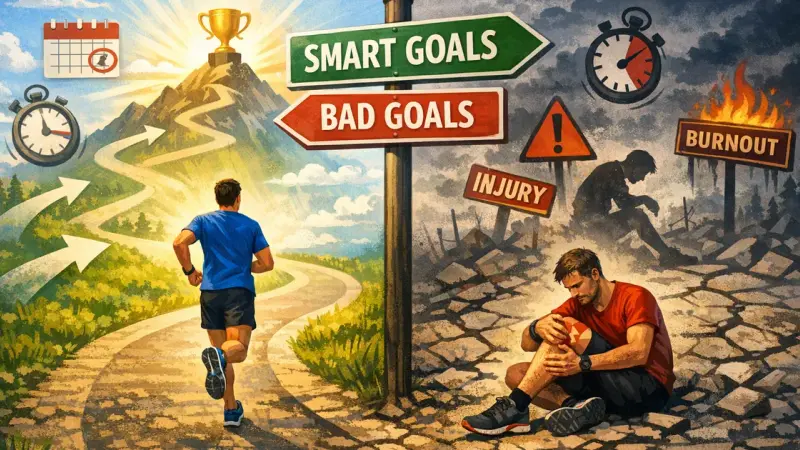
The right goal pulls you forward. The wrong goal pushes you toward injury or burnout.
Why Goals Matter
Goals Provide Direction
Without goals:
- Training becomes aimless
- No clear measure of progress
- Motivation wanes
- Decisions become arbitrary
With good goals:
- Training has purpose
- Progress is measurable
- Motivation has a target
- Decisions become clearer
Goals Create Accountability
External structure:
- Race dates create deadlines
- Plans have benchmarks
- Progress is trackable
- Commitment becomes concrete
Goals Enable Growth
Reaching for something:
- Challenges current limits
- Requires learning and adaptation
- Creates sense of accomplishment
- Builds confidence for future goals
Goal-Setting Framework
SMART Goals (Modified for Running)
Specific:
- "Run faster" → "Run a 24:00 5K"
- "Get fit" → "Run 30 miles per week consistently"
Measurable:
- Can you track progress?
- How will you know when achieved?
Achievable:
- Challenging but possible
- Not guaranteed, not impossible
- ~30-70% probability with good training
Relevant:
- Personally meaningful
- Aligned with your life
- Worth the required sacrifice
Time-bound:
- Has a deadline
- Creates urgency
- Allows for planning backward
Process vs. Outcome Goals
Outcome goals:
- The result you want
- Often time-based (run sub-X)
- Not fully in your control
Process goals:
- What you do to get there
- Behavior-based (run 4x/week)
- Fully in your control
Both matter:
- Outcome provides direction
- Process provides daily action
- Process goals build toward outcome
Layered Goal Timeframes
Session goals:
- Complete today's workout
- Hit target paces
- Listen to body
Weekly goals:
- Hit planned mileage
- Complete quality sessions
- Take scheduled rest
Block/season goals:
- Build base successfully
- Peak for goal race
- Stay healthy
Long-term goals:
- PR at distance X
- Qualify for event
- Run for life
Types of Running Goals
Time-Based Goals
Examples:
- Run sub-20:00 5K
- Break 4:00 marathon
- PR at half marathon
Pros:
- Clear and measurable
- Motivating
- Easy to track progress
Cons:
- Weather/course dependent
- Can lead to risky pacing
- May overshadow experience
Consistency Goals
Examples:
- Run 4 days/week for 12 weeks
- Complete every planned workout this block
- Don't miss more than 2 sessions per month
Pros:
- Fully in your control
- Build habits
- Foundation for other goals
Cons:
- Less exciting for some
- May lead to running when shouldn't
Experience Goals
Examples:
- Run first marathon
- Complete a trail ultra
- Run in 5 different states
- Join a running club
Pros:
- Expands horizons
- Not pressure-based
- Creates memories
Cons:
- Less specific progress measure
- May need combination with process goals
Health/Wellness Goals
Examples:
- Run pain-free for 6 months
- Maintain weight through running
- Use running for stress management
- Run with friends weekly
Pros:
- Sustainable motivation
- Holistic benefit
- Not performance pressure
Cons:
- Harder to measure
- May need to operationalize
Improvement Goals
Examples:
- Improve running economy
- Increase weekly mileage from X to Y
- Add strength training consistently
- Fix overstriding
Pros:
- Focuses on growth
- Progress visible
- Builds toward performance
Cons:
- Some things hard to measure
- May need professional assessment
How to Choose Goals
Start With "Why"
Ask yourself:
- Why do I run?
- What would make running more satisfying?
- What's missing currently?
- What excites me?
Assess Current State
Honest evaluation:
- Current fitness level
- Time available for training
- History with running
- Life circumstances
Consider the Gap
Between current and goal:
- Is gap achievable in timeframe?
- What's required to close it?
- Are you willing to do what's required?
- Is it healthy to pursue?
Make It Personal
Your goals should:
- Matter to you (not just impressive to others)
- Fit your life
- Align with your values
- Excite more than terrify
Adjusting Goals
When to Adjust
Circumstances change:
- Injury happens
- Life gets busy
- Fitness develops faster/slower than expected
- Original goal no longer meaningful
Adjustment is not failure:
- Goals are tools, not masters
- Rigid attachment causes problems
- Smart runners adapt
How to Adjust
Step back and reassess:
- What's the current situation?
- What's still possible?
- What makes sense now?
- What maintains motivation?
Options:
- Change the timeline (same goal, different date)
- Change the magnitude (similar goal, different target)
- Change the type (different goal entirely)
- Take a break from goals
Protecting Progress
When adjusting:
- Acknowledge what you've accomplished
- Don't discard training already done
- Find new direction that builds on foundation
- Avoid all-or-nothing thinking
When Goals Hurt
Signs of Problematic Goal Attachment
Red flags:
- Training through injury for the goal
- Anxiety overwhelming excitement
- Running stops being enjoyable
- Goal feels like obligation, not aspiration
- Self-worth tied to achievement
Healthy Goal Relationship
Balance means:
- Goals motivate, not torment
- Falling short disappoints but doesn't devastate
- Running remains enjoyable
- Goals serve you, not vice versa
- Identity isn't dependent on achievement
When to Let Go
It's okay to release a goal if:
- It no longer serves you
- Health is at risk
- Life priorities have changed
- Pursuit brings more pain than joy
Goals should make running better, not worse. Use our Running Goals Worksheet to clarify your targets, and track progress toward them on your dashboard.
Key Takeaway
The best running goals push you forward without crushing you. They should be challenging enough to require effort, specific enough to guide training, and flexible enough to adjust as reality unfolds.
Frequently Asked Questions
What if I keep failing to reach my goals?
Should goals always be about times and PRs?
How do I know if a goal is realistic?
References
- Goal-setting research
- Sport psychology