
Contents
Shin Splints: Causes, Treatment, and Prevention for Runners
Shin splints are one of the most common beginner injuries. Learn what causes them, how to treat them, and how to prevent them from returning.

What changed: Rewrote symptom, treatment, and return guidance against current orthopedic and clinical sources; removed fixed recovery timelines, medication advice, the 10% rule, and self-diagnostic certainty while adding care and red-flag boundaries.
Quick Hits
- •“Shin splints” commonly refers to medial tibial stress syndrome, but shin pain has other causes.
- •A recent increase in running load can be relevant, but risk is multifactorial.
- •Reduce or pause the activity that reproduces pain rather than testing it repeatedly.
- •Focal tenderness, walking pain, night pain, swelling, or failure to improve warrants assessment.
- •Return is based on symptoms and function, not a fixed number of days.
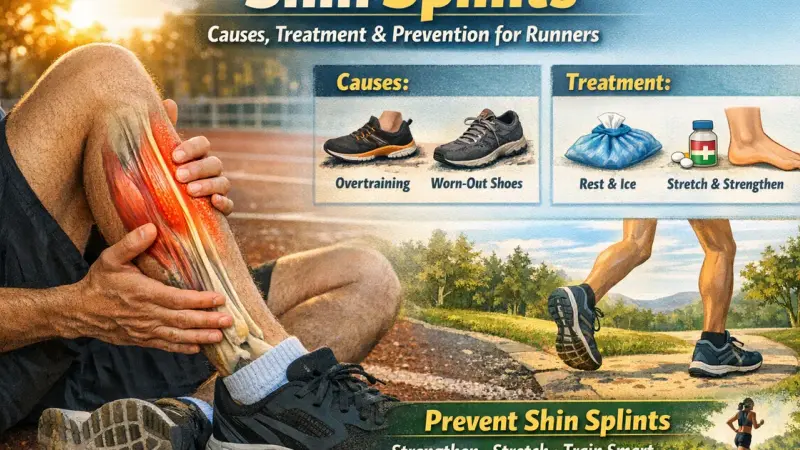
Shin Splints in Runners
This guide is general education, not a diagnosis or treatment plan. Shin pain can come from several conditions with different management. A sports-medicine clinician or physical therapist can assess your history, tenderness, function, and need for imaging.
“Shin splints” usually refers to medial tibial stress syndrome (MTSS), an exercise-related pain syndrome along the inner border of the tibia. The label should not be applied to every painful shin.
First Decision: Reduce Load or Seek Care?
| What you notice | Sensible next step | Why |
|---|---|---|
| Broad inner-shin soreness linked to running and settling with rest | Stop the run that provokes it, reduce impact load, and monitor daily function | The pattern can fit MTSS but is not diagnostic |
| A small, very focal tender area; pain with walking, hopping, rest, or at night; or localized swelling | Arrange prompt clinical assessment | Bone stress injury needs to be considered |
| Symptoms worsening despite reduced load or not improving with self-care | See a clinician or musculoskeletal service | The diagnosis and load plan may need review |
| Sudden severe pain after trauma, inability to bear weight, deformity, rapidly increasing swelling, or a numb/cold/discolored foot | Seek urgent medical care | These are not routine “run through it” symptoms |
If you are unsure which row fits, choose assessment over a self-test workout.
What MTSS Can Look Like
The American Academy of Orthopaedic Surgeons describes pain along the border of the tibia that can occur during and after exercise and may be tender to touch. Mild swelling can occur. Clinicians use the symptom history and examination and may investigate other causes when the pattern or recovery is not typical.
Possible alternatives include:
- tibial bone stress injury or stress fracture;
- tendinopathy or muscle-related pain;
- chronic exertional compartment syndrome;
- nerve or vascular problems;
- an acute injury.
This is why “diffuse equals safe” and “one spot equals stress fracture” are insufficient diagnostic rules. Location changes the level of concern; it does not establish the condition.
Why It Happens
A change in loading often precedes symptoms: more running, more intensity, a return after time away, different terrain, or a sudden change in sport demands. But current research describes MTSS risk as multifactorial. Alignment, range of motion, strength, gait, prior history, bone health, and recovery may contribute differently across runners.
Avoid assigning certainty to one feature such as pronation, surface, shoe age, sex, or calf tightness. A risk factor observed across groups does not prove the cause of one runner's pain.
What to Do When Pain Starts
Stop Reproducing the Symptom
End or modify the run when pain appears or worsens. For the next several days, track pain during ordinary walking and stairs as well as after activity. Repeatedly “testing” the shin with a hard run can make the trend harder to interpret.
Reduce the Provoking Load
This may mean shorter walking, pausing running, or temporarily replacing impact exercise. Cross-training is only an alternative if it does not reproduce symptoms and is appropriate for the suspected diagnosis; cycling is not automatically suitable for every cause of shin pain.
Use Comfort Measures Carefully
The NHS and AAOS list short periods of ice as a possible symptom-relief measure when used with skin protection. It does not diagnose or heal the underlying problem. Medication choices depend on your health, other medicines, and the possibility of bone injury, so discuss them with a pharmacist or clinician rather than following a generic dose online.
Review the Preceding Change
Write down:
- running time, distance, and intensity before symptoms began;
- changes in hills, track work, surfaces, or footwear;
- time away and the return pattern;
- sleep, nutrition, menstrual or hormonal health where relevant, and prior bone stress injury;
- the exact location and when pain occurs.
That history is more useful to a clinician than guessing which muscle is inflamed.
Strength, Mobility, and Footwear
Calf raises, foot and ankle strengthening, and mobility work may be included in an individualized rehabilitation plan. They are not universal cures, and exercise selection should respect pain and the suspected diagnosis.
Likewise, footwear can affect comfort but no shoe guarantees prevention. Change shoes gradually, choose a secure and comfortable fit, and avoid using a purchase to substitute for load management or assessment. The broader common running injuries guide explains why different symptom patterns need different responses.
Return to Running
Do not use “pain-free for three days” or a fixed percentage as universal clearance. A return plan may consider:
- comfortable daily walking and stairs;
- no worsening tenderness or next-day symptoms;
- clinician-guided functional tests when bone stress injury is a concern;
- tolerance of a short, easy run/walk exposure;
- stable response before duration, frequency, or intensity increases.
Change one loading variable at a time. Keep early runs easy and separated enough to observe the next-day response. If symptoms recur, stop progressing and review the diagnosis and plan rather than forcing the schedule.
If you are starting from scratch, build repeatable easy sessions before adding intensity. If this follows time away, use our general return-to-running principles only after the cause of your shin pain and your individual clearance are understood.
Your dashboard can document training changes and symptom notes, but it cannot determine whether shin pain is MTSS or a bone stress injury.
Key Takeaway
Treat new shin pain as a signal to reduce the provoking load and reassess—not as a condition you can diagnose from location alone. Escalate focal, severe, persistent, walking, rest, or night pain to a qualified clinician.
Frequently Asked Questions
What do shin splints feel like?
Can I run through shin splints?
How long do shin splints take to heal?
How can I tell shin splints from a stress fracture?
Does the 10% rule prevent shin splints?
References
- https://orthoinfo.aaos.org/en/diseases--conditions/shin-splints/
- https://orthoinfo.aaos.org/en/diseases--conditions/stress-fractures
- https://www.nhs.uk/conditions/shin-splints/
- https://www.nhs.uk/conditions/broken-leg/
- https://pubmed.ncbi.nlm.nih.gov/39577407/