
Contents
Giving Running Advice: How to Help Without Being Annoying
Your running friend asked for advice. Or maybe they didn't. Learn how to share running knowledge helpfully, when to speak up, and when to stay quiet.

Quick Hits
- •Unsolicited advice is rarely welcome—wait to be asked
- •Ask questions before giving answers
- •What worked for you may not work for them
- •Encourage more than correct
- •Know the limits of your knowledge
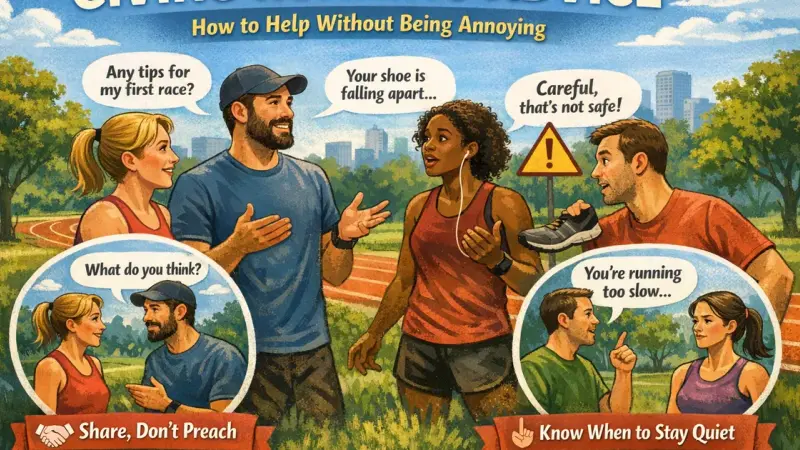
You've learned things running. Sharing that knowledge can help others—or alienate them.
When to Give Advice
When Asked
Best scenario:
- "What do you think about..."
- "How did you handle..."
- "Any suggestions for..."
Your job:
- Answer their specific question
- Share relevant experience
- Offer to discuss more if helpful
When Safety Is at Risk
Speak up for:
- Dangerous situations (running in traffic unsafely, etc.)
- Clear injury warning signs they're ignoring
- Equipment failures (worn shoes about to cause problems)
How to approach:
- Frame as concern, not criticism
- Share what you've seen/learned
- Offer help, not lectures
When It's Your Role
Appropriate if:
- You're their designated mentor/coach
- They've specifically asked you to watch for things
- You have an established advice-giving relationship
When NOT to Give Advice
Unsolicited Opinions
Resist the urge when:
- They didn't ask
- They're celebrating something (not the time for "but you could...")
- It's about their pace, weight, or body
- It's their first race (let them enjoy it)
Things Outside Your Expertise
Stay quiet about:
- Medical issues (direct to professionals)
- Nutrition for conditions you don't have
- Training for distances you haven't run
- Topics you've only read about, not experienced
How to Give Advice Well
Ask Questions First
Before advising:
- "What have you already tried?"
- "What do you think is happening?"
- "What are you hoping to achieve?"
Why this helps:
- Shows respect
- Reveals context you need
- Often they know the answer
Share Experience, Not Rules
Instead of: "You should do tempo runs once a week"
Try: "What's helped me is tempo runs once a week—that might work for you too"
Why:
- Acknowledges individual differences
- Removes pressure
- Shows humility
One Thing at a Time
Overwhelming:
- "You need to slow down, do more strength training, fix your cadence, hydrate better, and probably get new shoes"
Helpful:
- "The biggest thing that helped me early on was slowing my easy runs. Want to talk about that?"
Match Their Level
For beginners:
- Simple, fundamental concepts
- Encouragement heavy
- Technique light
- Just enough to improve
For experienced runners:
- More nuanced discussion
- Can handle complexity
- Peer-level conversation
Common Mistakes
The Unsolicited Form Critique
The trap: Seeing someone's form and commenting
Why it's problematic:
- Form is individual
- They didn't ask
- May cause self-consciousness
- You might be wrong
Exception: They specifically asked for form feedback
The Pace Police
The trap: Commenting on others' paces
Why it's problematic:
- Pace is personal
- You don't know their goals/context
- Creates judgment
- Not your business
The "What Works for Me" Assumption
The trap: Assuming your approach is right for everyone
Reality:
- Bodies respond differently
- Goals vary
- Life circumstances differ
- Multiple valid approaches exist
The Over-Explaining
The trap: Giving way more information than asked for
Better approach:
- Answer the question asked
- Offer to elaborate if wanted
- Let them ask follow-ups
Mentoring Newer Runners
What Good Mentors Do
Focus on:
- Encouragement and support
- Answering questions as they arise
- Sharing experience honestly
- Celebrating their progress
What Good Mentors Avoid
Don't:
- Overwhelm with information
- Compare their progress to yours
- Push them faster than they want
- Make it about you
Building Their Independence
Goal:
- Help them become self-sufficient
- Teach principles, not just rules
- Encourage their own learning
- Support their unique journey
Knowing Your Limits
Refer to Experts When
Medical issues:
- Persistent pain
- Injury symptoms
- Health concerns
- → "You should see a doctor/PT about that"
Advanced training:
- Beyond your experience level
- Complex periodization
- Elite goals
- → "A coach could really help with that"
Nutrition/Health:
- Eating disorders
- Serious deficiencies
- Medical conditions
- → "A sports dietitian would know better than me"
Being Honest About Knowledge
It's okay to say:
- "I don't know"
- "That's outside my experience"
- "Let me think about that"
- "You might want to ask someone else"
Better than:
- Guessing
- Speaking beyond your knowledge
- Pretending expertise
The best running communities are built on helpful, humble advice-sharing. Track your own progress on your dashboard and share what you learn along the way.
Key Takeaway
The best running advice is requested, specific, and humble. Share what's worked for you without claiming universal truth. Encourage first, correct only when asked. And remember: every runner's journey is their own.
Frequently Asked Questions
My friend is making obvious training mistakes. Should I say something?
How do I help a beginner without overwhelming them?
What if I give advice and they get injured?
References
- Coaching communication research
- Running community observations