
Contents
Lactate Threshold Explained: The Pace That Predicts Your Race
Learn what lactate threshold is, why it's often more important than VO2max, and how to train it effectively for faster race times.

Quick Hits
- •Lactate threshold is the intensity where lactate accumulates faster than your body can clear it
- •It typically occurs at 75-90% of VO2max, depending on training level
- •Threshold pace is roughly your one-hour race pace—close to half marathon pace for most runners
- •Improving threshold lets you race at a higher percentage of your VO2max
- •Tempo runs (20-40 minutes at threshold) are the classic way to train it
You've probably heard the term "lactate threshold" or "tempo pace." Maybe your watch shows a lactate threshold estimate.
But what does it actually mean? And why do coaches obsess over it?
Here's the physiology that matters—and how to use it.
What Is Lactate Threshold?
The Basic Concept
At rest and during easy running, your body produces lactate and clears it at roughly equal rates. Blood lactate stays low.
As intensity increases, lactate production rises. At some point, production exceeds clearance. Lactate accumulates.
Lactate threshold = the intensity where accumulation begins.
Why Lactate Accumulation Matters
When lactate accumulates faster than you clear it:
- Blood becomes more acidic
- Muscles fatigue more rapidly
- Sustainable effort becomes unsustainable
- You're forced to slow down
Running above threshold for too long leads to the familiar feeling of "dying"—that's accumulated lactate and associated metabolic stress.
The Technical Definitions
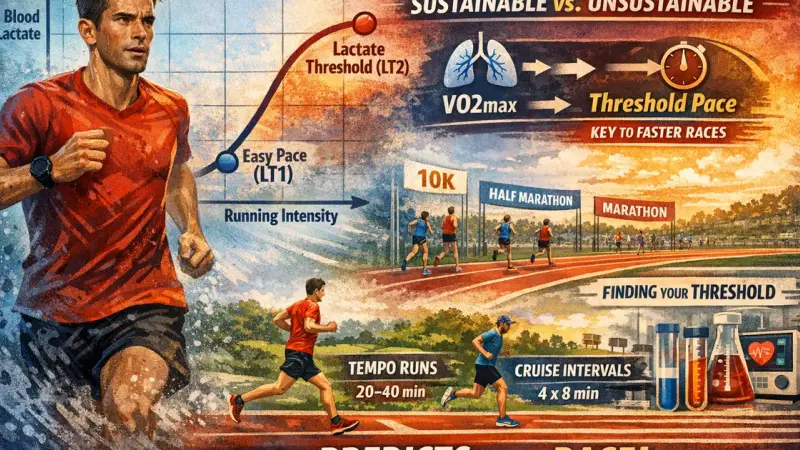
LT1 (Lactate Threshold 1): First rise above baseline. Roughly easy-moderate effort.
LT2 (Lactate Threshold 2) or OBLA: Where lactate reaches 4 mmol/L. The practical "threshold" most runners reference.
For training purposes, when people say "threshold," they typically mean LT2.
Why Threshold Matters More Than VO2max
The Percentage Game
VO2max tells you your aerobic ceiling.
Threshold tells you how close to that ceiling you can race.
Example:
- Runner A: VO2max 60, threshold at 90% of VO2max
- Runner B: VO2max 65, threshold at 75% of VO2max
Runner A's threshold pace is faster despite lower VO2max.
The Trainability Factor
VO2max: Limited trainability (15-25% max improvement), largely genetic.
Threshold: Highly trainable. Can improve significantly with proper training.
This is why threshold training is so valuable—you're improving something that responds well to training.
Race Prediction Power
For distances from 10K to marathon, threshold pace predicts race performance better than VO2max.
Why: These races are run at or slightly below threshold. Your threshold pace essentially determines your race pace.
Finding Your Threshold
Method 1: One-Hour Race Pace
Your threshold pace is approximately the pace you could sustain for one hour of racing.
Estimates:
- Faster than 10K pace (40-60 min race for most)
- Close to half marathon pace (90-120 min race for most)
- Faster than marathon pace (3-5+ hour race)
For a 45-minute 10K runner: threshold is slightly slower than 10K pace. For a 2-hour half marathoner: threshold is roughly half marathon pace.
Method 2: Heart Rate
Threshold typically occurs at 85-90% of maximum heart rate.
To find it:
- Warm up thoroughly
- Run a sustained hard effort (20-30 minutes)
- Average heart rate during that effort approximates threshold HR
Method 3: The Talk Test
At threshold pace:
- You can speak only a few words at a time
- Complete sentences are difficult
- Breathing is heavy but controlled
Below threshold: can hold conversation Above threshold: can barely speak
Method 4: Lab Testing
Blood lactate testing identifies exact threshold:
- Run at increasing speeds
- Blood sample taken at each stage
- Threshold is where lactate rises sharply
Most accurate, but expensive and not necessary for most runners.
Method 5: Calculator Estimate
Use a threshold pace calculator based on recent race times.
Training Your Threshold
The Classic: Tempo Runs
What: 20-40 minutes of continuous running at threshold pace.
Why it works: Extended time at threshold creates the adaptation stimulus.
Example: 10-minute warmup, 25 minutes at threshold, 10-minute cooldown.
Feel: "Comfortably hard." Challenging but sustainable.
Cruise Intervals
What: Shorter segments at threshold with brief recovery.
Example: 4 x 8 minutes at threshold with 2-minute easy jog between.
Why use them: Accumulate more time at threshold than continuous tempo allows. Easier mentally.
Total threshold time: 25-40 minutes per session (including recovery).
Threshold-Paced Long Run Segments
What: Include threshold segments within your long run.
Example: 16-mile long run with miles 10-14 at threshold pace.
Why use them: Race-specific for half marathon and marathon. Teaches threshold running on tired legs.
Progression Runs
What: Start easy, gradually accelerate, finish at threshold.
Example: 8 miles, starting at easy pace, last 2-3 miles at threshold.
Why use them: Teaches pacing. Less mentally daunting than pure tempo.
Training Frequency and Volume
Weekly Threshold Work
For most runners: 1 threshold-focused session per week during build phase.
Total weekly threshold time: 20-45 minutes depending on experience and training phase.
Periodization
Base phase: Limited threshold work, focus on aerobic volume.
Build phase: 1 threshold session per week, increasing duration.
Peak phase: Maintain threshold fitness, may add race-specific work.
Taper: Reduced volume threshold work to maintain fitness.
Common Threshold Training Mistakes
1. Running Too Fast
The mistake: Turning tempo runs into races. Running at 10K pace instead of threshold.
The problem: Shifts training effect toward VO2max. Increases fatigue and injury risk.
The fix: Threshold should feel hard but controlled. If you can't maintain pace for 40+ minutes (theoretically), you're too fast.
2. Running Too Slow
The mistake: "Tempo" that's actually moderate effort.
The problem: Doesn't provide sufficient stimulus for threshold adaptation.
The fix: Use heart rate or pace to ensure you're in the right zone.
3. Too Much Threshold Work
The mistake: Multiple tempo runs per week or very long tempos.
The problem: Excessive stress without recovery. Plateau or overtraining.
The fix: One quality threshold session per week is enough for most runners.
4. Ignoring Easy Running
The mistake: All threshold, minimal easy running.
The problem: Aerobic base erodes. Recovery suffers. Threshold actually stagnates.
The fix: 80% of running should be easy. Threshold is the quality work within that framework.
Threshold vs. Marathon Pace
They're Not the Same
| Pace Type | Effort | Sustainable Duration |
|---|---|---|
| Threshold | Hard | 60 minutes |
| Marathon | Moderate-hard | 2-5+ hours |
Marathon pace is typically 15-30 seconds per mile slower than threshold.
Training Implications
For half marathon: Race at or slightly below threshold.
For marathon: Race well below threshold (85-90% of threshold pace).
Both threshold training and marathon-pace training matter for marathon preparation, but they serve different purposes.
Signs Your Threshold Is Improving
Performance Indicators
- Same heart rate at faster pace
- Same pace at lower heart rate
- Faster race times at threshold distances
- Tempo runs feel more controlled
Training Indicators
- Can extend tempo duration at same pace
- Recovery between threshold intervals feels easier
- Finish of threshold runs feels stronger
Advanced Threshold Concepts
Two-Threshold Model
Modern physiology recognizes two thresholds:
LT1 (Aerobic threshold): Upper limit of easy running. Below this, you can run for hours.
LT2 (Anaerobic threshold): Traditional threshold. Maximum sustainable intensity for about an hour.
The zone between LT1 and LT2 is sometimes called "tempo" or "zone 3."
Threshold and Fatigue
Threshold pace isn't fixed—it drops as you fatigue:
- Fresh: True threshold
- Mid-long run: Effective threshold is lower
- End of marathon: Much lower
This is why marathon pace is well below fresh threshold.
The Practical Takeaway
For Most Runners
- Find your threshold: Use one-hour race pace or heart rate estimate
- Train it weekly: One tempo run or cruise interval session
- Keep it honest: Hard but sustainable, not racing
- Be patient: Threshold improves over months, not weeks
Sample Threshold Workouts
Beginner:
- 10-min warmup + 15-min tempo + 10-min cooldown
Intermediate:
- 10-min warmup + 3 x 10-min at threshold (3-min recovery) + 10-min cooldown
Advanced:
- 10-min warmup + 30-35-min continuous tempo + 10-min cooldown
Lactate threshold is where sustainable meets unsustainable. Train it with tempo runs and cruise intervals, and you'll race faster at every distance from 10K to marathon.
Calculate your threshold pace with our Threshold Pace Calculator.
Key Takeaway
Lactate threshold is where your body can no longer clear lactate as fast as it accumulates—approximately one-hour race pace. It often predicts race performance better than VO2max because it determines how much of your aerobic capacity you can actually use. Train it with tempo runs and cruise intervals.
Frequently Asked Questions
What's the difference between lactate threshold and anaerobic threshold?
How do I find my lactate threshold pace?
Can I run a marathon at threshold pace?
How often should I do threshold workouts?
Is threshold training better than VO2max training?
References
- Exercise physiology research
- Lactate testing studies
- Elite training methods