
Contents
Heart Rate During Runs: Readings, Drift and Sensor Checks
Identify your zone method and troubleshoot an unexpected heart-rate reading, a rising long-run trace or lag during short intervals without guessing a diagnosis.

Quick Hits
- •Check the zone method and sensor before interpreting a zone number.
- •The same percentage gives different results for maximum HR and HR reserve.
- •An unexpected reading is not automatically sensor error, even if the run feels easy.
- •A rising long-run trace cannot by itself diagnose dehydration or overtraining.
- •Do not accelerate a short interval merely to make the display reach a target zone.
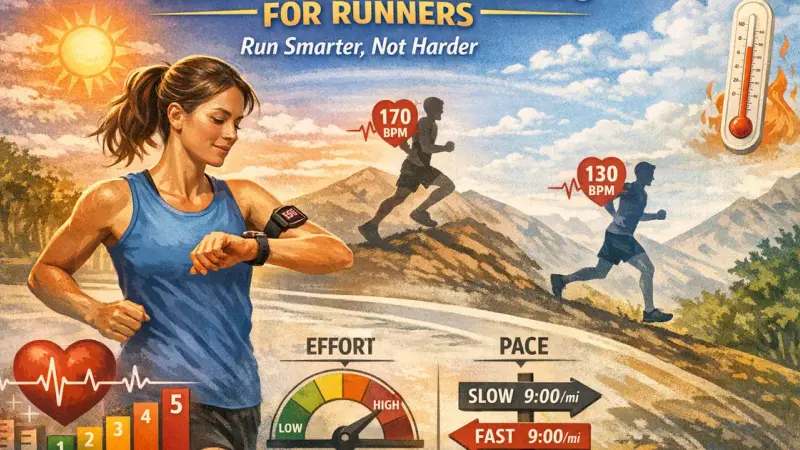
Your watch reports a number, but interpreting it requires context. First identify what produced the reading and how the zones were calculated. Then compare the pattern with the run's purpose, conditions and how you feel.
This is an application and troubleshooting guide. Use the heart-rate zone reference for definitions and calculations, and the training-metric comparison for the different roles of heart rate, pace and perceived effort.
Identify Your System Before Acting on a Zone
| System | Basis to check | What a zone number does not establish |
|---|---|---|
| Percentage of maximum HR | The supplied or estimated maximum and percentage boundaries | A measured lactate or ventilatory threshold |
| Heart rate reserve | Maximum minus resting HR; add resting HR back after applying the fraction | Equivalence to the same percentage of maximum HR |
| Threshold-based zones | Which threshold and assessment protocol the system uses | Interchangeability with an age-estimated maximum |
| Three-zone physiological model | Boundaries defined by specified lower and upper thresholds | The same meaning for Zone 2 as a five-zone watch system |
The number of zones alone does not identify the method. Check the watch's selected sport profile and any custom boundaries as well as the named system.
Synthetic settings example: maximum HR 180 bpm, resting HR 50 bpm. A 60–70% maximum band is 108–126 bpm. A 60–70% reserve band is 50 + (180 − 50) × 0.60 to 0.70, or 128–141 bpm. The difference comes from the formula, not a change in fitness.
You can reproduce those exact settings in the heart-rate band calculator. It rounds endpoints to whole beats and requires resting HR for reserve mode. Its numbered bands are arithmetic outputs, not measured thresholds or personalized clearance to exercise.
If your maximum is only an estimate, record that uncertainty. A highest recorded value is not automatically a validated maximum. This guide does not prescribe a maximal hill test or tell you whether maximal testing is appropriate.
Scenario 1: An Unexpected Reading on an Easy Run
Synthetic observation: the wrist trace jumps suddenly while pace and perceived effort seem unchanged. That makes measurement quality worth checking; it does not prove the number is wrong.
Ask:
- Which sensor is recording—wrist optical or a paired accessory?
- Is the device positioned and fitted according to its manual? Is the sensor clean?
- Is the wrist cold, or is movement interfering with stable contact?
- Does the trace resemble cadence, and does the pattern repeat after checking setup?
- Has your effort or how you feel changed, even if the displayed pace has not?
Garmin's optical-HR support describes cadence lock as a possible artifact. Its Forerunner manual also gives fit, cleanliness and cold-weather checks. Follow your device's instructions; resemblance to a known artifact is not a medical finding.
Pause to check when appropriate rather than speeding up to test the sensor. If a concerning pattern persists, seek advice instead of repeatedly changing settings until the display looks reassuring.
Scenario 2: Heart Rate Rises During a Long Run
Synthetic observation: the later part of a long run shows higher HR at a similar pace. First check whether the comparison really is like for like: terrain, wind, elapsed time, stops, conditions, sensor source and perceived effort.
Cardiovascular drift has been studied experimentally. In a 1994 study by Heaps and colleagues, nine participants cycled under different hydration conditions; the investigators observed differences in HR and stroke-volume responses. That controlled cycling experiment supports a possible contribution from hydration. It does not let you diagnose dehydration from a running trace or assign a universal acceptable rise in beats per minute.
Record what changed rather than naming a cause prematurely. A rise might lead you to reassess the session, shorten it or change the plan; this article cannot determine which choice fits an individual run. Do not use a fixed drift allowance to justify continuing despite concerning symptoms or unexpectedly difficult effort.
Scenario 3: The Display Rises Late During Short Intervals
Synthetic observation: during short repetitions, the displayed HR is still climbing as the work ends and may stay high into recovery. The body's response and the device's measurement/display behavior are separate issues; neither makes the current number an instant measure of the repetition's effort.
Polar's measurement guidance notes that its chest sensor responds more readily to rapid HR changes than wrist measurement. That is manufacturer guidance about its devices, not proof that every chest strap always beats every wrist sensor.
Check the session's intended pace or effort, repetition length and recovery instructions. Do not run faster merely because the display has not reached a high zone, or shorten recovery because it briefly shows a lower band. There is no fixed seconds-of-lag rule or universal recovery-HR threshold in this guide.
When Symptoms Matter More Than Troubleshooting
Sensor checks are not a reason to ignore symptoms. The NHS advises emergency help for persistent palpitations or palpitations accompanied by chest pain, shortness of breath, or feeling faint/fainting. Stop the session and use your local emergency service in that situation; do not wait for a different watch reading. If those concerning symptoms have stopped, the NHS still advises urgent medical advice; use the appropriate urgent-care service where you are. Recurrent palpitations also warrant clinical advice. A watch cannot establish their cause.
Build an Observation Record
For an ordinary run without concerning symptoms, note observations before trying to fine-tune zones. This is not an instruction to keep training unchanged through a problem.
| Record | Useful detail |
|---|---|
| Intended session | Easy, long, intervals, or another purpose specified by your plan |
| Zone setup | Method, input values, sport profile and any custom boundaries |
| Sensor | Wrist/accessory model, fit and selected recording source |
| Conditions | Terrain, weather and changes during the run |
| Pattern | Gradual rise, abrupt jump, dropout or delayed response; when it occurred |
| Effort and symptoms | What you noticed, without assuming the cause |
| Decision | Paused, shortened, stopped, sought advice, or changed a setting |
| Follow-up question | What remains uncertain and who or what could resolve it |
Compare similar sessions cautiously. A single change in pace at a given HR does not prove adaptation, and a fixed ceiling does not guarantee that training will work.
If reviewing weekly intensity, use the distance-based intensity distribution tool with categories you explicitly define. Distance percentages, time in HR bands and numbers of sessions answer different questions. Do not import an 80/20 target or dismiss an entire numbered zone as useless without identifying the method and context.
A watch-derived fitness estimate is a separate interpretation. Neither a zone label nor an estimate replaces reviewing what the run actually involved.
Key Takeaway
Use heart rate as one observation alongside effort, conditions and the session purpose. Check the measurement and its settings without treating either the watch or perceived effort as a diagnosis.
Frequently Asked Questions
Why does my watch disagree with an online zone calculator?
Is a high reading during an easy run definitely wrong?
How much drift should I allow on a long run?
Should I chase heart rate during short intervals?
References
- https://support.garmin.com/en-GB/?faq=xQwjQjzUew4BF1GYcusE59&productID=621922&tab=topics
- https://support.polar.com/en/support/the_what_and_how_of_polars_wrist_based_heart_rate_measurement?product_id=88275
- https://pubmed.ncbi.nlm.nih.gov/8157372/
- https://www.nhs.uk/symptoms/heart-palpitations/