
Contents
Running by Feel: How to Train Without a Watch
Learn to run by perceived effort, not GPS pace. Develop your internal sense of effort for smarter training and more enjoyable running.

Quick Hits
- •Elite runners often train by feel—pace is a reference, not a mandate
- •Running by feel means using perceived effort to gauge intensity
- •Benefits: accounts for conditions, fatigue, and daily variation automatically
- •The skill takes practice but becomes more reliable than GPS for many situations
- •Consider occasional watch-free runs to develop your internal pacing sense
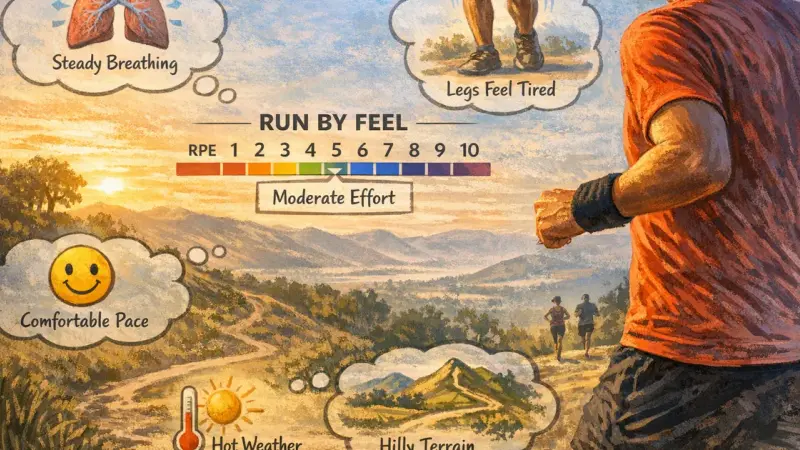
Constantly checking your watch. Adjusting pace every few seconds. Feeling bad when the numbers don't match the effort.
There's another way: running by feel.
What Is Running by Feel?
The Concept
Running by feel = using internal sensation to guide effort, rather than external metrics.
Instead of: "I need to run 8:30 pace."
You think: "I need to run at an effort I can sustain for 2 hours."
What You're Sensing
Physical signals:
- Breathing rate and depth
- Muscle fatigue
- Heart rate (perceived, not measured)
- Overall body state
Mental signals:
- Sense of sustainability
- Perceived difficulty
- Enjoyment level
- Focus ability
The RPE Scale
Rate of Perceived Exertion (1-10):
| RPE | Effort | Description |
|---|---|---|
| 1-2 | Very easy | Walking, warming up |
| 3-4 | Easy | Conversation pace |
| 5-6 | Moderate | Can speak sentences |
| 7 | Hard | Few words only |
| 8-9 | Very hard | Can't speak |
| 10 | Maximum | All-out, unsustainable |
Why Run by Feel
Natural Adjustment
Feel accounts for everything:
- Heat and humidity
- Fatigue from previous days
- Sleep quality
- Life stress
- Altitude
- Course terrain
GPS doesn't know you slept poorly, it's 90°F, and you're stressed from work.
Better Easy Running
Most runners run easy days too fast.
Why: GPS shows a pace that feels "too slow."
By feel: Easy is easy. You don't speed up to hit a number.
Reduced Anxiety
Watch-checking creates stress:
- "Am I on pace?"
- "That split was too slow!"
- "I should be faster than this."
By feel: The run is what it is. You're present.
Racing Application
In races, conditions change:
- Hills
- Wind
- Heat
- Crowd density
Pacing by feel adjusts naturally. Pacing by GPS ignores reality.
Enjoyment
Without the watch:
- Notice your surroundings
- Focus on the run itself
- Experience running, not chasing numbers
How to Develop the Skill
Step 1: Cover Your Watch
Start simple:
- Wear your watch for data
- Cover the screen with a wristband
- Check only at the end
This preserves data while training feel.
Step 2: Estimate Before Checking
After runs:
- Guess your average pace
- Then check actual data
- Notice the gap
Over time: Your estimates improve.
Step 3: Learn Effort Levels
Deliberately practice:
- "This run will be RPE 4" (easy)
- "This tempo will be RPE 7" (hard)
- Check afterwards: did effort match result?
Step 4: Run Occasionally Watch-Free
Full commitment:
- Leave the watch at home
- Run entirely by feel
- Accept not knowing the data
This forces reliance on internal signals.
Step 5: Use Physical Anchors
Associate efforts with sensations:
- Easy: Can sing a song
- Moderate: Can speak sentences
- Hard: Can only say a few words
- Max: Can't speak at all
Breathing is a reliable gauge.
When to Use Feel vs. Data
Best Times for Feel
Easy runs:
- Conversation pace matters, not GPS pace
- Feel automatically adjusts for conditions
Long runs (aerobic portion):
- Sustainable effort is the goal
- Feel tells you what's sustainable
Recovery runs:
- Maximum benefit from going easy
- Feel keeps you honest
Fartlek:
- By definition, unstructured
- Feel guides surge intensity
Best Times for Data
Intervals:
- Specific paces target specific systems
- Watch helps hit targets
Tempo runs:
- Threshold pace is definable
- Watch provides feedback
Racing:
- Goal pace matters
- Watch helps execute strategy
Note: Even in these situations, feel should complement data, not be ignored.
Calibrating Your Feel
Compare Regularly
Process:
- Run by feel
- Estimate your pace
- Check actual data
- Adjust calibration
Example: "I thought I was running 8:30s but was actually running 9:00s. My 'moderate' is actually 'easy.'"
Account for Conditions
Learn how conditions affect feel:
- Hot weather: Same effort = slower pace (normal)
- Hilly route: Same effort = slower average (normal)
- Fresh legs: Same effort = faster pace (normal)
Feel adjusts; pace expectations should too.
Trust the Feel
Common mistake: "I feel easy but I'm 30 seconds slower than usual—I should speed up."
Better approach: "I feel easy and I'm slower. Something is affecting me today. I'll trust the easy feel."
Feel and Training Quality
The Danger of Ignoring Feel
Scenario: Training plan says tempo at 7:30 pace. You're exhausted, stressed, under-slept. You force 7:30 pace anyway.
Result: Poor quality workout. Extra fatigue. Injury risk.
Better: Adjust based on feel. Tempo at 7:50 that feels like tempo is better than 7:30 that feels like death.
The Danger of Only Feel
Scenario: Feel like taking it easy every day. Never push.
Result: Stagnation. No hard effort, no adaptation.
Balance: Feel guides execution, but training structure provides the stimulus.
Running by Feel in Racing
The Benefits
Races have variables:
- Course difficulty
- Weather
- Competition
- Crowds
Pacing by feel adapts. Pacing by GPS ignores these factors.
The Approach
Start: Slightly conservative by feel (should feel too easy early).
Middle: Lock into sustainable effort.
Finish: Increase effort (using remaining capacity).
Check GPS: Occasionally, to ensure you're roughly on target.
Combining Feel and Data
Best of both worlds:
- Run by feel as primary guide
- Check data occasionally as reference
- Adjust if way off target
Example: "I feel like I'm at tempo effort. Let me check—okay, 7:35, that's right. Back to feel."
Challenges and Solutions
"I Don't Trust My Feel"
Solution: Practice. Compare to data. Calibrate over months.
Reality: Feel is trustworthy when developed. It takes time.
"I'll Run Too Slow"
Solution: That might be good (if easy days are currently too fast).
Reality: After calibration, feel is reliable for all paces.
"I Need the Data for Training Analysis"
Solution: Wear the watch, just don't look at it during the run.
You can: Have both feel-based running AND data for review.
"I Get Anxious Not Knowing"
Solution: Start small. Cover watch for 10 minutes. Build tolerance.
Reality: The anxiety often reveals over-reliance on data.
Running by feel reconnects you with your body's signals. It naturally adjusts for conditions your watch can't measure. Develop this skill through practice, and you'll have a reliable internal guide that complements your data—not fights with it.
Track your running data on your dashboard.
Key Takeaway
Running by feel means using perceived effort rather than pace data. It naturally adjusts for conditions, fatigue, and individual variation. Develop this skill by running without watching your pace, learning what different efforts feel like, and trusting your body's feedback. It complements data-driven training.
Frequently Asked Questions
What does 'running by feel' mean?
Is running by feel better than using a GPS watch?
How do I know if I'm running easy without checking pace?
Won't I run too slow without my watch?
How do I develop this skill?
References
- Sports psychology
- Elite runner practices
- Training methodology