
Contents
IT Band Syndrome: The Runner's Knee Pain Solution
IT band syndrome causes lateral knee pain that can sideline runners. Learn what causes it, how to treat it, and how to prevent it from returning.

Quick Hits
- •IT band syndrome causes pain on the outside of the knee, typically starting partway into runs
- •It's often caused by weak hip muscles, especially glutes, combined with training errors
- •Foam rolling the IT band itself doesn't lengthen it—focus on hip and glute strengthening
- •Treatment requires addressing the cause: hip strength, not just symptoms
- •Recovery typically takes 4-8 weeks with consistent rehabilitation
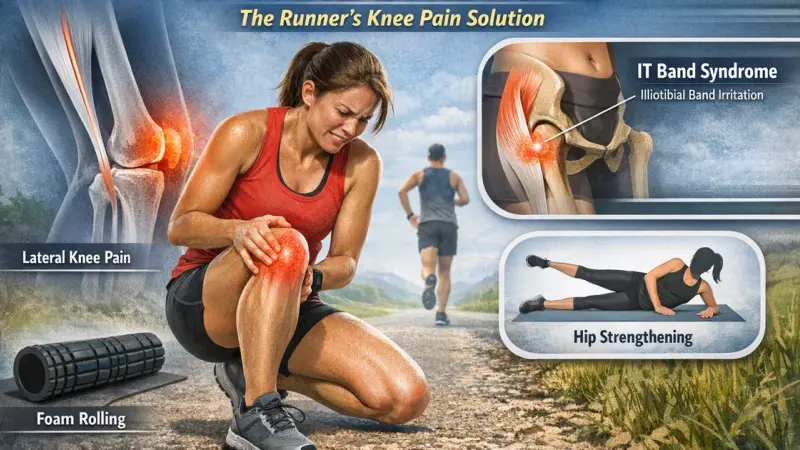
That sharp pain on the outside of your knee? It might be IT band syndrome—one of the most common running injuries.
Here's how to fix it.
What Is IT Band Syndrome?
The Anatomy
The iliotibial band:
- Thick band of fascia running from hip to knee
- Provides lateral stability
- Connects to glutes and tensor fasciae latae (TFL)
What Goes Wrong
ITBS (Iliotibial Band Syndrome):
- The band rubs repeatedly over the bony prominence at the outer knee
- Creates irritation and inflammation
- Causes lateral knee pain
The Pattern
Typical presentation:
- Pain on outside of knee
- Often starts 1-2 miles into run
- Gets worse as you continue
- May disappear with rest, return with running
- Can be sharp, burning, or aching
What Causes ITBS
Primary Cause: Hip Weakness
The critical insight:
ITBS is usually a hip problem presenting as knee pain.
Why:
- Weak hip abductors (glutes) create instability
- The IT band compensates as a stabilizer
- Overworked band becomes irritated at the knee
Contributing Factors
Training errors:
- Sudden mileage increase
- Lots of downhill running
- Running on cambered surfaces
- Repetitive routes (always same direction)
Biomechanics:
- Leg length discrepancy
- Overpronation
- Narrow running gait (crossover)
- Tight hip flexors
Risk Factors
More common in:
- Runners who increase mileage quickly
- Those with weak hips/glutes
- Runners doing lots of downhill
- Those with previous ITBS
Treatment
Phase 1: Calm It Down
Reduce inflammation:
- Rest from running
- Ice the painful area (15-20 min, several times daily)
- Anti-inflammatories if appropriate
Avoid aggravators:
- No running through pain
- Avoid stairs if painful
- Cross-train without lateral knee stress
Phase 2: Hip Strengthening (Critical)
This is the key to recovery.
Clamshells:
- Lie on side, knees bent
- Keep feet together, raise top knee
- 3 sets of 15-20
Side-lying leg raises:
- Lie on side, bottom knee bent
- Raise top leg (straight)
- 3 sets of 15-20
Single-leg bridges:
- Lie on back, one knee bent
- Drive through heel, lift hips
- 3 sets of 10-12 each leg
Monster walks:
- Resistance band around ankles
- Walk sideways, maintaining tension
- 3 sets of 10-15 steps each direction
Single-leg squats:
- Progress to this once stronger
- Controls knee and hip stability
Phase 3: Mobility and Foam Rolling
Foam roll (not the IT band itself):
- TFL (front of hip)
- Glutes
- Quads
Hip flexor stretches:
- Kneeling hip flexor stretch
- 30 seconds, 3 times each side
Note: The IT band doesn't lengthen with foam rolling—it's too thick and fibrous. Roll the muscles that attach to it.
Phase 4: Gradual Return
When to return:
- Pain-free daily activities
- Can do strengthening without pain
- Several pain-free days
Return protocol:
- Start short, flat, easy
- Progress gradually
- Continue hip strengthening forever
Prevention
Hip Strengthening (Ongoing)
The single best prevention:
- Regular hip/glute strengthening
- 2-3 times per week
- The exercises listed above
Training Practices
Reduce risk by:
- Gradual mileage increases
- Varying running routes and directions
- Limiting downhill (especially early)
- Including flat and varied terrain
Running Form
Consider:
- Avoiding crossover gait (feet too close together)
- Slightly wider foot placement
- May benefit from gait analysis
Footwear
Check for:
- Appropriate support
- Not worn out
- Good fit
When to See a Doctor
Warning Signs
Seek evaluation if:
- Pain doesn't improve with rest
- Pain at rest or night
- Swelling around knee
- Mechanical symptoms (locking, catching)
- Symptoms lasting longer than 6-8 weeks
Other Possibilities
ITBS can be confused with:
- Lateral meniscus issues
- Lateral ligament problems
- Patellofemoral syndrome
- Referred hip pain
Return to Running
Timeline
With consistent rehab:
- Improvement in 2-4 weeks
- Return attempts at 4-6 weeks
- Full return by 6-8 weeks (many cases)
Return Protocol
Week 1 returning:
- Short run/walk (15-20 min)
- Flat terrain only
- Every other day
- Assess response
Week 2:
- Gradual increase if pain-free
- Still no hills
- Continue all strengthening
Week 3-4:
- Progressive return
- Add variety cautiously
- Monitor closely
Ongoing Management
After recovery:
- Permanent hip strengthening habit
- React quickly to any return of symptoms
- Maintain variety in training
IT band syndrome is frustrating but very treatable when you address the actual cause—hip weakness. Foam rolling the band itself provides temporary relief at best. The real solution is strengthening the hip abductors, particularly the glutes. Build strong hips, and the IT band takes care of itself.
For more on injury prevention and recovery, see the Complete Running Injuries Guide.
Track your recovery on your dashboard.
Key Takeaway
IT band syndrome is typically a hip weakness problem presenting as knee pain. Foam rolling the band itself isn't the solution—strengthening the hip abductors (especially glutes) is essential. Address the cause, not just the symptom.
Frequently Asked Questions
What does IT band syndrome feel like?
Should I foam roll my IT band?
What causes IT band syndrome?
Can I run through IT band syndrome?
How long does IT band syndrome take to heal?
References
- Sports medicine research
- IT band studies
- Physical therapy protocols