
Contents
Hydration for Runners: Measurement, Planning and Water Access
Separate sweat measurements from drinking decisions, prepare a route and product record, and distinguish the two running hydration worksheets.

Quick Hits
- •A measured sweat estimate and a chosen drinking volume are different records.
- •The sweat worksheet does not prescribe an intake or sodium dose.
- •The carrying planner calculates quantities from a volume you supply.
- •Check each route segment and refill source, not just total capacity.
- •Neither worksheet diagnoses symptoms or replaces medical assessment.
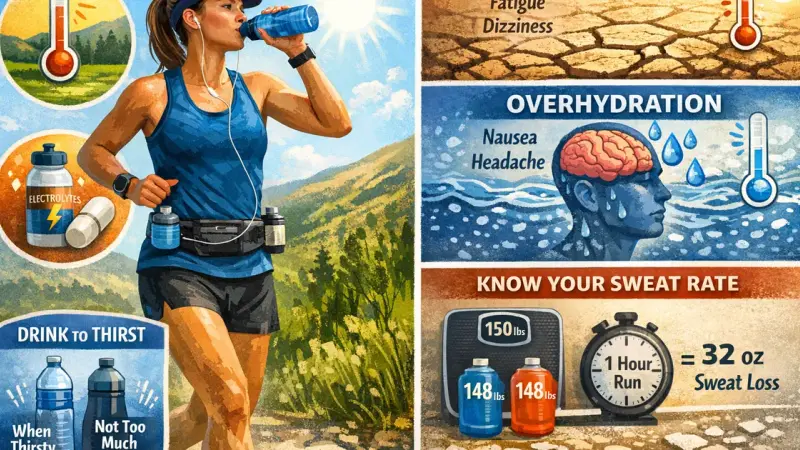
Start with three separate questions: what happened in a measured session, what hydration approach you intend to use, and how you will access fluids along the route. A single calculator cannot answer all three.
The 2017 NATA fluid-replacement statement emphasizes individual assessment. Both insufficient and excessive fluid intake can be harmful. Its guidance does not support assigning everyone the same volume from body weight alone. Discuss personal requirements with an appropriate professional, especially when a medical condition or treatment affects fluid intake.
Choose the worksheet for your question
| Your task | Resource | What it does not decide |
|---|---|---|
| Estimate losses from measurements around one session | Measured sweat-rate worksheet | Appropriate drinking rate, sodium needs or diagnosis |
| Calculate carrying and refill quantities | Water carrying and refill planner | Whether your chosen volume or refill spacing is suitable |
| Prepare questions about an individual strategy | The record below, discussed with an appropriate professional | A personalized prescription from this article |
The measurement equation uses body mass in kilograms and fluid/urine volumes in litres. It estimates session sweat loss as before mass minus after mass, plus drinks minus urine. Duration converts that result to a rate. A fluid ounce is a volume unit, not an ounce of body mass. The linked worksheet handles the conversions and records missing urine measurements explicitly.
Before the run: record the plan and assumptions
Use an approach already chosen for your circumstances. This checklist helps you identify missing information before relying on the route.
| Planning item | Your record |
|---|---|
| Run and expected duration | |
| Expected conditions and source/date checked | |
| Where the hydration approach came from | |
| Starting quantity and container capacity, with units | |
| Refill sources, availability and opening times | |
| Product and actual serving information, if used | |
| Route change or exit if a source is unavailable | |
| Questions still unresolved |
Read the actual label when recording a product. Record serving size and preparation instructions with any carbohydrate or sodium amount; brand name alone does not specify the product or concentration. The worksheet does not select a sodium dose from run duration, visible salt residue or a broad “heavy sweater” label.
During the run: access is more than a total
A carrying total says nothing about where supplies become available. Work through the gaps between sources, and distinguish container capacity from the amount you intend to obtain or consume. Unused capacity is not a reason to drink more.
Illustrative logistics: a previously chosen total of 1.3 L, a 0.5 L start and 0.5 L refill capacity require 0.8 L additional: one 0.5 L fill and one 0.3 L fill. This arithmetic does not recommend 1.3 L, set a drinking frequency or verify that either stop occurs at a useful location.
If the only source is closed, the arithmetic can still be correct while the route plan fails. Record an alternative route or exit rather than treating a spreadsheet total as proof of access.
Afterward: compare the record with the plan
| Observation | What actually happened | Uncertainty / question |
|---|---|---|
| Duration and conditions | ||
| Drinks obtained and consumed, with units | ||
| Refill sources available or missed | ||
| Measurement conditions, if using the sweat worksheet | ||
| Symptoms or unexpected difficulties | ||
| What needs discussion before another attempt |
Repeated sweat assessments in relevant conditions are more informative than treating one session as a permanent personal rate. Wet clothing, unrecorded intake and inconsistent measurements can affect the estimate. Do not turn a changed number into an automatic replacement prescription.
Symptoms are outside these worksheets
NATA notes that early symptoms of inadequate and excessive hydration can overlap. Adding salt does not make excessive fluid intake safe; sports drinks can also contribute to overconsumption. Neither a symptom checklist nor these calculations can establish the cause.
Confusion, loss of consciousness or seizures during heat exposure require emergency help. Call the local emergency number, stop activity, move to a cooler place and begin rapid cooling while help is coming. Do not wait for sweating to stop: heat stroke can involve heavy sweating. These actions follow CDC/NIOSH heat-illness guidance, which is written for occupational heat exposure; the worksheets are not an emergency assessment.
Key Takeaway
Keep the measurement, the chosen strategy and the route logistics separate. Record what happened and what remains uncertain before changing the plan.
Frequently Asked Questions
How much should I drink while running?
Is sweat rate the amount I should drink?
What does the hydration calculator do?
Can these tools tell me whether symptoms are dehydration?
References
- https://www.nata.org/sites/default/files/2025-08/fluid_replacement_for_the_physically_active.pdf
- https://www.cdc.gov/niosh/heat-stress/about/illnesses.html