
Contents
Mizuno Hyperwarp Elite Review: Light, Low-Drop Race Efficiency
The Mizuno Hyperwarp Elite pairs dual-layer Enerzy XP foam with a carbon plate in a 6oz racer. See its fit, ride, tradeoffs, and ideal distances.

Quick Hits
- •The Elite uses dual-layer Enerzy XP foam and a full-length carbon Smooth Speed Plate.
- •Its 3.5mm drop, 6oz catalog weight, and forefoot-biased geometry favor efficient race turnover.
- •RTINGS measured strong energy return but found average stability and a less compelling ride for heel strikers.
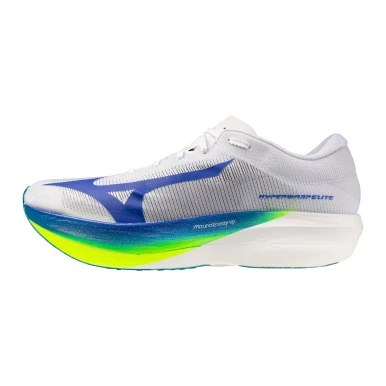
Mizuno Hyperwarp Elite Review
This review combines Mizuno's product information, TrainingPlan's audited catalog, and RTINGS' published testing. It does not represent first-person testing by TrainingPlan. The research manifest records no verified exact-model Amazon listing, so this draft contains no affiliate CTA.
Quick Verdict
The Mizuno Hyperwarp Elite is the center model in Mizuno's new three-shoe racing family, but “center” does not mean ordinary. At a cataloged 6.0oz with a 3.5mm drop, dual-layer Enerzy XP foam, and a full-length carbon Smooth Speed Plate, it is a highly specialized racer. RTINGS measured roughly 82% energy return at both the heel and forefoot and found the package efficient over longer races.
Its geometry favors runners who land and load farther forward. Heel strikers and athletes who need a broad, inherently stable base may get more from the Hyperwarp Pro. The Elite's appeal is low mass, strong rebound, and a snappy toe-off—not universal ease. See the best carbon plate racing shoes for other approaches.
Key Specifications
| Spec | Value |
|---|---|
| Category | Racing |
| Cushion Level | Maximum |
| Heel-to-Toe Drop | 3.5mm |
| Weight (Men's/Women's) | 6.0oz / 6.0oz |
| Stack Height | 38mm heel / 34.5mm forefoot |
| Pronation Support | Neutral |
| Width Options | Standard |
| MSRP | MSRP: $275 |
| Surface | Road |
The table uses exact current TrainingPlan runtime values. Mizuno's published stack is roughly one millimeter lower, a small measurement-convention difference. The unisex reference weight is repeated in both catalog fields; actual weight varies with size.
What Changed
The Elite belongs to a new Hyperwarp structure rather than replacing a same-named predecessor. Mizuno gives each model a clear job: Pure pursues the most minimal expression, Elite balances low weight and long-distance race performance, and Pro adds protection and stability.
The Elite's dual-layer midsole pairs a PEBA-based upper layer with a TPEE-based lower layer according to RTINGS, with the carbon plate between them. Mizuno's monofilament woven upper and lightweight G3 outsole complete the race-focused construction. This is materially different from the more support-oriented carbon-infused nylon plate in the Pro.
Ride and Intended Use
Mizuno says the Smooth Speed Plate supports the midfoot through heel and assists forefoot running. RTINGS' results align with the responsive portion of that claim: 82.0% forefoot and 81.9% heel energy return in its protocol, with a bouncy but not mushy midsole and a snappy toe-off. The outlet found the low-drop, forefoot-rich geometry particularly compatible with forward landings.
The Elite can cover 5K through marathon racing, but its strongest distinction is sustained efficiency rather than protective stability. The best 5K racing shoes guide highlights sharper short-race options, while the best half marathon shoes includes models balancing response and distance protection.
Fit and Sizing
RTINGS found true-to-size length and a secure race fit. The monofilament woven upper is designed for low weight and breathability, not the plush structure of a daily trainer. The catalog lists only a standard width.
Runners should use their normal size as the starting point, then verify forefoot volume and heel hold at faster pace. The plate and rocker work best when the foot stays correctly positioned over the geometry. Anyone who needs a wide fit should avoid solving the issue simply by adding length.
What Works Well
- Excellent weight-to-cushion ratio: A 6.0oz catalog weight accompanies a substantial race platform.
- Strong measured rebound: RTINGS recorded nearly identical, high energy return at heel and forefoot.
- Race-specific plate: The full-length carbon design creates stiffness and a decisive toe-off.
- Clear lineup position: It is more performance-focused than the Pro without pursuing the Pure's most minimal construction.
Tradeoffs
- Average lateral stability: RTINGS did not find the Elite as composed as the broader Hyperwarp Pro.
- Forward-landing bias: Heel strikers may not engage the geometry as effectively.
- High MSRP and one width: The MSRP: $275 price and standard-only fit narrow the audience.
Who Should Consider This Shoe
- Midfoot and forefoot strikers who respond well to low-drop plated geometry.
- Racers seeking very low mass without giving up forefoot cushioning.
- Athletes wanting one premium shoe for multiple road-race distances.
Who Should Look Elsewhere
- Runners who prioritize broad-platform stability.
- Heel strikers who prefer a higher offset and generous rear protection.
- Buyers seeking a durable daily mileage shoe rather than a race specialist.
Cross-Brand Comparison
The Saucony Endorphin Pro 5 is another long-distance carbon racer, but fit, rocker, and drop will decide which geometry works better for an individual. The Nike Vaporfly versus ASICS Metaspeed guide is useful context: there is no single super-shoe shape that suits every strike pattern.
Same-Brand Comparison
The Hyperwarp Pro is the obvious sibling comparison. It adds platform width, heel protection, and a steadier ride while giving up some of the Elite's light, explosive character. The Mizuno Wave Rebellion Pro 2 uses a more radical silhouette. The Elite is Mizuno's cleaner conventional answer for runners who still want a highly responsive plate-and-foam system.
Value
At MSRP: $275, value depends on fit and racing intent. RTINGS' strong rebound measurements and the exceptionally low catalog weight support the performance case. The shoe is poor value as an occasional fashion purchase or routine easy-day trainer. It becomes defensible when its geometry matches the runner and it fills a genuine race-day role across several distances.
Final Verdict
The Mizuno Hyperwarp Elite has a precise brief: deliver light, responsive, carbon-plated efficiency for runners who can load a low-drop platform. Its dual-layer foam and plate produce excellent measured rebound, while the 6.0oz reference keeps the package lean. Average stability and a forward-strike bias are meaningful boundaries.
Choose it for race day when that geometry fits your mechanics and preferences. Choose the Hyperwarp Pro when control, heel comfort, and workout versatility matter more than minimum weight.
Key Takeaway
The Hyperwarp Elite is a light, responsive racer tuned for forward landings, with less stability and heel-striker appeal than the more controlled Pro.
Frequently Asked Questions
Who is the Mizuno Hyperwarp Elite best for?
How does the Mizuno Hyperwarp Elite fit?
Is the Mizuno Hyperwarp Elite worth its $275 MSRP?
References
- https://usa.mizuno.com/running-hyperwarp-elite-unisex
- https://www.rtings.com/running-shoes/reviews/mizuno/hyperwarp-elite-carbon-fiber