
Contents
Nike Pegasus Trail 5 Review: The Correct ReactX Specs
Research-based Nike Pegasus Trail 5 review covering its ReactX midsole, ATC outsole, verified 9.5mm drop, road-to-trail ride, fit, limitations, and comparisons.

What changed: Corrected the midsole from React to ReactX and replaced the old 8mm drop, 33mm heel, and weight figures with Nike's exact-model references; added independent measurements, fit nuance, current-model status, and limitations.
Quick Hits
- •Nike lists 300g for men's US 10, 243g for women's US 8, a 37mm men's heel stack, and a 9.5mm drop.
- •ReactX foam and Nike Trail ATC rubber replace the article's former React-only description.
- •The current ACG Pegasus Trail has more foam, more traction, a wider forefoot, and an 8mm drop.
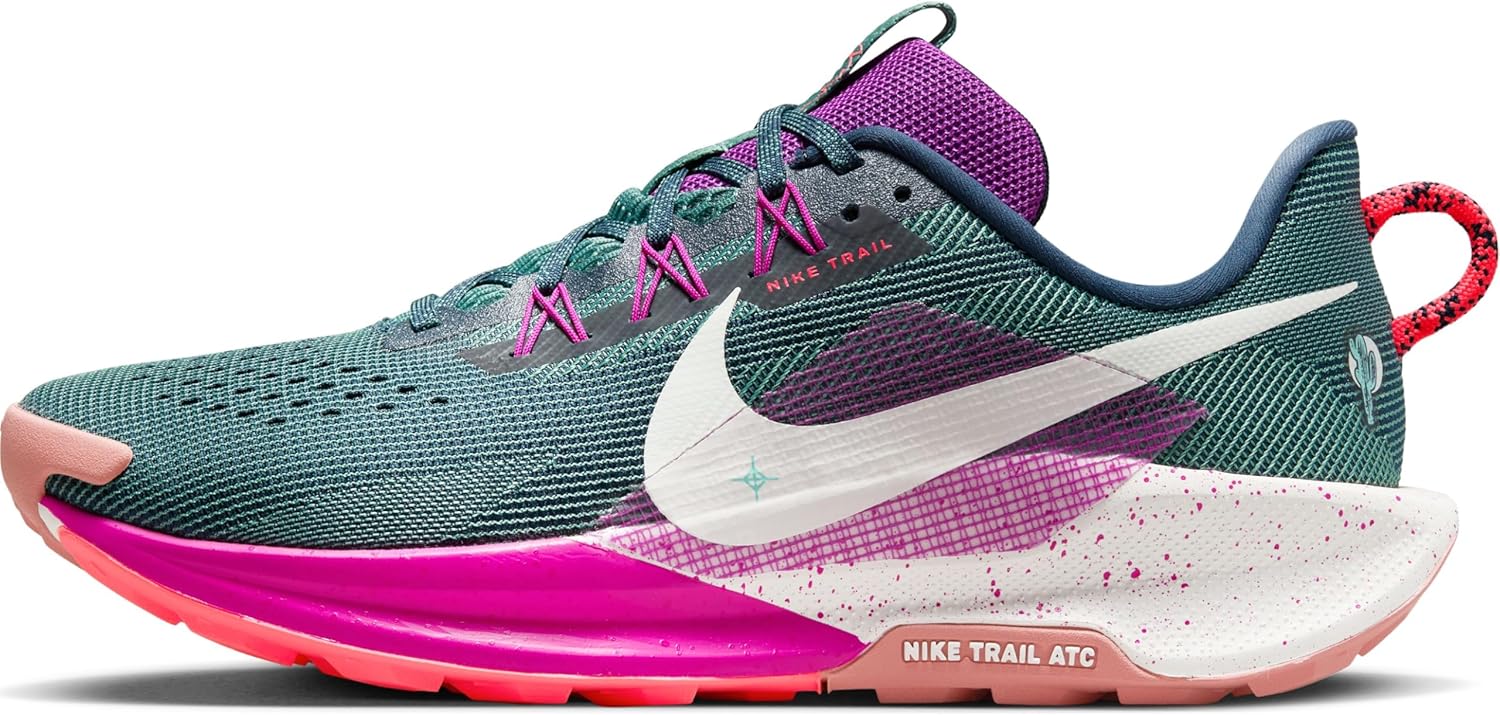
Nike Pegasus Trail 5 Review
Quick Verdict
The Nike Pegasus Trail 5 is a genuine road-to-trail shoe: cushioned and smooth enough for pavement, with enough outsole texture for gravel, park paths, and moderate singletrack. Its appeal is transition, not specialization. Deep mud, sharp off-camber terrain, and technical descending expose the limits of its 3.5mm nominal lugs and road-influenced build.
The previous version of this page had the core construction wrong. Version 5 uses ReactX, not legacy React, and Nike's exact-model figures are a 9.5mm drop and 37mm men's heel stack rather than 8mm and 33mm. TrainingPlan has not hands-on tested this pair; the verdict is based on Nike's technical brief and three independent exact-model tests.
Key Specifications
| Spec | Verified value |
|---|---|
| Category | Road-to-trail trainer |
| Midsole / outsole | ReactX / Nike Trail ATC rubber |
| Heel-to-Toe Drop | 9.5mm |
| Weight (Men's/Women's) | 10.6oz / 8.6oz |
| Stack Height | 37mm heel / 27.5mm forefoot |
| Lugs | 3.5mm nominal |
| Width Options | Standard |
| MSRP | MSRP: $150 |
Nike's technical brief uses men's US 10 and women's US 8 for the 300g and 243g weights. It publishes the 37mm men's heel but not the forefoot; 27.5mm is the value implied by the official 9.5mm drop and is also reported in RoadTrailRun's spec set. RunRepeat measured its test pair at 34.6/25.0mm, 9.6mm drop, and 10.1 ounces, illustrating why brand specifications and one lab sample should not be mixed without labels.
What Changed
The major update from Pegasus Trail 4 is the ReactX midsole. Nike also introduced its All Terrain Compound outsole, revised the forefoot shape, raised the men's heel stack, and reduced outsole coverage in selected areas. Nike's brief describes 3.5mm lugs and more forefoot room on its MR-64 last.
Independent reviewers broadly found the ride softer and more road-friendly than version 4. RoadTrailRun's testers also noted the higher stack and flexible forefoot, while iRunFar emphasized the smoother road-to-trail transition. This is an evolution toward mixed-surface comfort, not an attempt to become a deeply lugged mountain shoe.
Ride and Intended Use
ReactX gives the Pegasus Trail 5 a cushioned, moderately responsive feel. On pavement, the shallow lugs do not create the harsh, disconnected sensation of an aggressive trail outsole. On gravel and dry dirt, the ATC rubber adds useful bite while the 37mm heel gives more underfoot protection than the old article suggested.
The compromise appears as terrain becomes loose or technical. RunRepeat's lab measured 3.2mm lugs on its sample and described the shoe as best for gravel and moderate trail. RoadTrailRun and iRunFar likewise stop short of positioning it as a mud or technical specialist. Wet rock performance can vary with surface texture, wear, and conditions, so a compound name should not be treated as a safety guarantee.
Use the shoe for routes that connect road, towpath, gravel, and manageable trail. There is no defensible fixed weekly-mileage range; terrain skill, fit, recovery, and wear condition matter more than a catalog number.
Fit and Sizing
Nike says the version 5 last adds room in the forefoot, yet its UK product page also says the shoe fits small and recommends going up half a size. Independent results do not fully agree: RunRepeat's owner voting leans true to size and its gel measurement found an average interior, while individual RoadTrailRun testers reported different volume needs.
Try your normal Nike trail size and a half-size up. Wear the socks you use on trails, then check heel hold on an incline and leave enough front space that toes do not contact the upper downhill. Do not solve forefoot pressure with so much extra length that the foot slides on uneven ground.
What Works Well
- Mixed-surface continuity: ReactX and moderate lugs behave coherently when a run alternates between pavement and dirt.
- More accurate protection: The official 37mm men's heel provides meaningful cushioning without pretending this is a maximal technical shoe.
- Moderate dry-trail grip: ATC rubber and 3.5mm nominal lugs suit gravel, park trails, and ordinary singletrack.
Tradeoffs
- Limited mud bite: The lug depth and layout are not designed for deep, soft ground.
- Size ambiguity: Nike's half-size-up advice and independent true-to-size reports make a returnable fitting important.
- Heavier than a road Pegasus: Trail rubber and the reinforced build add mass.
Who Should Consider This Shoe
- Runners whose normal route combines road, gravel, and moderate trail.
- Nike users wanting a familiar cushioned feel with more outsole grip.
- Travelers who value one versatile running shoe over terrain specialization.
Who Should Look Elsewhere
- Runners spending most of their time in mud or on highly technical mountain terrain.
- Road-only runners who do not need trail rubber.
- Athletes who prefer a low, precise platform with strong ground feel.
Cross-Brand Comparison
The HOKA Challenger ATR 7 is another cushioned hybrid with a lower drop. The New Balance Fresh Foam X Hierro v8 is more trail-centered and heavier, while the Saucony Peregrine 14 is the better starting point for deeper lugs and technical precision. The Pegasus Trail makes the strongest case when pavement remains a meaningful part of the route.
Same-Brand Comparison
The Nike Pegasus 41 is smoother for road-only training. The Nike Zegama 2 adds Vibram Megagrip and more trail protection for demanding terrain. Nike's current ACG Pegasus Trail succeeds version 5 with more ReactX, a wider forefoot, updated ATC traction, an 8mm drop, and a MSRP: $155 US price.
Value
At its original MSRP: $150 MSRP, the Pegasus Trail 5 competed directly with other premium hybrids. In 2026 it is a previous-generation shoe, so value depends on a meaningful reduction and the availability of the right size. A small discount is not enough if the current ACG model's wider forefoot or stronger traction better matches the route.
Final Verdict
The corrected Pegasus Trail 5 is more substantial than the old description: ReactX foam, a 37mm men's heel, 9.5mm drop, and Nike Trail ATC outsole. Those ingredients make it comfortable and competent across pavement, gravel, and moderate trail.
Its limitations are equally clear. It is neither a pure road shoe nor a technical-trail specialist. Buy it when a mixed route is the problem you actually need to solve, and fit it in a returnable setting because sizing evidence is not uniform.
Key Takeaway
Choose the Pegasus Trail 5 for mixed pavement, gravel, and moderate trail—not as a substitute for an aggressive technical-trail shoe, and not based on the incorrect React/8mm specifications formerly published here.
Frequently Asked Questions
Is the Nike Pegasus Trail 5 good on roads?
Is the Pegasus Trail 5 good for technical trails?
Does the Pegasus Trail 5 run small?
References
- https://about.nike.com/en/newsroom/collections/nike-running-shoes/Nike-Pegasus-Trail-5
- https://www.nike.com/gb/t/pegasus-trail-5-trail-running-shoes-dFd7ft
- https://runrepeat.com/nike-pegasus-trail-5
- https://www.roadtrailrun.com/2024/04/nike-reactx-pegasus-trail-5-multi.html
- https://www.irunfar.com/nike-pegasus-trail-5-review
- https://www.nike.com/t/acg-pegasus-trail-trail-running-shoes-Z5DRSN1X/HV8116-001