
Contents
How to Pick a Training Plan: Compare Fit Before Features
Compare two running plans using prerequisites, opening load, peak demands, recovery and adjustment guidance, with a filled half-marathon example.

Quick Hits
- •Check starting requirements and calendar fit before comparing optional features.
- •Plan labels are author-specific; read the actual first and peak weeks.
- •Count cross-training and preparation time as well as running.
- •A mismatch in required days or starting load cannot be cancelled out by a good total score.
- •Treat injury or illness interruptions separately from an ordinary scheduling conflict.
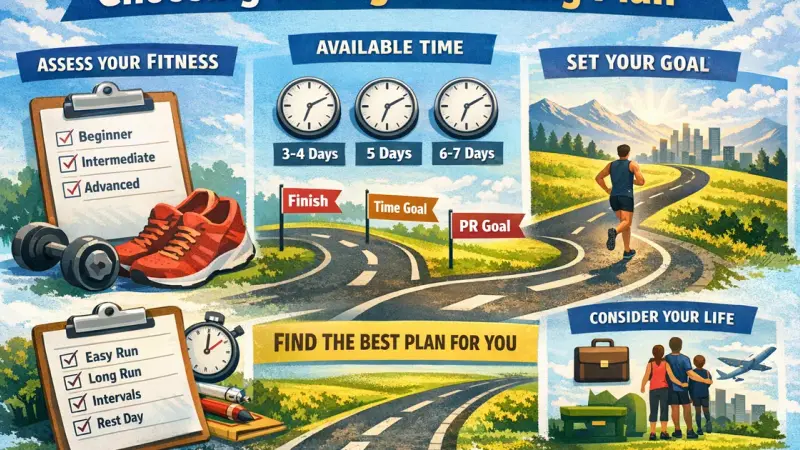
Start with the week you can currently manage and the calendar you actually have. A plan should be assessed against both before its branding, success stories or promised finish time influence the decision.
This page gives you a reusable comparison worksheet and a filled example using two published plans. It helps you choose what to investigate or rule out; it is not a substitute for following the complete plan instructions.
Write Your Starting Constraints
Record your recent typical running week, the range of weeks you have completed, longest recent session, experience with the proposed session types, available days and longest available time slot. Include other exercise, travel and recovery commitments.
Keep a desired future level separate from the current starting point. Choosing an advanced label does not resolve a gap between your recent training and week one.
If you are starting from scratch, use a starting-level resource before selecting a race plan that assumes regular running. A return after injury needs an appropriate return plan and any relevant professional guidance, rather than an automatic move into a plan labeled beginner.
Required Fit Comes Before Preferences
| Required check | What a mismatch means |
|---|---|
| Stated prerequisites | If you do not meet them, do not treat the published plan as ready to start unchanged. |
| Opening load and session demands | A large jump from recent training is a reason to seek a more suitable starting point or review, not award a lower score and carry on. |
| Required days and longest time slot | If those sessions cannot fit, rule out the unchanged schedule until a workable adjustment is established. |
| Race date and preparation window | Do not compress weeks merely to make the finish date line up. |
| Clear instructions and adjustment support | Identify unresolved questions before relying on the plan. |
Only then compare preferences: time versus distance prescriptions, format, explanation style, tracking convenience, cost and access to feedback. A favorite app interface cannot compensate for unavailable training days.
A Worksheet for Two Actual Plans
Open the full instructions and schedule for each candidate. Fill this table with numbers or explicit uncertainties; do not use a combined suitability score.
| Field | Plan A | Plan B |
|---|---|---|
| Author, exact version, source and date checked | Record | Record |
| Goal and prerequisites | Record | Record |
| Week-one running distance or time | Record, including optional branches | Record, including optional branches |
| Run days and other exercise days | Count both | Count both |
| Longest session and its estimated calendar slot | Record assumptions | Record assumptions |
| Peak week and total demands | Include other exercise | Include other exercise |
| Intensity instructions | Record effort types; mark unspecified proportions | Record effort types; mark unspecified proportions |
| Taper | Describe this plan's final weeks and race inclusion | Describe this plan's final weeks and race inclusion |
| Missed-day and adjustment guidance | Record what is actually explained | Record what is actually explained |
| Required-fit decision | Compatible, incompatible or unresolved—with reason | Compatible, incompatible or unresolved—with reason |
| Preferences worth comparing afterward | Record | Record |
Filled Example: Two Half-Marathon Plans
The following is a source-based comparison of Hal Higdon's published mile schedules, checked September 8, 2026: Novice 1 and Novice 2. Read those complete instructions before using either. This is not a head-to-head outcome study or an endorsement.
| Field | Novice 1 | Novice 2 |
|---|---|---|
| Starting audience | Assumes ability to run 3 miles, 3–4 times weekly | Described for more experienced runners; no single numerical entry test stated |
| Length | 12 weeks | 12 weeks |
| Week-one running | 10 miles, or 12 with Wednesday run option | 13 miles |
| Usual run days | Three plus optional Wednesday run/cross-training | Four |
| Other exercise in week one | Saturday 30 minutes; Wednesday cross-training if not running | Sunday 60 minutes |
| Longest pre-race run | 10 miles | 12 miles |
| Peak listed running week | Week 11: 20 miles, or 23 with Wednesday run | Week 11: 23 miles |
| Effort instructions | Comfortable running; optional practice races | Easy running plus some designated race-pace Wednesdays and optional races |
| Final week before race | 6 or 9 running miles before the race | 7 running miles before the race |
| Adjustment guidance | Allows rearrangement; check optional branches | Allows occasional missed sessions and rearrangement |
Neither table provides a complete measured intensity distribution. Do not invent an 80/20 percentage from session labels. Race-week figures above exclude the race itself; optional unmeasured activity also needs its own allowance.
Turn Distance Into Calendar Time
For illustration only, assume 10 minutes per mile, 15 minutes of preparation/travel/cleanup per exercise day, and select the Wednesday running option in Plan A. These assumptions estimate calendar demand; they do not prescribe a training pace.
- Plan A opening week: 12 × 10 + 30 = 150 exercise minutes. Five exercise days add 75 minutes overhead: 225 minutes, or 3 hours 45 minutes.
- Plan B opening week: 13 × 10 + 60 = 190 exercise minutes. Five exercise days add 75 minutes overhead: 265 minutes, or 4 hours 25 minutes.
Under the same assumptions, each selected peak week is 23 × 10 + 60 + 75 = 365 minutes, or 6 hours 5 minutes. The longest pre-race run slots differ: 115 minutes for 10 miles plus overhead versus 135 minutes for 12 miles plus overhead. Additional warm-ups, strength work or other activities require additional time if not already counted. Weather, terrain and actual effort can change duration.
A Filled Fit Decision
Synthetic runner: Alex has a stable four-run routine totaling 12 miles and has completed a four-mile run. Alex can reserve four hours in the opening week, expects six hours later, and has a maximum two-hour session slot.
Plan B's opening budget exceeds the available four hours; its longest-run slot also exceeds two hours. Those are incompatibilities with the unchanged plan, regardless of preferred features. Plan A is closer at the start, but its selected peak budget still exceeds six hours and its later progression needs review. The result is neither plan approved unchanged. Alex must resolve the time limit, find another plan, or arrange an appropriate review. A lower starting total does not prove suitability.
Read Progression and Taper in Context
A weekly percentage cannot capture changes in session length, effort and available recovery. Do not treat “under 10%” as a safety certificate or a larger percentage alone as a complete diagnosis of a plan's quality.
Likewise, do not impose a universal two- or three-week taper on every distance and background. Record what the actual plan does, distinguish pre-race training from the race itself, and seek an explanation when its assumptions do not fit your situation. This worksheet describes differences; it does not certify a training method.
For another scheduling tradeoff, the three-day half-marathon evidence guide counts the cross-training and calendar overhead that a running-day label can hide. The half-marathon guide is the broader distance resource; choosing and following a plan are separate tasks.
Separate Schedule Changes From Recovery Decisions
| Interruption | Bounded next decision |
|---|---|
| One ordinary scheduling conflict | Review the remaining week; do not automatically stack the missed session onto another demanding day. |
| Travel or several unavailable days | Check the author's adjustment guidance and the next feasible week; do not automatically repeat or skip ahead by a fixed number of days. |
| Illness, pain or injury | Let recovery needs and relevant professional advice determine the next step. A calendar rule cannot establish readiness to resume. |
| Goal date changes | Reconsider the remaining preparation window and goal before compressing the schedule. |
The fixed-plan adjustment guide provides examples of reviewing a changed week. Use it to structure the decision, not to assume software can clear an illness or injury.
Compare Support Fairly
A fixed plan makes the intended structure available to inspect. Ask what explanation and adjustment guidance accompanies it.
An adaptive app can calculate changes based on the inputs and rules it actually uses. Ask what triggers a change, what requires your input, and what you can review before following it. The adjustment-process guide explains that distinction.
A human coach can discuss context and proposed changes, but scope, qualifications, contact frequency and fees vary. Check those terms rather than assuming unlimited or clinical support.
The two named examples above are publicly viewable schedules at the verification date. This comparison makes no claim about current app subscriptions, prices or paid-service capabilities. Choose support that resolves your actual questions, after required fit has been established.
Key Takeaway
Choose only after checking required fit. Record incompatibilities and unanswered questions explicitly, then compare preferences among options that remain plausible.
Frequently Asked Questions
How do I know whether a plan fits?
Are beginner and advanced labels standardized?
Must every plan follow a 10 percent rule?
Is a paid or adaptive plan necessarily better?
References
- https://www.halhigdon.com/training-programs/half-marathon-training/novice-1-half-marathon/
- https://www.halhigdon.com/training-programs/half-marathon-training/novice-2-half-marathon/