
Contents
Running Foot Strike: Heel, Midfoot and Forefoot Explained
Understand initial foot contact, what foot-strike studies can establish, and why a reported pattern cannot select an injury treatment.

Quick Hits
- •Foot strike describes which part of the foot contacts first.
- •A contact label does not identify the cause of pain.
- •A measured loading difference is not proof of a difference in injury incidence.
- •Comparing habitual patterns is different from testing a gait change.
- •Keep unclear observations labeled unknown.
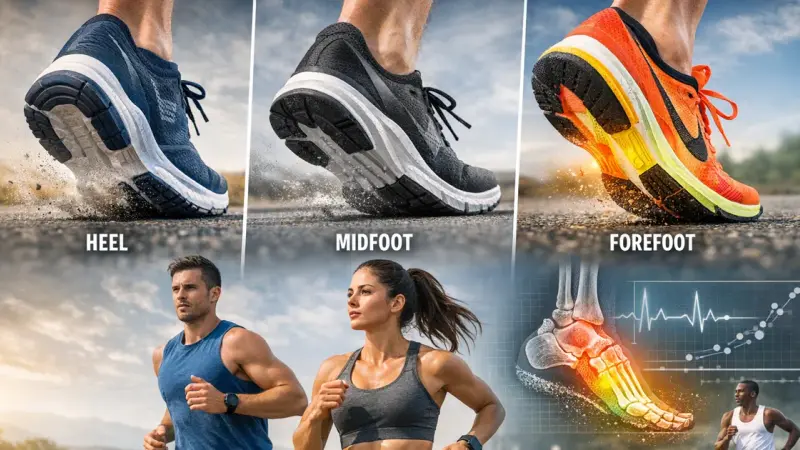
A foot-strike label describes the start of ground contact. It does not, by itself, explain pain, measure running economy or tell you which technique to use.
Describe the contact you can see
| Pattern | Description | Limit |
|---|---|---|
| Rearfoot or heel strike | Heel contacts before the forefoot | Does not describe every other part of the stride |
| Midfoot strike | Heel and forefoot contact approximately together | An unclear frame should not be forced into this category |
| Forefoot strike | Forefoot contacts before the heel | Does not establish what the heel does later in the step |
| Unknown | Contact order cannot be established | A useful observation, not a failed assessment |
Foot-contact order and where the foot is relative to the body are different descriptions. Neither should be converted into an injury diagnosis from a single frame. This guide does not rank a particular landing location as a universal correction.
Ask which question a study answered
| Research question | What to check before applying the finding |
|---|---|
| How do habitual patterns differ? | Were runners compared in their usual pattern, and under what conditions? |
| What happens after an instructed change? | Was the change immediate or practiced over time? What was actually measured? |
| Are injuries associated with a pattern? | Were injuries recorded prospectively or recalled from the past? |
| Does changing pattern prevent injury? | Was a change tested against a comparison group with injury outcomes? |
Those questions are not interchangeable. An immediate laboratory measurement cannot establish a long-term injury benefit.
Anderson and colleagues' 2020 systematic review examined injury, economy and biomechanics. It reported differences in loading measures between strike conditions, but could not determine the relationship with injury risk from the available retrospective evidence. A different distribution of mechanical load is not a personal safety score.
Why “the injury rates are the same” overstates the evidence
Burke and colleagues' 2021 review included 13 studies using categorical patterns or continuous contact measures. Findings differed, and the injury evidence had limitations including retrospective designs, small samples and assessment methods. Uncertain evidence is not proof of identical injury rates.
A concrete example is Daoud and colleagues' 2012 retrospective study. It examined 52 collegiate cross-country runners: 36 primarily rearfoot and 16 primarily forefoot. Rearfoot runners had a higher recorded repetitive-stress injury rate in that sample. The authors explicitly did not test the causal explanation. It was not a trial showing that switching a recreational runner's strike prevents injury.
Read the population, injury definition and comparison before applying a headline to yourself. A finding about habitual runners does not automatically describe someone learning a new pattern.
Use observation to prepare a question
If you already have an ordinary running clip with the foot visible, note the view, conditions and uncertainty. Do not run through pain or force a different contact pattern to create a recording.
For example: “The side view shows heel-first contact in the visible steps, but I do not know whether it represents my other runs.” That is an observation. “My heel strike caused my knee pain” adds a conclusion the clip has not established.
Use the foot-strike observation worksheet to record those details and copy questions for an assessment. The worksheet handles your notes; this article explains how to interpret the evidence. Neither analyzes uploaded video or prescribes a transition schedule.
If an injury or persistent pain is the concern, discuss it with an appropriately qualified clinician. Questions can include what further assessment is needed, why a particular change is being considered, and how its effects would be reviewed. A broad label such as “shin problem” should not automatically lead to a cadence increase, a new shoe category or a different landing pattern.
Key Takeaway
Describe initial contact separately from conclusions about injury or efficiency. Read the study design and population before turning a research finding into a decision about changing your own running.
Frequently Asked Questions
Is heel striking bad for running?
Should I switch to forefoot running?
How do I identify my foot strike?
References
- https://pubmed.ncbi.nlm.nih.gov/31823338/
- https://pubmed.ncbi.nlm.nih.gov/34527750/
- https://pubmed.ncbi.nlm.nih.gov/22217561/