
Contents
Tracking Running Progress: Key Metrics That Actually Matter
What should you track as a runner? Learn which metrics provide actionable insights versus vanity numbers, and how to use data for improvement.

What changed: Reorganized the guide around a minimal metric set and weekly decision process, added evidence for subjective monitoring, and linked the narrower pace-trend workflow.
Quick Hits
- •Start with volume, comparable performance, RPE, and recovery context.
- •Compare like with like; weather, terrain, and workout purpose affect pace.
- •One unusual run is a prompt for context, not proof of progress or decline.
- •Review weekly; use longer windows for fitness trends.
- •Add heart rate, HRV, or load scores only when they answer a defined question.
Tracking Running Progress
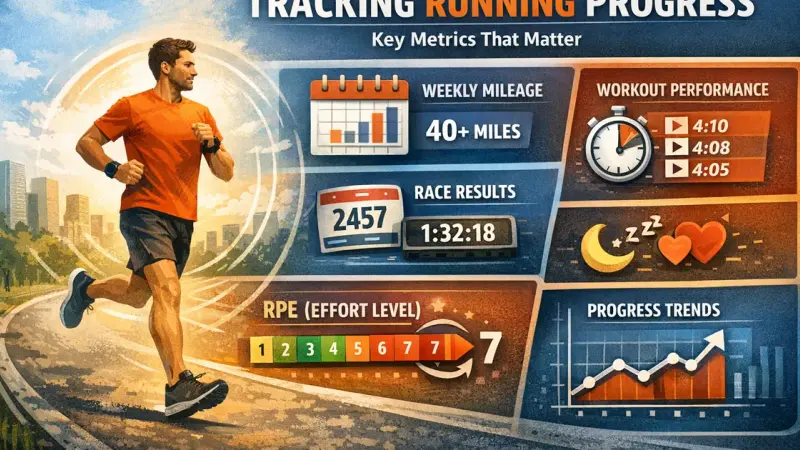
The useful question is not “What can my watch measure?” It is “What decision will this metric improve?” For most runners, four records are enough to begin.
The Minimal Tracking Set
| Record | Capture | Decision it can support | Main caution |
|---|---|---|---|
| Weekly volume | Running time or distance | Whether training was consistent with the plan | More is not automatically better |
| Comparable performance | A repeat workout, time trial, or race | Whether the same task changed over time | Conditions and pacing must be comparable |
| Session RPE | 1–10 effort rating soon after each run | How hard the completed work felt | Use the same scale and anchors |
| Recovery note | Sleep, soreness, motivation, illness, unusual stress | Whether the next planned demand still makes sense | A note is context, not a diagnosis |
Research reviews on athlete monitoring support subjective measures such as perceived effort and wellness because they are practical and responsive. They work best as part of a repeatable framework, not as a magic readiness score.
A Five-Minute Weekly Review
1. Did the Work Match the Plan?
Compare completed time or distance with what you intended. Note why the two differ instead of treating every shortfall as failure: illness, travel, weather, pain, and deliberate recovery are materially different explanations.
2. How Did the Work Feel?
Scan RPE and recovery notes. A week of normal effort and normal recovery tells a different story from the same mileage with rising effort, worsening sleep, or persistent soreness.
3. What Comparable Result Do You Have?
Choose one repeatable reference:
- the same interval session with the same recoveries;
- a controlled tempo on a similar route;
- a regular time trial;
- a race at the same distance, with course and weather noted.
A faster result at similar effort can support a progress hypothesis. It does not isolate the cause, and one session can still be affected by wind, temperature, terrain, pacing, measurement error, or freshness.
4. Is an Adjustment Needed?
Use a simple rule:
- Plan matched + response normal: continue unless another constraint changed.
- Plan missed + explanation temporary: resume deliberately; do not automatically make up every mile.
- Effort or recovery worsening across several entries: review the next hard session and total load.
- Persistent pain, illness, or marked functional change: step outside the dashboard and seek appropriate professional guidance.
Tracking Pace Without Chasing It
Pace is most useful inside a controlled comparison. Our pace-progression tracking guide covers rolling trends and plateaus in detail.
For a quick comparison, keep these factors visible:
| Factor | Why it matters |
|---|---|
| Workout purpose | Easy, threshold, and interval paces answer different questions |
| Route and surface | Hills, turns, trails, and track surfaces change pace |
| Weather | Heat and wind can materially affect the result |
| Recovery | A rested time trial is not equivalent to a workout inside a heavy week |
| Measurement | GPS smoothing and short intervals can distort split pace |
If those factors differ, compare effort and execution before comparing raw pace.
When Extra Metrics Earn Their Place
Add one metric at a time and state its job.
Heart Rate
Useful for comparing internal response at similar pace or controlling easy effort. Interpret it with heat, hydration, caffeine, stress, sensor quality, and medication in mind.
Heart Rate Variability
Potentially useful as an individual morning trend when measured consistently. It is sensitive to many non-training factors and should not issue a standalone “train” or “rest” command.
ATL, CTL, and TSB
Useful for summarizing recorded training stress. Read how ATL, CTL, and TSB work before treating their platform labels as direct fitness or fatigue measurements.
Cadence and Running Dynamics
Useful when investigating a defined technique question with comparable pace and terrain. A universal cadence target is not a valid progress standard.
Worked Monthly Review
Imagine four weeks with similar running time. A controlled 5 × 1 km session is slightly faster, average RPE is unchanged, and recovery notes are normal. That combination supports “performance at this task likely improved” more strongly than pace alone.
Now change one fact: RPE rises from 6 to 9 and sleep notes worsen. The faster splits remain real, but the decision changes. Instead of adding load immediately, preserve the context and see whether recovery normalizes before drawing a broad fitness conclusion.
Metrics to De-Emphasize
- estimated calories when the estimate will not change a fueling plan;
- fastest isolated easy-run pace;
- step counts that duplicate your running-volume question;
- comparison with another runner whose course, training, and physiology differ;
- any score you cannot explain well enough to act on.
For race data, use the dedicated race-results analysis workflow. For day-to-day decisions, keep the system small: work completed, response, result, context.
Use your dashboard to view the record, then write the decision in plain language. If the data cannot support that sentence, collect a better comparison before changing the plan.
Key Takeaway
A small, consistent set of metrics is more useful than a large dashboard with no decision rule. Track the work, the response, the result, and the context.
Frequently Asked Questions
What is the most useful metric for a new runner?
Should I track pace on every run?
How often should I review running data?
What if the metrics disagree?
References
- https://pmc.ncbi.nlm.nih.gov/articles/PMC9012875/
- https://pmc.ncbi.nlm.nih.gov/articles/PMC4789708/
- https://www.acsm.org/docs/default-source/files-for-resource-library/exercise-intensity-infographic.pdf