
Contents
Mobility and Flexibility for Runners: Choose a Routine for Your Purpose
Compare warm-up, post-run stretching and separate mobility time, with practical time budgets, position choices and clearly scoped research.

Quick Hits
- •Choose a routine by purpose, available time and usable positions.
- •Warm-up, flexibility work and strength training have different jobs.
- •Count both sides and transitions; a timer is not a reason to force a position.
- •Pain or a short stride does not diagnose a mobility restriction.
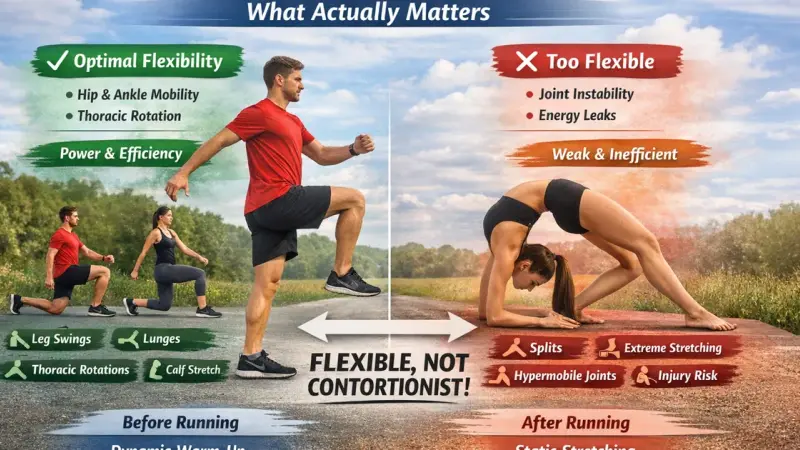
Start with the task you want to support. Preparing for a run, exploring comfortable movement and recording strength work are different jobs. A routine should fit your available time and positions you can use without forcing them.
Four terms, four different jobs
| Term | Meaning in this guide | What it does not establish |
|---|---|---|
| Flexibility | Available range of motion in a particular movement or position | More range is not automatically better running performance. |
| Mobility | Your ability to move through a useful range with control for the task | A feeling of tightness is not a diagnosis of a restricted joint or its cause. |
| Warm-up | Preparation for the activity you are about to do | Completing a fixed list does not guarantee injury prevention or readiness for a hard session. |
| Strength | Ability to produce force in a particular task | Stretching alone is not a resistance-training program. |
A short stride, sore back or unfamiliar movement does not identify one “tight” or “weak” area as the cause. Do not use this page as a pass/fail mobility screen. Seek appropriate assessment for persistent pain, new limitations or uncertainty about suitable exercise.
Choose one routine
| Purpose | Time to allow | Equipment and positions | Where to start |
|---|---|---|---|
| Prepare for an upcoming run | At least the time needed for your chosen warm-up; the general NHS example takes at least six minutes, with longer if needed | Clear standing space; support if needed | Use the professional warm-up reference below, adapted to the planned activity. |
| Optional comfortable stretching after a run | About seven minutes for the current five bilateral holds, including transitions; longer if needed | Wall/chair support and, for floor options, a comfortable surface | Use the post-run template; choose usable positions rather than forcing the entire list. |
| Separate mobility/flexibility time | A ten-minute planning example below; additional setup or adaptations may take longer | Space/support suited to the selected movements | Choose a small menu from professional references; this is separate from the next run's preparation. |
You do not need to do all three. If a floor position is impractical, choose a suitable standing or seated movement for your purpose, or omit it; a different position is not necessarily an equivalent stretch of the same structure.
Pre-run preparation
The NHS general warm-up includes marching, heel digs, knee lifts, shoulder rolls and shallow knee bends. Its written routine allows at least six minutes, and longer if needed. This is a general exercise reference, not proof that six minutes prepares every runner for intervals. Follow its demonstrations and suitability guidance rather than rushing repetition targets.
The same reference advises stopping if exercise causes pain or you become unwell, and seeking advice about persistent or concerning symptoms. If conditions, injury or recent health changes affect suitable exercise, arrange professional guidance. NHS reference, reviewed June 24, 2026.
Post-run stretching
The post-run stretching template keeps the short routine and longer exercise menu separate. Five holds of 30 seconds on each side require 5 × 2 × 30 = 300 seconds of holding. Add 120 seconds for switching sides and positions: 420 seconds, or seven minutes. That allowance is editorial scheduling arithmetic, not a validated recovery dose.
Take longer for transfers or skip an unsuitable position. Stretching is optional, and this clock does not establish how much range you need or whether a maneuver treats pain. NHS post-exercise guidance gives professional position examples and advises individualized changes where injury or medical circumstances require them.
A separate session: reserve time, then choose movements
Here is a hypothetical ten-minute time budget, not a required routine or clinical exercise prescription:
| Part | Budget |
|---|---|
| Comfortable general movement appropriate to you | 3 minutes |
| Set up a stable chair/wall or floor space and choose usable movements | 2 minutes |
| Four selected bilateral movements: 20 seconds each side plus 20 seconds for side/position changes per movement | 4 minutes |
| Record what you did and any questions | 1 minute |
| Total | 10 minutes |
The arithmetic is 180 + 120 + 4 × (20 + 20 + 20) + 60 = 600 seconds. A professional reference may specify a different repetition or hold format; use that instruction and recalculate the time instead of forcing every movement into this budget. A simultaneous two-sided position is not automatically counted twice.
For supported standing and seated options, the NHS flexibility reference demonstrates calf movements and comfortable neck movement. It does not prescribe pushing the head with a hand. Choose movements for a relevant purpose; those examples are not mandatory replacements for a hip or lower-limb task.
Worked choice: five minutes before leaving
Hypothetical runner: five minutes remain before a planned demanding run, and there is no practical floor space. The runner does not squeeze a seven-minute stretching sequence into five minutes or treat it as the warm-up. They change the run timing or session so appropriate preparation can fit. The optional separate mobility session can happen later when space is available.
If the purpose later is simply to explore comfortable movement, a supported standing or seated option may be usable. If the purpose is a specific painful restriction, changing positions without assessment does not identify or treat its cause.
What stretching research does—and does not—show
Dose, timing, participants and the performance test matter. The following summaries use the published abstracts; neither study tested this guide’s routine menu.
Wilson and colleagues (2010) studied ten trained male distance runners. On separate visits, participants completed 16 minutes of five lower-body static stretches or quiet sitting, followed by 30 minutes of running at 65% of VO2max and a 30-minute distance-performance test. The stretching condition had higher energy expenditure during the first running segment and less distance covered in the performance test. Those findings concern this relatively long pre-run stretching protocol and small trained sample, not every brief stretch or post-run routine.
Hayes and Walker (2007) studied seven competitive male middle- and long-distance runners under control, static, progressive-static and dynamic conditions. Each stretching routine used two 30-second bouts for each of five exercises. Running economy and oxygen uptake were measured in the final three minutes of a ten-minute run below lactate threshold; neither measure changed significantly. This submaximal test does not establish that all stretching is neutral before maximal performance.
These different protocols do not support a universal 2–5% performance penalty lasting 30 minutes or a guarantee that dynamic movements have no adverse effects.
Likewise, immediate range or perceived comfort is not proof of improved race performance, injury prevention or long-term adaptation. The recovery guide separates soreness from function and adaptation when discussing optional techniques.
Foam rolling and the IT band
Do not infer that a lateral-thigh sensation proves the IT band has been lengthened. In a 2021 randomized trial involving 30 participants, a single stretching or rolling intervention did not change short-term IT-band stiffness at the measured sites. That result is limited to the studied intervention and measurements; it is not proof that every possible technique has the same effect.
Rolling is optional. Pain is not a target for greater pressure, and a roller is not a diagnostic or injury-treatment tool supplied by this guide.
Keep a useful record
Record the selected movement, side, actual duration or repetitions, support and how it felt. Do not turn the entry into a readiness score. If you are recording resistance work, use the strength session log for load units, per-side counts and comparisons; it is a separate task from this routine-selection guide.
Key Takeaway
Choose one useful task, use comfortable positions and record the context. More range or less soreness does not by itself prove better running or recovery.