
Contents
Heart Rate Variability (HRV) for Runners: What It Means and How to Use It
Demystify HRV. Learn what heart rate variability actually measures, how to interpret it, and whether it should influence your training decisions.

Quick Hits
- •HRV measures the variation in time between heartbeats—higher is generally better
- •HRV reflects autonomic nervous system balance: stress, recovery, and readiness
- •Trends matter more than single readings—look at your 7-day average
- •Low HRV might mean you need easier training, but context is everything
- •HRV is a useful tool but shouldn't override how you actually feel
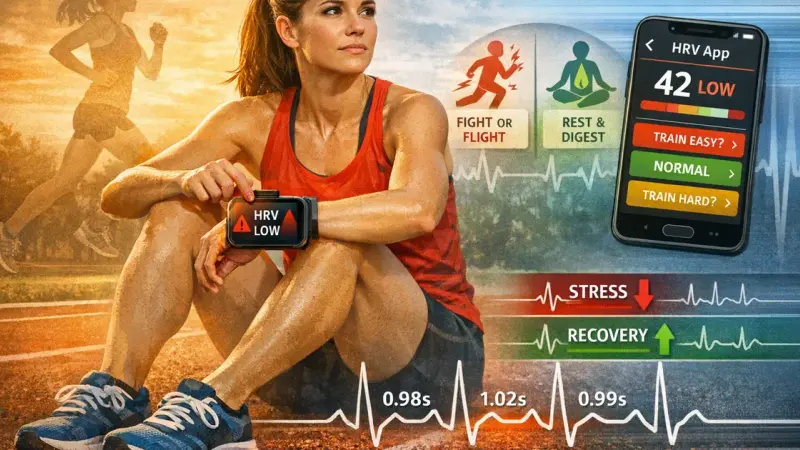
Your watch says your HRV is low. Should you skip your workout?
Maybe. Maybe not. Here's what HRV actually means and how to use it intelligently.
What Is HRV?
The Basics
Heart Rate Variability (HRV) = the variation in time between consecutive heartbeats.
Even at a steady heart rate of 60 bpm, the time between beats varies:
- Beat 1 to Beat 2: 0.98 seconds
- Beat 2 to Beat 3: 1.02 seconds
- Beat 3 to Beat 4: 0.99 seconds
HRV measures this variation.
Why It Matters
Your heart rate is controlled by the autonomic nervous system (ANS):
Sympathetic (fight or flight):
- Increases heart rate
- Decreases HRV
- Activated by stress, exercise, poor recovery
Parasympathetic (rest and digest):
- Decreases heart rate
- Increases HRV
- Activated by relaxation, recovery, good health
Higher HRV generally indicates good parasympathetic tone—your body is recovered and adaptable.
Lower HRV can indicate stress, fatigue, illness, or poor recovery.
The Interpretation
| HRV Trend | Possible Meaning |
|---|---|
| Stable, relatively high | Well-recovered, good ANS balance |
| Gradually increasing | Improving fitness, good adaptation |
| Suddenly high (above normal) | Possible illness, overreaching, or parasympathetic spike |
| Declining over several days | Accumulated fatigue, stress, illness |
| Single low reading | Could be noise (poor sleep, stress, etc.) |
How to Measure HRV
Consistency Is Key
Same conditions every time:
- Same time of day (morning is best)
- Same position (lying down preferred)
- Same duration (1-5 minutes)
- Same device
Why: HRV varies throughout the day. Consistency allows meaningful comparison.
Measurement Devices
Most accurate:
- Chest strap (Polar, Garmin HRM-Pro) + HRV app
- Dedicated devices (Whoop, Oura Ring)
Good enough:
- Smartwatches with optical sensors (varies by model)
- Smartphone camera + HRV app (finger on camera)
Apps and Platforms
HRV4Training: Research-backed, training recommendations. Elite HRV: Detailed analysis, morning readiness. Whoop: Continuous monitoring, recovery scores. Garmin/Apple: Built into watch ecosystem.
Reading Format
RMSSD (most common for HRV):
- Measured in milliseconds
- Range: typically 20-100+ ms for adults
- Higher is generally better
HRV Score (normalized):
- Many apps convert to 0-100 or other scales
- Makes tracking easier but loses raw data precision
Interpreting Your Data
Baseline First
Before using HRV:
- Measure for 2-4 weeks
- Establish your personal baseline
- Note your normal range
Why: There's no universal "good" HRV. You're comparing to yourself.
Trends Over Single Readings
Don't react to:
- One low morning reading
- Day-to-day fluctuations
Do respond to:
- 3-7 day declining trend
- Consistently low readings with symptoms
- Pattern of low HRV before injuries/illness
Correlate With Feel
The question: Does my HRV match how I feel?
| Scenario | Interpretation |
|---|---|
| Low HRV, feel tired | Listen to both signals—ease up |
| Low HRV, feel great | Watch the trend, proceed cautiously |
| High HRV, feel tired | May still need rest, other factors at play |
| High HRV, feel great | Green light for quality training |
Context Matters
Low HRV might be caused by:
- Poor sleep
- Alcohol
- Illness (including before symptoms appear)
- High training load
- Life stress
- Dehydration
- Time of day variation
Consider all factors, not just the number.
Using HRV for Training
The Simple Approach
Very high HRV (above normal range):
- Could do a harder workout
- But also monitor for illness signs
Normal HRV:
- Train as planned
- No modifications needed
Below normal HRV:
- Consider easier training
- Monitor for other symptoms
- Look at multi-day trend
Very low HRV (significantly below normal for multiple days):
- Reduce training load
- Prioritize recovery
- Consider if something is wrong
Recovery-Based Training
Some apps recommend daily training based on HRV:
- Green = go hard
- Yellow = moderate
- Red = rest or easy
Pros:
- Objective input to training decisions
- Catches overtraining early
Cons:
- May not account for training plan structure
- Single metric shouldn't override everything
- Can create anxiety about numbers
Practical Integration
What works:
- Use HRV as one input among many (sleep, feel, performance)
- Trust trends more than single readings
- Don't cancel important workouts for one low reading
- Do adjust if HRV + feel + performance all point same direction
HRV Limitations
It's Not a Crystal Ball
HRV can't tell you:
- Exactly what's wrong
- Whether you'll get sick
- Whether you'll have a good workout
Individual Variation
Some runners:
- Have very stable HRV (small variations)
- Have highly variable HRV (large swings)
- Respond differently to stress
Your pattern is your pattern. What's normal for someone else isn't relevant.
Measurement Noise
Sources of error:
- Movement during measurement
- Inconsistent timing
- Device inaccuracy
- Caffeine, position changes
Reduce noise: Consistent protocol, same conditions, quality device.
Overreliance
Danger: Letting a number override everything else.
Better: Use HRV as one data point alongside:
- How you feel
- Sleep quality
- Performance trends
- Life stress
- Motivation
HRV Best Practices
For Beginners
- Get a baseline: 2-4 weeks of consistent morning measurement.
- Look at 7-day averages: Ignore daily fluctuations.
- Correlate with feel: Does the data match your experience?
- Don't obsess: It's one metric, not the answer.
For Experienced Users
- Track long-term trends: Months and years of data are valuable.
- Notice patterns: Does HRV drop before illness? After hard weeks?
- Use for periodization: HRV can inform training load adjustments.
- Maintain perspective: It's still just one tool.
When to Pay Attention
Take HRV seriously when:
- Trend has been declining 3+ days
- Reading is significantly below normal (20%+)
- You also feel tired, unwell, or unmotivated
- Performance has been declining
Probably okay to ignore when:
- Single low reading
- You feel fine
- Recently had alcohol, poor sleep, or other clear cause
- Reading is just slightly below normal
HRV offers a window into your body's stress and recovery status. Used wisely—tracking trends, maintaining consistency, and integrating with how you actually feel—it's a valuable tool. Used poorly—obsessing over daily numbers, overriding feel with data—it creates more stress than it solves.
Track your metrics on your dashboard.
Key Takeaway
HRV reflects the balance of your autonomic nervous system—a window into recovery and stress. Track trends (not single readings), measure consistently, and use it as one input among many. It's a useful tool but not a crystal ball. How you feel still matters most.
Frequently Asked Questions
What is a good HRV score?
Should I skip a workout if my HRV is low?
How do I measure HRV?
Why does HRV change day to day?
Is higher HRV always better?
References
- HRV research
- Sports science
- Recovery studies