
Contents
Understanding Training Load: ATL, CTL, TSB Explained
Learn how to measure and manage training load using ATL, CTL, and TSB metrics. Understand the fitness-fatigue model for smarter training decisions.

What changed: Replaced universal ATL, CTL, and TSB targets with sourced platform definitions, a practical decision framework, and explicit limits on what load metrics can establish.
Quick Hits
- •ATL is a short-term weighted average of recorded training stress.
- •CTL is a longer-term weighted average, not a direct fitness measurement.
- •TSB compares the two estimates; positive and negative are context, not grades.
- •TrainingPeaks defaults to roughly 7-day ATL and 42-day CTL time constants.
- •Use load trends with subjective recovery and comparable performance evidence.
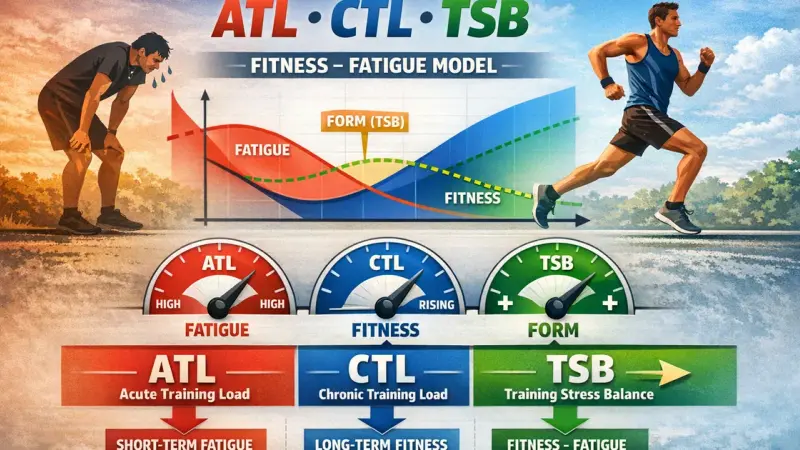
Understanding Training Load
ATL, CTL, and TSB are model outputs, not measurements of fatigue, fitness, or readiness. They become useful when you follow the trend and check it against how training actually feels and performs.
For the broader choice between distance, time, heart rate, RPE, and other load inputs, start with our training-load monitoring guide.
What Each Metric Means
| Metric | Practical definition | What a change can prompt you to check | Main limitation |
|---|---|---|---|
| ATL | A short-term exponentially weighted average of daily training stress | Has recent workload risen or fallen sharply? | It estimates recent load, not biological fatigue |
| CTL | A longer-term exponentially weighted average of daily training stress | Is recorded workload building, holding, or declining? | It is not a direct test of aerobic fitness |
| TSB | The difference between the longer- and shorter-term estimates | Does the current load pattern resemble a build, recovery week, or taper? | It does not prove readiness or predict a result |
TrainingPeaks uses default time constants of about seven days for ATL and 42 days for CTL. Those defaults are implementation choices inspired by the fitness-fatigue model; other tools can use different inputs or settings. Compare values only when the calculation method and data source are consistent.
ATL: Recent Training Stress
ATL gives more weight to recent sessions, so it rises and falls faster than CTL. A demanding workout or several dense training days can raise it quickly; easier or off days let it fall.
Treat a high or rising ATL as a prompt to review:
- the last week of duration and intensity;
- session RPE and whether planned paces remain controlled;
- sleep, soreness, motivation, illness, and life stress;
- whether the next hard session still fits the plan.
Calling ATL “fatigue” is convenient platform shorthand. Two runners with the same ATL can feel very different, and the same runner can respond differently during heat, travel, illness, or poor sleep.
CTL: The Longer Load Trend
CTL changes more slowly because older training still contributes to the weighted average. A rising line means the model sees a sustained increase in recorded stress. It does not demonstrate that every part of fitness improved: speed, economy, durability, strength, and technical skill can move differently.
Absolute CTL comparisons between athletes are especially weak when their thresholds, sports, devices, or data completeness differ. A more defensible comparison is your own trend calculated consistently over time.
TSB: The Gap Between the Trends
TSB is calculated from CTL and ATL. In the common TrainingPeaks interpretation:
- a negative value means recent load is above the longer load estimate;
- a value near zero means the estimates are similar;
- a positive value means recent load has fallen below the longer estimate.
That pattern can describe a build, maintenance period, recovery week, or taper. Positive is not automatically “good,” and negative is not automatically “bad.” Platform display timing also matters, so check whether your software labels the balance for today or the following day before comparing screenshots or plans.
A Better Decision Framework
1. Verify the Inputs
Confirm workouts are present, thresholds are current, and stress scores were calculated consistently. Missing easy sessions or a stale threshold can distort all three lines.
2. Name the Planned Context
Ask what the training block is supposed to do. A rising ATL during a planned build is different from an unplanned spike caused by make-up sessions. A falling CTL during a taper is different from a long interruption.
3. Add a Human Check
Record a simple 1–10 session RPE plus a short recovery note. Reviews of athlete monitoring support using subjective measures as part of a decision framework, not treating objective and subjective data as rivals.
4. Compare With Performance
Use repeatable evidence: a similar workout, route, or race under reasonably similar conditions. Our guide to analyzing race results shows how to separate pacing patterns from possible explanations.
5. Make the Smallest Useful Adjustment
If load rose as planned and recovery remains normal, the chart may require no action. If the rise was unplanned and several recovery signals deteriorated, consider reducing or rescheduling the next demanding session. Persistent or concerning symptoms call for qualified medical or coaching input, not a different chart color.
Worked Example
Suppose CTL has climbed gradually for six weeks, ATL jumps after a weekend race, and TSB becomes more negative. The chart supports one conclusion: recent recorded stress is now above the longer trend.
It does not tell you whether to train hard Tuesday. That decision needs the race goal, soreness, sleep, pain, next event, and how you normally recover from racing. If those checks are normal, the planned session may still be appropriate; if several are poor, moving it is reasonable.
Limits to Keep Visible
- The model depends on the quality and completeness of its stress input.
- Time constants summarize history; they do not model every runner's physiology.
- Training load is associated with performance and health outcomes in complex ways; a threshold is not a diagnosis or safety guarantee.
- Life stress, illness, nutrition, sleep, terrain, and pain are not fully represented.
- A chart can organize a conversation, but it cannot replace athlete judgment, coaching context, or clinical evaluation.
Use the weekly mileage comparison to describe distance changes. It does not measure recovery, readiness or injury risk.
Key Takeaway
ATL, CTL, and TSB summarize recorded training stress. Their most useful role is to prompt better questions about a change in load, recovery, or performance—not to make the decision alone.
Frequently Asked Questions
What is the difference between ATL and CTL?
Is there an ideal TSB for race day?
Can ATL or CTL predict injury?
References
- https://help.trainingpeaks.com/hc/en-us/articles/204071894-Fatigue-ATL-
- https://www.trainingpeaks.com/learn/articles/what-is-the-performance-management-chart/
- https://www.trainingpeaks.com/learn/articles/the-science-of-the-performance-manager/
- https://pmc.ncbi.nlm.nih.gov/articles/PMC9012875/
- https://pmc.ncbi.nlm.nih.gov/articles/PMC5394138/