
Contents
Training Zones: Compare Heart Rate, Pace and Perceived Effort
Understand what each running metric measures, identify the zone system in your plan and investigate disagreements without forcing a numerical match.

Quick Hits
- •Heart rate, pace and perceived effort provide different observations; compare their context instead of making one an automatic winner.
- •Zone numbers are specific to a method and do not transfer directly between systems.
- •A pace conversion is not a fitness prediction or an automatic training prescription.
- •Weekly time, distance and session percentages are different summaries.
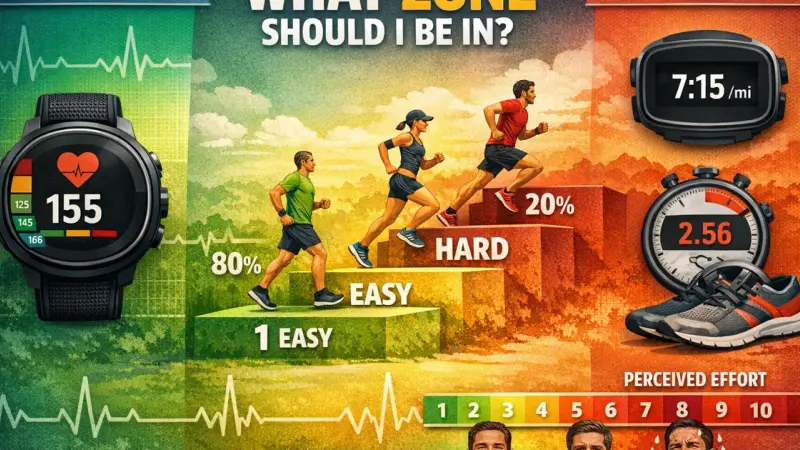
Heart rate, pace and perceived effort help describe a run in different ways. Before using a zone label to make a training decision, identify the system in the plan and what your device is measuring.
This is the cross-metric comparison. Use the heart-rate reference for formulas and the heart-rate application guide for sensor, drift and interval scenarios.
What Each Metric Gives You
| Metric | Observation | Questions before interpretation |
|---|---|---|
| Heart rate | Beats per minute recorded by the selected sensor | Is the signal plausible? Which reference value and zone method are configured? |
| Pace | Time per unit distance | How was distance measured? Is this instant, lap or average pace? What terrain and conditions apply? |
| Perceived effort | Your report of how demanding the activity feels | Which scale or verbal description are you using? How does it compare with the intended session? |
Heart rate is not a direct measurement of every component of effort. Pace does not encode terrain or recovery status. Perceived effort is useful context, but feeling comfortable does not prove that an unusual reading is erroneous.
Identify the Zone System
A plan might use percentages of maximum HR, percentages of HR reserve, threshold-based boundaries, pace ranges or verbal effort descriptions. These are not interchangeable definitions.
For example, the same supplied maximum of 180 bpm and resting value of 50 bpm give a 60–70% maximum interval of 108–126 bpm and a 60–70% reserve interval of 128–141 bpm. The formula reference shows the arithmetic. Neither band can automatically be renamed as a measured threshold or assigned an exact perceived-effort score.
A threshold-defined three-zone model and a five-zone percentage model can use the same numeral for different intensities. Record the method, not just “Zone 2.” More zone subdivisions do not by themselves make a plan more precise or appropriate.
Describe Effort Consistently
If your plan uses a numerical perceived-effort scale, name that scale and follow its definitions. If it uses words such as easy or hard, write down the intended meaning and discuss unclear instructions with its author or coach.
You can record whether conversation felt comfortable, interrupted or difficult as an observation. Do not turn that observation into an exact universal HR boundary. Likewise, a calculator that converts a finishing time into average pace does not establish training zones or demonstrate that you can run the proposed session.
When the Metrics Disagree
These are synthetic interpretation examples, not diagnoses or workout prescriptions.
| Observation | Check | Avoid concluding |
|---|---|---|
| Familiar pace, unexpectedly high HR | Sensor source/fit, zone inputs, terrain, conditions, effort and symptoms | “The pace feels easy, so the HR must be wrong” |
| Slower pace on a climb with similar perceived effort | Course gradient and the purpose of the session | “I must speed up to stay in my pace zone” |
| Low displayed HR early in a short repetition | Recording behavior, elapsed time and the planned repetition | “I need to sprint until the HR catches up” |
| A familiar HR but unusually difficult effort | How you feel, conditions, measurement quality and whether to change or stop the session | “The number is in range, so continuing is appropriate” |
For concerning symptoms, follow the health guidance in the application guide. Do not solve a health concern by adjusting a watch until its colors look reassuring.
Summarize a Week Without Mixing Units
A distance summary asks how many miles or kilometers you assigned to each intensity category. Time in HR bands asks how many minutes the device recorded within its configured boundaries. Session counting assigns a category to whole sessions. Those are different calculations.
Synthetic arithmetic: four sessions classified as three easy and one hard give 75% easy by session count. If their assigned distances are 5, 5, 5 and 10 km, the same session-level assignment gives 15/25 = 60% easy by distance. Neither calculation tells us the actual time in HR bands or the easy warm-up distance inside the session labeled hard.
Use the distance-distribution tool only with explicit category assignments and consistent units. Do not claim a precise weekly distribution from a list of session names with no distances or durations.
A Practical Setup Checklist
- Write down the session purpose and the metric the instructions use.
- Identify the zone method, reference inputs and sport profile.
- Check the sensor and distinguish instant pace from lap/average pace.
- Record conditions and perceived effort alongside the numbers.
- Investigate disagreements rather than forcing a fixed conversion between metrics.
- Review similar sessions using the same definitions; keep uncertainty visible.
Zone labels organize observations. They do not guarantee progress, define an injury-free training pattern or make a moderate-intensity session inherently useless. Keep the plan's purpose and your circumstances in the decision.
Key Takeaway
Heart rate, pace and perceived effort provide different observations; compare their context instead of making one an automatic winner.