
Contents
Why Every Runner Needs a Training Log (And How to Use One)
Discover why keeping a running log is essential for improvement. Learn what to track, how to review your data, and how to turn insights into better training.

Quick Hits
- •The best runners and coaches all track training—patterns reveal what works
- •Key metrics: mileage, pace, effort, sleep, life stress, and how you felt
- •Weekly and monthly reviews catch trends before they become problems
- •Subjective data (how you felt) is often more valuable than objective data (pace)
- •A log helps you train smarter, not just harder
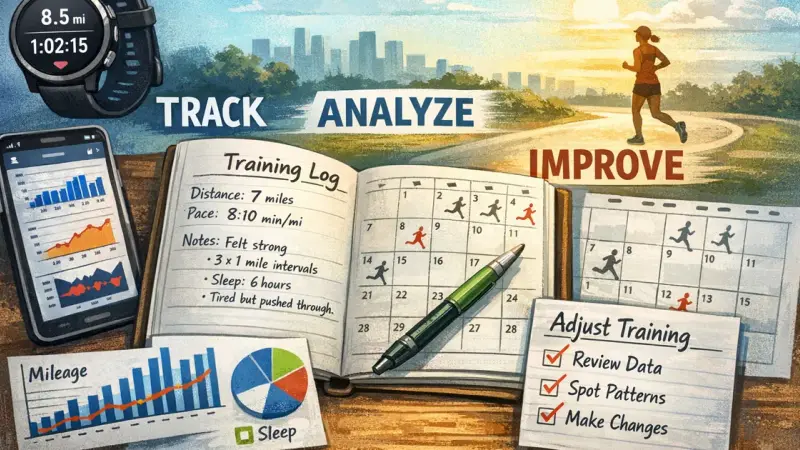
Every serious runner keeps a log.
Elite athletes. Experienced coaches. Record-chasers.
Why? Because data reveals patterns your memory can't capture.
Why Track Your Running
Memory Is Unreliable
What you remember:
- Big races
- Injury periods
- Extreme workouts
What you forget:
- What mileage you were running 6 months ago
- That nagging fatigue before the injury
- How the breakthrough week felt before the PR
Your log remembers everything.
Patterns Become Visible
Questions a log answers:
- How much mileage can I sustain without injury?
- What did my training look like before my best race?
- Do certain workouts leave me tired for days?
- How does sleep affect my running?
Accountability
Writing it down creates:
- Commitment to training
- Recognition of skipped days
- Awareness of trends (good and bad)
Smarter Training
With data, you can:
- Repeat what worked before your PR
- Avoid patterns that preceded injuries
- Adjust training based on actual response
What to Track
Essential Metrics
Every run:
- Distance
- Duration (or pace)
- Type of run (easy, tempo, intervals, etc.)
Daily:
- Subjective feel (1-10 scale or notes)
- Sleep quality/duration
- Energy level
Workout Details
For quality sessions:
- Specific workout details (5 x 1000m, 25 min tempo, etc.)
- Paces or heart rates
- How it felt compared to expected
- Weather conditions
Life Context
Factors that affect training:
- Work stress level
- Sleep hours and quality
- Illness/health notes
- Life events (travel, stress, etc.)
- Menstrual cycle (for female runners)
Subjective Notes
The most valuable data is often qualitative:
- "Legs felt dead despite rest day"
- "Best tempo in months, felt smooth"
- "Pushed through but shouldn't have"
- "Low motivation, just went through motions"
What NOT to Track (Obsessively)
Can become counterproductive:
- Every minor variation in pace
- Body weight (daily fluctuations are noise)
- Heart rate on every easy run
- Comparing to others' data
Tracking Methods
Apps and Platforms
Strava:
- Social features
- Route tracking
- Basic analysis
- Good for motivation
Garmin Connect / Apple Fitness:
- Syncs automatically with devices
- Detailed workout data
- Long-term trends
TrainingPeaks:
- Advanced analytics
- Training load tracking
- Coach integration
Final Surge:
- Workout planning and logging
- Calendar views
- Free tier available
Paper Logs
Benefits:
- Forces reflection
- No technology needed
- Can be more personal
- Ritual of writing
Downsides:
- Can't analyze easily
- Can be lost
- No automatic data
Spreadsheets
Benefits:
- Fully customizable
- Easy to analyze
- Can track anything
Downsides:
- Requires manual entry
- No automatic sync
Hybrid Approach
Many runners use:
- Automatic sync for data (watch → app)
- Written notes for context and reflection
- Periodic review combining both
Weekly Review Process
What to Check
Volume:
- Total mileage
- Compared to plan
- Compared to previous weeks
Quality:
- Workout results
- Paces achieved
- How they felt
Trend:
- Am I improving?
- Am I fatigued?
- Am I consistent?
Subjective:
- Overall energy this week
- Motivation level
- Any warning signs
Questions to Ask
- Did I hit my planned mileage? Why or why not?
- How did the key workouts go?
- How does my body feel overall?
- Am I excited for next week?
- Anything I need to adjust?
Red Flags to Catch
Training issues:
- Workouts significantly slower than expected
- High perceived effort for moderate paces
- Declining performance over several sessions
Health issues:
- Persistent fatigue
- Sleep disruption
- Elevated resting heart rate
- Nagging aches that aren't improving
Life issues:
- High stress levels
- Poor sleep patterns
- Low motivation
Monthly Review Process
Big Picture Analysis
Look at:
- Total monthly mileage (trend over months)
- Quality workout progression
- Injury or illness patterns
- Motivation and energy trends
Compare to Previous Months
Key questions:
- Am I running more or less than 3 months ago?
- Are my paces improving?
- Am I healthier or more injury-prone?
Adjust Future Training
Based on data:
- Increase volume if handling it well
- Reduce if signs of overtraining
- Adjust workout types based on what's working
Pre/Post Race Analysis
Before a Goal Race
Review:
- What did training look like before your best races?
- Any patterns in peak weeks?
- What taper worked best?
Apply:
- Mimic successful patterns
- Avoid known pitfalls
After a Race
Analyze:
- How did the race go compared to training indicators?
- What mileage led up to this performance?
- What workouts translated?
- What would you do differently?
Record:
- Race details and splits
- Conditions
- How you felt
- Key learnings
Turning Data Into Action
Pattern Recognition
Example patterns:
- "Every time I go over 50 mpw for 3+ weeks, I get injured"
- "My best races come after weeks with lower intensity"
- "I run worse when sleep drops below 7 hours"
Training Adjustments
Based on patterns:
- Cap mileage at sustainable level
- Adjust intensity distribution
- Prioritize sleep when training hard
Long-Term Development
Track progress over years:
- See how fitness has developed
- Notice what training blocks were most effective
- Build training approach based on personal response
Common Logging Mistakes
1. Tracking Everything Obsessively
The problem: Analysis paralysis, stress over minor variations.
The fix: Track essential metrics consistently. Add detail only where useful.
2. Tracking Nothing
The problem: No data to analyze when questions arise.
The fix: At minimum, log distance, type, and how you felt.
3. Not Reviewing
The problem: Data collected but never analyzed.
The fix: Schedule weekly review. Make it a habit.
4. Comparing to Others
The problem: Their data isn't your data.
The fix: Focus on your own trends and progress.
5. Using Data to Beat Yourself Up
The problem: "I should have done more."
The fix: Data is for learning, not judgment.
Your training log is the memory you can trust. It reveals patterns, catches problems early, and shows what works for YOUR body. Track consistently, review regularly, and let the data guide smarter training.
Track your training on your dashboard.
Key Takeaway
A training log is your running memory. It reveals patterns—what works, what doesn't, what leads to injury or breakthrough. Track both objective data (mileage, pace) and subjective data (how you felt). Review regularly to train smarter.
Frequently Asked Questions
What's the most important thing to track?
Should I use an app or paper log?
How often should I review my log?
What patterns should I look for?
Can I just let my watch track everything automatically?
References
- Coaching experience
- Training analysis research
- Elite athlete practices