
Contents
Training Plan Phases: Base, Build, Peak, Taper Explained
Every good training plan has phases. Learn what each phase accomplishes, how long it lasts, and how to execute each phase for optimal race preparation.

Quick Hits
- •Base phase builds aerobic foundation (4-8 weeks)
- •Build phase adds race-specific intensity (6-10 weeks)
- •Peak phase sharpens fitness at highest load (2-4 weeks)
- •Taper phase reduces fatigue while maintaining fitness (1-3 weeks)
- •Each phase has specific goals—don't skip or rush them
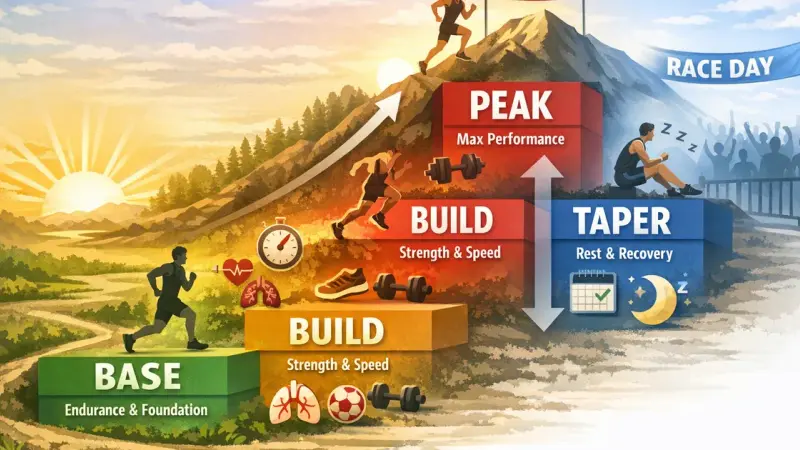
A training plan isn't just a list of workouts. It's a progression through distinct phases, each with a purpose.
Why Phases Matter
The Adaptation Timeline
Different systems adapt at different rates:
- Cardiovascular: Weeks to months
- Muscular: Weeks
- Skeletal (bones, tendons): Months
- Neuromuscular: Weeks
Phases respect these timelines. Building aerobic base before adding intensity gives slower-adapting systems time to catch up.
The Stress-Recovery Cycle
Training creates:
- Stress (the workout)
- Recovery (adaptation happens here)
- Supercompensation (you're fitter than before)
Phases manage this cycle across weeks and months, not just days.
Base Phase (4-8 weeks)
Purpose
Build the aerobic foundation:
- Cardiovascular efficiency
- Capillary development
- Mitochondrial density
- Fat oxidation
- Structural strength
What It Looks Like
Volume: Moderate to moderately high Intensity: Mostly easy (80-90% of running) Workouts: Easy runs, building long runs, maybe strides Quality sessions: Limited or none
Key Principles
Keep it easy:
- Zone 2 heart rate most of the time
- Conversational pace
- Building volume, not intensity
Progress gradually:
- Increase weekly mileage 5-10%
- Build long run incrementally
- Include cutback weeks
Signs It's Working
- Easy runs feel easier
- Recovery between runs improves
- Can handle more volume
- Resting heart rate stable or decreasing
Build Phase (6-10 weeks)
Purpose
Develop race-specific fitness:
- Lactate threshold improvement
- VO2max development
- Race-pace familiarity
- Mental toughness
What It Looks Like
Volume: Maintained or slightly increased Intensity: Quality sessions added (10-20% of running) Workouts: Tempo runs, intervals, race-pace work Long runs: Continues building, may add progression elements
Key Principles
Add quality strategically:
- 1-2 quality sessions per week
- Don't sacrifice easy day recovery
- Match workout type to race demands
Maintain the base:
- Easy runs stay easy
- Volume supports quality
- Recovery enables adaptation
Signs It's Working
- Workout paces improving
- Can handle prescribed intensities
- Recovering well between quality days
- Confidence building
Peak Phase (2-4 weeks)
Purpose
Sharpen fitness to highest level:
- Maximum training load
- Race-specific simulation
- Confidence-building workouts
- Final fitness gains
What It Looks Like
Volume: Highest of the cycle (or near it) Intensity: Quality sessions maintained or slightly increased Workouts: Race-specific, often at or near goal pace Long runs: Longest of the cycle
Key Principles
Push but don't break:
- This is the hardest phase
- Fatigue is expected
- Don't add more than planned
Trust the process:
- You may feel tired
- Performance may seem flat
- Fitness is building underneath
Signs It's Working
- Completing planned workouts (even if tired)
- No injury warning signs
- Mental engagement maintained
- Ready for taper
Taper Phase (1-3 weeks)
Purpose
Shed fatigue while maintaining fitness:
- Reduce training load
- Allow full recovery
- Sharpen for race day
- Maximize performance potential
What It Looks Like
Volume: Reduced 40-60% from peak Intensity: Short efforts at race pace maintained Workouts: Abbreviated versions, maintaining sharpness Long runs: Significantly reduced
Key Principles
Reduce volume, not intensity:
- Run less, but keep some fast running
- Quality sessions get shorter, not eliminated
- Maintain neuromuscular readiness
Trust the taper:
- You will feel anxious (taper tantrums)
- You may feel sluggish
- Rest is productive
Signs It's Working
- Energy returning
- Motivation increasing
- Legs feeling fresher
- Ready to race
Phase Transitions
Base → Build
Transition by:
- Adding one quality session
- Keeping volume similar
- Gradually increasing workout intensity
Watch for:
- Overreaching too quickly
- Abandoning easy days
- Too much too soon
Build → Peak
Transition by:
- Continuing quality progression
- Reaching highest volume
- Most demanding workouts
Watch for:
- Injury warning signs
- Overtraining symptoms
- Mental burnout
Peak → Taper
Transition by:
- Reducing volume significantly
- Maintaining some intensity
- Prioritizing rest and recovery
Watch for:
- Adding extra workouts from anxiety
- Losing fitness (you won't)
- Not resting enough
Putting It Together
Example 16-Week Marathon Plan
| Weeks | Phase | Focus |
|---|---|---|
| 1-4 | Base | Aerobic foundation, volume building |
| 5-10 | Build | Tempo, intervals, increasing long runs |
| 11-13 | Peak | Highest volume, race-specific workouts |
| 14-16 | Taper | Reduced volume, race readiness |
Example 12-Week Half Marathon Plan
| Weeks | Phase | Focus |
|---|---|---|
| 1-3 | Base | Aerobic running, moderate volume |
| 4-9 | Build | Tempo runs, speed work, long runs |
| 10-11 | Peak | Highest load, race-pace work |
| 12 | Taper | Freshness for race day |
Each phase serves a purpose in your development. Use our Training Plan Length Calculator to determine how long you need, and track your progress through phases on your dashboard.
Key Takeaway
Training phases exist because the body adapts to different stimuli at different rates. Respecting each phase—building aerobic base before adding intensity, peaking before tapering—produces better results than random training.
Frequently Asked Questions
How long should each training phase be?
Can I skip the base phase if I'm already fit?
What if I don't have time for all phases?
References
- Periodization research
- Running coach methodologies