
Contents
When to Replace Your Running Shoes: Signs, Mileage, and Timing
Know exactly when your running shoes need replacing. Learn the mileage guidelines, physical signs of wear, and how worn shoes increase injury risk.

Quick Hits
- •Most running shoes last 300-500 miles—track your mileage
- •Physical signs: worn outsole, compressed midsole, stretched upper
- •Body signals: new aches, more fatigue, shin splints returning
- •Rotating multiple pairs extends each shoe's lifespan
- •Replace based on mileage and feel, not calendar time
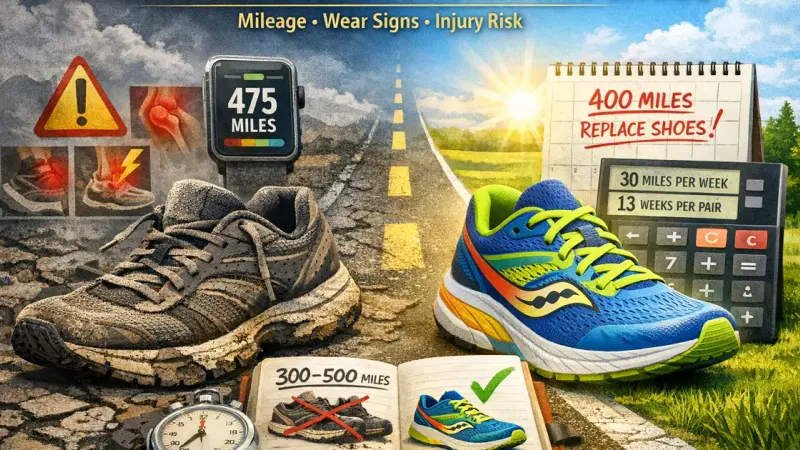
Your running shoes are the one piece of gear that directly affects every step of every run. When they're fresh, they cushion impact, provide stability, and help you run efficiently. When they're worn, they do the opposite.
The problem: most runners don't know when their shoes need replacing until they're already hurt.
The Mileage Reality
General Guidelines
Most running shoes last 300-500 miles, but this range varies significantly based on:
Factors that reduce lifespan:
- Higher body weight (more force per step)
- Running on concrete vs. trails
- Heavier foot strike
- Lighter, less durable shoe construction
- High temperatures (degrades foam faster)
Factors that extend lifespan:
- Lighter body weight
- Softer running surfaces
- Efficient running form
- Rotating multiple pairs
- Proper storage (cool, dry place)
Mileage by Shoe Type
| Shoe Category | Typical Lifespan | Notes |
|---|---|---|
| Daily trainers | 400-500 miles | Built for durability |
| Lightweight trainers | 300-400 miles | Less foam, less life |
| Maximalist cushioned | 300-400 miles | Thick foam compresses faster |
| Stability shoes | 400-500 miles | Usually durable construction |
| Racing flats | 100-200 miles | Built for speed, not longevity |
| Carbon-plated racers | 150-300 miles | Foam and plate degrade together |
| Trail shoes | 300-500 miles | Depends on terrain aggressiveness |
The Mileage Tracking Habit
If you don't track mileage per shoe, you don't know when to replace them. Period.
Use our Shoe Mileage Tracker or your running app's gear tracking feature. Log every run to the correct shoe.
Quick calculation:
- Weekly mileage: _ miles
- Shoe lifespan: 400 miles (conservative estimate)
- Replace every: 400 ÷ weekly mileage = _ weeks
At 30 miles per week, that's about 13 weeks (3 months) per pair.
Physical Signs of Wear
The Outsole (Bottom)
Check for:
- Worn-through rubber in high-impact areas (usually heel and forefoot)
- Tread pattern smoothed or disappeared
- Uneven wear indicating gait issues
The test: Look at the bottom of your shoe under bright light. If you can see white or colored midsole material showing through the outsole, the shoe is significantly worn.
The Midsole (Cushioning Layer)
This is the most important—and least visible—part of shoe wear.
Check for:
- Visible creasing or wrinkles in the foam
- Foam that feels hard or "dead" when pressed
- Asymmetric compression (one side lower than the other)
The press test: Push your thumb firmly into the midsole. Fresh foam springs back immediately. Worn foam stays compressed or recovers slowly.
The twist test: Hold the shoe at toe and heel and twist. Fresh shoes have controlled flexibility. Worn shoes twist too easily, indicating breakdown.
The Upper
Check for:
- Mesh separating from overlays
- Holes in the toe box
- Stretched or deformed shape
- Heel collar collapse
The wear pattern: Does the shoe lean inward or outward when set on a flat surface? This indicates significant structural breakdown.
The Heel Counter
Check for:
- Loss of rigidity in the heel cup
- Heel slipping during runs
- Visible breakdown of internal structure
Body Signals: The Most Important Signs
Your body knows before your eyes do. Pay attention to these warning signs:
New or Returning Aches
If you develop:
- Shin splints after being shin-splint free
- Knee pain that wasn't there before
- Hip or lower back discomfort
- Plantar fascia pain in the morning
And nothing else changed (mileage, intensity, surfaces), suspect your shoes.
Increased Fatigue
Signs:
- Legs feel more tired than usual at same effort
- Recovery takes longer
- Runs that were easy now feel hard
Worn cushioning means your muscles absorb more impact, leading to faster fatigue.
The "Dead" Feeling
Runners often describe worn shoes as feeling "dead" or "flat." The bounce is gone. The spring is absent. You know how new shoes feel—when your shoes stop feeling that way, they're wearing out.
Post-Run Soreness
If you're consistently sorer after runs than you used to be—and your training hasn't changed—shoe wear is a likely culprit.
Timing Your Replacement
The Rotation Solution
Instead of wearing one pair to death, rotate 2-3 pairs:
Benefits:
- Each shoe lasts longer (foam recovers between uses)
- Different shoes stress your body differently (injury prevention)
- You always have a backup
- You can match shoe to workout
Example rotation:
- Shoe A: Easy runs, recovery runs
- Shoe B: Long runs
- Shoe C: Workouts, intervals
When to Buy New Shoes
Don't wait until your current shoes are completely dead. Instead:
- Track mileage on current shoes
- At 300 miles, start looking for replacements
- At 350-400 miles, have new shoes in hand
- Break in new shoes gradually (alternate with old shoes for a few weeks)
- Retire old shoes at 450-500 miles
The Transition Period
Never race or do a long run in brand-new shoes. Break them in with 3-5 easy runs first. If possible, transition gradually over 2-3 weeks.
How to Extend Shoe Lifespan
Do
- Rotate pairs — 24-48 hours between wears lets foam recover
- Dry them properly — Remove insoles after wet runs; stuff with newspaper
- Use for running only — Don't wear them for walking, errands, gym
- Store properly — Cool, dry place away from direct sunlight
- Clean gently — Brush off dirt; avoid washing machines
Don't
- Dry with heat — Hair dryers and radiators degrade foam
- Store in hot cars — Heat accelerates breakdown
- Use daily — Even for running, alternate pairs
- Buy based on price alone — Cheap shoes often cost more in injury bills
The Cost-Per-Mile Calculation
Good running shoes are expensive. But consider cost per mile:
Example:
- Shoe price: MSRP: $150
- Expected mileage: 400 miles
- Cost per mile: MSRP: $0.375
That's 37.5 cents per mile for the equipment that protects your body from 1,000+ footstrikes per mile.
Compared to:
- Doctor visit for running injury: MSRP: $100-500
- Physical therapy (8 sessions): MSRP: $400-1,600
- Time lost to injury: priceless
Replacing shoes on time is cheaper than treating the injuries from worn shoes.
Common Mistakes
Mistake 1: Judging by Appearance
"They still look fine" is not a valid assessment. The midsole—invisible from outside—wears out first.
Mistake 2: Going by Calendar Time
Shoes don't expire by date. A shoe with 100 miles in two years is fine. A shoe with 500 miles in three months is done.
Mistake 3: Waiting for Pain
By the time worn shoes cause pain, you've already stressed your body excessively. Replace shoes before problems start.
Mistake 4: Not Tracking Mileage
If you don't know how many miles are on your shoes, you can't make informed decisions about replacement.
Mistake 5: Buying New Shoes for Race Day
New shoes for race day = blisters and uncertainty. Break in new shoes during training, race in proven pairs.
What About Minimalist Shoes?
Minimalist and barefoot-style shoes have different wear patterns:
- Less midsole foam = less foam degradation
- More ground feel = easier to sense wear
- Outsole wear is primary indicator
Replace when:
- Outsole is worn through
- Ground feel becomes uncomfortable
- You notice new aches from impact
Your running shoes are a tool—the most important tool you have. Treat them with respect, track their mileage, and replace them before they cause problems. A fresh pair of shoes is one of the simplest upgrades you can make to your running.
Track your shoes with the Shoe Mileage Tracker.
Key Takeaway
Running shoes wear out from the inside before they look worn on the outside. Track your mileage, pay attention to how your body feels, and replace shoes before they cause problems—not after.
Frequently Asked Questions
How many miles do running shoes last?
Can I tell if my shoes are worn by looking at them?
What happens if I keep running in worn-out shoes?
How do I track mileage on my running shoes?
Should I rotate multiple pairs of shoes?
References
- Shoe industry research
- Running injury studies
- Biomechanics literature