
Contents
Mizuno Wave Rider 30 Review: Stable Daily Workhorse
The Mizuno Wave Rider 30 is a stable neutral daily trainer with an 8mm drop and full-length Wave plate. See its ride, fit, tradeoffs, and value.

Quick Hits
- •The Wave Rider 30 combines nitrogen-infused Enerzy NXT with a full-length Wave plate and 42.5/34.5mm geometry.
- •RTINGS found it stable, protective, and smooth for daily and long mileage, with a true-to-size average-width fit.
- •Its weight and below-average propulsion make it a poor choice for speedwork or racing.
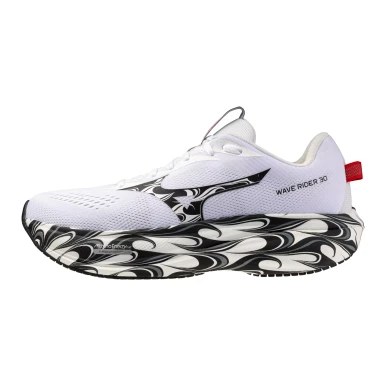
Mizuno Wave Rider 30 Review
Disclosure: As an Amazon Associate, we earn from qualifying purchases. This helps support TrainingPlan at no extra cost to you.
Affiliate link - we may earn a commission
This review combines Mizuno's product information, TrainingPlan's current catalog, and RTINGS' published lab testing. It does not represent first-person testing by TrainingPlan.
Quick Verdict
The Mizuno Wave Rider 30 is a protective, stable neutral daily trainer that prioritizes predictable mileage over speed. Nitrogen-infused Enerzy NXT sits above a full-length Wave plate, while an engineered-mesh upper and revised lightweight outsole complete the package. The 42.5/34.5mm catalog platform is taller than the Wave Rider name historically suggests.
RTINGS found the ride smooth, cushioned, and very stable, but below average in propulsion. That makes the shoe a dependable choice for easy runs and long steady mileage, not a convincing interval or race option. The best daily trainer guide places it among more and less energetic workhorses.
Key Specifications
| Spec | Value |
|---|---|
| Category | Daily Trainer |
| Cushion Level | High |
| Heel-to-Toe Drop | 8mm |
| Weight (Men's/Women's) | 9.4oz / 8.3oz |
| Stack Height | 42.5mm heel / 34.5mm forefoot |
| Pronation Support | Neutral |
| Width Options | Standard and Wide |
| MSRP | MSRP: $150 |
| Surface | Road |
These are the exact current runtime catalog values. RTINGS' laboratory measurements and sample-weight context may differ, but its findings support the catalog's overall high-cushion, stable-neutral positioning.
What Changed
Mizuno extends Enerzy NXT across the top layer and uses a full-length Wave plate to distribute force and organize the transition. The outsole is redesigned to reduce weight, and the engineered mesh aims to keep the increased protection wearable.
RTINGS found the result smoother and more protective than the Wave Rider 29. The evolution raises cushioning and stability rather than transforming the Rider into a bouncy super trainer. Longtime fans should expect continuity in workhorse purpose with a more substantial platform.
Ride and Intended Use
The dual-density construction and full-length plate create an even, guided transition. RTINGS found the platform very stable and well cushioned, useful for accumulating daily and long-run mileage. The plate contributes more to structure than race-like snap.
Propulsion tested below average, and the 9.4oz men's weight further limits speed appeal. Easy runs, steady aerobic mileage, and marathon training are natural roles; short intervals and goal racing are not. The best marathon training shoes includes models with broader pace range, while best shoes for beginners highlights approachable daily options.
Fit and Sizing
RTINGS found the Wave Rider 30 true to size with average width and arch dimensions. The engineered mesh provides a familiar trainer-style wrap rather than a race-tight fit. The toe box can feel low vertically for runners with taller toes even when horizontal width is adequate.
Standard and wide widths are cataloged. Choose width for forefoot breadth, but also check toe height and upper pressure before assuming the wide size solves all volume concerns.
What Works Well
- Stable neutral platform: The broad geometry and Wave plate create predictability without a formal support category.
- Smooth protection: RTINGS found version 30 cushioned and easier through transition than version 29.
- Multiple widths: Standard and wide choices serve more foot shapes.
- Clear daily purpose: The shoe is easy to place in a rotation for steady road mileage.
Tradeoffs
- Weak propulsion: Independent testing found below-average energy and speed assistance.
- Substantial weight: A 9.4oz men's reference is reasonable for a workhorse but not for racing.
- Low toe-box ceiling: Some high-volume toes may contact the upper.
- Plate without race feel: Buyers expecting carbon-shoe mechanics may misunderstand the Wave plate's structural role.
Who Should Consider This Shoe
- Neutral runners wanting a stable, protective daily workhorse.
- Beginners who prefer predictable transitions and multiple width choices.
- Marathon trainees seeking a steady easy- and long-run companion.
Who Should Look Elsewhere
- Runners prioritizing intervals, short races, or strong propulsion.
- Athletes who prefer very soft, flexible, or low-to-ground shoes.
- Feet that need generous vertical room above the toes.
Cross-Brand Comparison
The Mizuno Wave Rider versus Brooks Ghost guide compares two enduring neutral workhorses. Version 30 gives the Rider a taller, plate-guided platform, while the Ghost remains a conventional benchmark. The Nike Pegasus versus Brooks Ghost guide adds a more responsive mainstream alternative.
Same-Brand Comparison
The Mizuno Wave Rider 29 is less protective and not as smooth, making version 30 a meaningful update for runners who want more cushioning. The Mizuno Neo Vista 3 is softer, taller, and more premium, while the Rider remains the firmer, stable-workhorse choice.
Value
At MSRP: $150, the Wave Rider 30 is priced squarely against mainstream daily trainers. Its full-length plate, multiple widths, stable geometry, and long-mile comfort make that price reasonable for runners who will use it frequently. Speed-focused buyers receive better value from a lighter, more-responsive trainer.
Final Verdict
The Mizuno Wave Rider 30 modernizes a classic workhorse without abandoning its identity. More cushioning, a smooth full-length Wave plate, and a stable broad platform make it dependable for daily and long road running.
It remains deliberately unexciting at speed. Limited propulsion, moderate weight, and a low toe-box ceiling are the main cautions. Choose it for consistent, protective mileage; choose something livelier when workouts and racing define the rotation.
Disclosure: As an Amazon Associate, we earn from qualifying purchases. This helps support TrainingPlan at no extra cost to you.
Affiliate link - we may earn a commission
Key Takeaway
The Wave Rider 30 is a smooth, stable neutral workhorse for daily and long mileage, offering more protection than version 29 but limited excitement for speed-focused runners.
Frequently Asked Questions
Is the Mizuno Wave Rider 30 a stability shoe?
How does the Mizuno Wave Rider 30 fit?
What runs suit the Mizuno Wave Rider 30?
References
- https://usa.mizuno.com/running-wave-rider-30-uni-disclosure/
- https://www.rtings.com/running-shoes/reviews/mizuno/wave-rider-30