
Contents
Why Your Running Data Varies Day to Day (And When to Care)
Yesterday's easy pace feels impossible today. Is something wrong? Learn why running data naturally varies and when variation signals a real problem.

Quick Hits
- •5-10% pace variation day-to-day is completely normal
- •Weather, sleep, nutrition, and life stress all affect performance
- •Accumulated fatigue from training is the biggest performance variable
- •Trends over weeks matter more than individual day performance
- •Excessive variation may signal overtraining or health issues
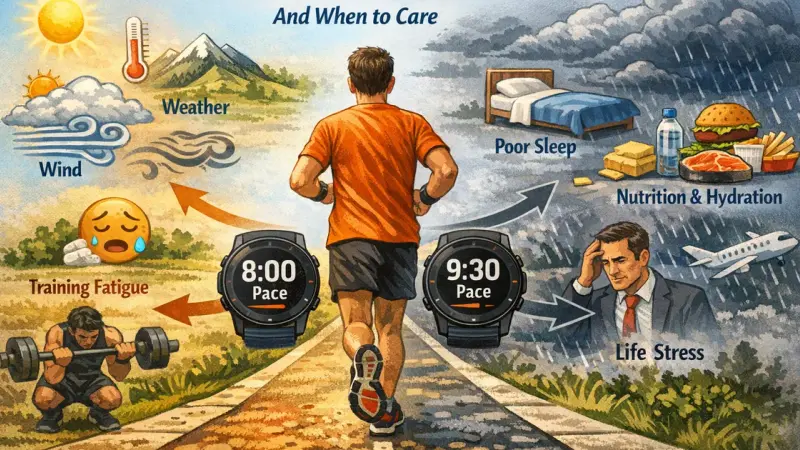
Same route. Same watch. Different pace. What gives?
Daily performance variation is normal—but understanding it helps you train smarter.
Normal Variation Sources
Weather
Temperature:
- Heat increases effort at same pace by 5-10%
- Cold affects differently (can help once warmed up)
- Humidity compounds heat effects
Wind:
- Headwind can add 30-60+ seconds per mile
- Tailwind can subtract similar amounts
- Variable wind = variable pace
Altitude:
- Even moderate elevation changes affect performance
- Takes days-weeks to adapt
- Often forgotten when traveling
Sleep
One bad night:
- Can add 5-15 bpm to HR at same pace
- Perceived effort increases
- Performance decreases 2-5%
Accumulated sleep debt:
- Compounds over days
- Affects recovery and adaptation
- May take several good nights to clear
Nutrition and Hydration
Under-fueled:
- Glycogen-depleted runs feel harder
- Common on morning runs without eating
- Affects performance more in longer runs
Dehydration:
- Even 2% dehydration affects performance
- HR increases, pace decreases
- Often unrecognized
Caffeine:
- Increases HR, may help or hurt pace
- Effects vary by individual
- Timing and dose matter
Training Fatigue
Recent hard sessions:
- Residual fatigue affects easy runs
- Normal and expected
- Why easy days should be easy
Accumulated training load:
- Builds over weeks
- May not notice until it catches up
- Cutback weeks reset this
Where you are in training cycle:
- Peak training = more fatigue = slower easy days
- Taper = less fatigue = faster easy days
Life Stress
Work stress:
- Cortisol affects performance
- Distraction affects perceived effort
- Real physiological impact
Emotional stress:
- Same mechanisms as work stress
- May need easier training during tough times
- Self-care, not pushing through
Travel:
- Time zones, sleep disruption
- Different routes and conditions
- Often underestimated
How Much Variation Is Normal
Easy Runs
Normal variation:
- 30-60 seconds per mile
- 10-15 bpm heart rate at same pace
- Day-to-day feeling of "good" vs. "meh"
Example: Easy pace might range from 9:00 to 9:45 on different days
Quality Sessions
Normal variation:
- 10-20 seconds per mile from your best
- Some intervals faster, some slower
- Occasional off days
Concerning variation:
- Consistently unable to hit paces
- Getting worse over multiple sessions
- No recovery between hard days
Race Performance
Normal race-to-race:
- 1-3% variation at same distance
- Weather and course dependent
- Training state dependent
Concerning:
- Large drops in equivalent race performances
- Can't reproduce previous times
- Declining despite training
When to Pay Attention
Investigate If:
Pattern emerges:
- Multiple days of unexpected slowness
- Consistently elevated HR
- Declining performance trend
Doesn't recover:
- Easy days don't feel easy anymore
- Weekend rest doesn't help
- Taking longer to bounce back
Other symptoms:
- Poor sleep despite being tired
- Appetite changes
- Mood changes
- Getting sick frequently
Don't Worry About:
- One slow run
- Variation that has an explanation (weather, sleep, etc.)
- Normal day-to-day fluctuation
- Easy days feeling harder during peak training
Reducing Unwanted Variation
Controllable Factors
Sleep:
- Prioritize 7-9 hours
- Consistent sleep schedule
- Pre-run sleep especially important
Nutrition:
- Consistent fueling patterns
- Adequate pre-run nutrition
- Post-run recovery nutrition
Hydration:
- Start runs hydrated
- Consistent daily hydration
- Monitor in hot weather
Recovery:
- Respect easy days
- Include cutback weeks
- Adequate rest between hard sessions
Accepting Uncontrollable Factors
Weather:
- Can't control it
- Adjust expectations
- Don't judge yourself by hot-day paces
Life events:
- Sometimes stress is unavoidable
- Training may need to flex
- Prioritize overall health
Using Variation as Data
What Variation Tells You
High variation = something's off
- Investigate controllable factors
- Consider training load
- Check for overtraining signs
Low variation = good consistency
- Training and recovery balanced
- External factors controlled
- Body adapting well
Tracking for Patterns
Keep simple notes:
- Weather conditions
- Sleep quality (1-5)
- Stress level (1-5)
- How run felt (1-5)
Over time, patterns emerge:
- "Bad runs usually follow poor sleep"
- "Heat affects me more than most"
- "Work deadlines = harder training"
Adjusting Expectations
Know your variation range:
- What's your "good day" pace?
- What's your "meh day" pace?
- What's outside your normal range?
Use ranges, not single numbers:
- Easy pace: 9:00-9:45 (not 9:20)
- Tempo pace: 7:45-8:00 (not 7:50)
- Allows for normal variation
Use the weekly mileage comparison to describe distance changes. It does not measure recovery, readiness or injury risk.
Key Takeaway
Variation is normal and often informative. Don't judge individual runs in isolation. Look at patterns, identify consistent variation sources, and use the data to train smarter rather than stress over daily fluctuations.
Frequently Asked Questions
How much pace variation is normal?
Why did I run slower today on the same route?
Should I adjust my training when I'm having a bad day?
References
- Exercise physiology research
- Training adaptation studies